
Pest Control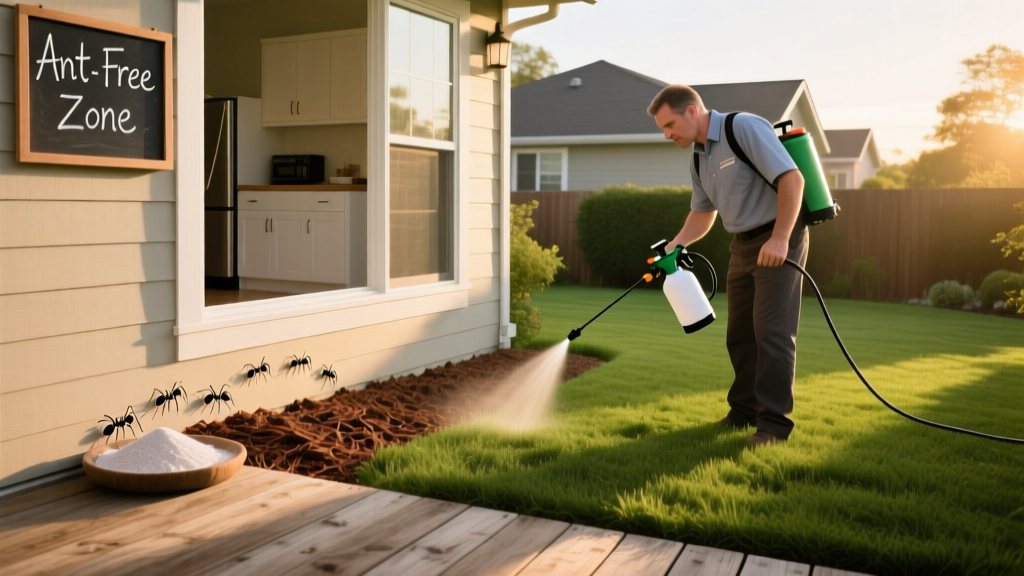
How to Get Ants Out of House: Yard Perimeter & Indoor Defense
The Yard-to-House Migration: Why Ants Invade
When homeowners ask how to get ants out of house interiors, they usually focus on the kitchen baseboards. This is a strategic error. The ants inside your home are merely foraging scouts representing a massive colony located in your yard. To permanently eradicate an indoor ant problem, you must sever the connection between the exterior nest and the interior food source. According to the UC Statewide IPM Program, ant colonies expand and migrate based on moisture levels, temperature fluctuations, and food scarcity, making the perimeter of your home their primary highway.
⚠️ The Scout vs. Colony Rule: Never spray a visible ant trail with a fast-acting contact killer (like standard aerosol bug sprays). Killing the scouts destroys the pheromone trail, which signals the colony to send out hundreds of new scouts in random directions, ultimately worsening the infestation and potentially causing colony 'budding' in species like Pharaoh ants.
Step 1: Establish a Yard Perimeter Defense
The most effective way to stop ants from entering your home is to create an invisible, non-repellent chemical barrier around the foundation. Non-repellent insecticides are undetectable to ants. They walk through the treated zone, pick up the active ingredient, and carry it back to the yard colony, transferring it to the queen and brood via grooming.
Top Non-Repellent Perimeter Products (2026 Pricing)
- Termidor SC (Fipronil 9.1%): The industry gold standard. Costs approximately $75 for a 20oz bottle, which yields up to 42 gallons of finished spray, treating roughly 30,000 square feet. Requires a 0.8 fl oz per gallon dilution rate.
- Alpine WSG (Dinotefuran): A water-soluble granule that is highly effective and safe for use near sensitive areas once dry. A box of 10 packets costs around $45. Use 1 packet per gallon of water.
- Taurus SC (Fipronil 9.1%): A generic alternative to Termidor with identical efficacy, typically priced around $65 for a 20oz bottle.
Application Protocol
- Clear the Zone: Rake back mulch, dead leaves, and soil to expose the bare foundation. Ants love nesting in moist mulch touching the siding.
- Trim Vegetation: Cut back all tree branches and shrubs so they are at least 3 feet away from the roofline and siding. This eliminates 'ant bridges' that bypass your chemical barrier.
- Spray the Foundation: Using a 1-gallon or 2-gallon pump sprayer, apply the non-repellent solution 2 feet up the foundation wall and 2 feet out onto the bare soil. Ensure the soil is lightly moist but not saturated to prevent runoff.
| Treatment Type | Active Ingredient | Best For | Limitations |
|---|---|---|---|
| Liquid Non-Repellent | Fipronil / Dinotefuran | Creating continuous foundation barriers | Requires mixing and pump sprayer equipment |
| Granular Bait | Indoxacarb / Abamectin | Targeting specific yard mounds and lawn edges | Can be washed away by heavy rain or irrigation |
| Dust Insecticide | Deltamethrin / Silica Gel | Weep holes, cracks, and void spaces | Ineffective if applied to damp surfaces |
Step 2: Interior Eradication & Trail Disruption
While the perimeter treatment works to collapse the yard colony (a process taking 3 to 14 days), you must manage the ants already inside. The goal here is to use slow-acting baits that the foraging workers will carry back to the nest.
Matching the Bait to the Ant Species
Ant dietary preferences change based on the season and the species. According to research from Penn State Extension, misidentifying the feeding preference is the number one reason baiting fails.
- Odorous House Ants & Argentine Ants (Sweet Feeders): These species crave carbohydrates and sugars. Use Advion Ant Gel Bait (Indoxacarb 0.05%). Apply small, pea-sized drops every 12 inches along active trails. Cost: ~$30 for a 4-tube pack.
- Carpenter Ants & Pavement Ants (Protein/Grease Feeders): Especially in spring and early summer, these ants seek proteins to feed the brood. Use Advance Carpenter Ant Bait (Abamectin 0.011%) or Maxforce Fleet. Cost: ~$35 per pound.
- Pharaoh Ants (Opportunistic): Highly prone to budding. Never use sprays. Use a combination of sweet and protein baits, such as Alpine Ant Bait Stations, rotating them every few days to match their shifting cravings.
Pro Tip: The Pre-Baiting Test
Before committing to a commercial bait, place a tiny dab of honey and a tiny crumb of peanut butter near the trail. Observe which one the ants swarm. If they choose honey, buy a sugar-based gel. If they choose peanut butter, buy a protein-based granular bait.
Before committing to a commercial bait, place a tiny dab of honey and a tiny crumb of peanut butter near the trail. Observe which one the ants swarm. If they choose honey, buy a sugar-based gel. If they choose peanut butter, buy a protein-based granular bait.
Step 3: Disrupting the Pheromone Trail
Once the ants have consumed the bait and traffic has slowed, you must erase the invisible pheromone highway they left behind. If you skip this step, new scouts from neighboring yard colonies will follow the old chemical map right back into your kitchen.
- Mix a solution of 1 part white vinegar to 1 part water, adding a few drops of liquid dish soap.
- Thoroughly wipe down the baseboards, countertops, and window sills where trails were observed.
- The soap breaks down the oily residue of the pheromone, while the vinegar alters the pH, rendering the trail unreadable to future scouts.
Step 4: Sealing the Envelope (Physical Exclusion)
Chemical and baiting strategies will fail long-term if the physical structure remains compromised. Ants can enter through gaps as small as 1/16th of an inch. Use the following materials for specific structural vulnerabilities:
- Cracks in Masonry & Concrete: Use a polyurethane-based sealant like Loctite PL Concrete Crack Sealant. It remains flexible and adheres to dusty surfaces better than silicone.
- Window Frames & Plumbing Penetrations: Use GE Advanced Silicone 2. It is waterproof and cures quickly in high-moisture environments like under sinks.
- Weep Holes & Large Vents: Never seal weep holes in brickwork completely, as they are required for moisture escape. Instead, stuff them with Stainless Steel Copper Mesh (1/16-inch gauge). This blocks ants and rodents while allowing air and water vapor to pass.
Frequently Asked Questions
Why do I see more ants after applying perimeter spray?
It is normal to see an initial spike in ant activity during the first 48 hours after applying a non-repellent like Termidor SC. The ants are aggressively foraging and contacting the chemical. Do not spray them with contact killers; let them return to the yard colony to spread the active ingredient.
Can I use diatomaceous earth (DE) to get ants out of the house?
Food-grade Diatomaceous Earth can kill ants by desiccating their exoskeletons, but it only works if kept perfectly dry. In high-humidity areas like bathrooms or outdoor perimeters, DE loses its efficacy. It is best reserved for dry, indoor void spaces like behind baseboards or under appliances.
How long does it take to completely eliminate a yard colony?
Using a transfer-effect liquid like Fipronil, a standard yard colony will collapse in 7 to 14 days. Massive super-colonies (common with Argentine ants) may require a second perimeter application 30 days after the initial treatment to achieve total control.

