
Pest Control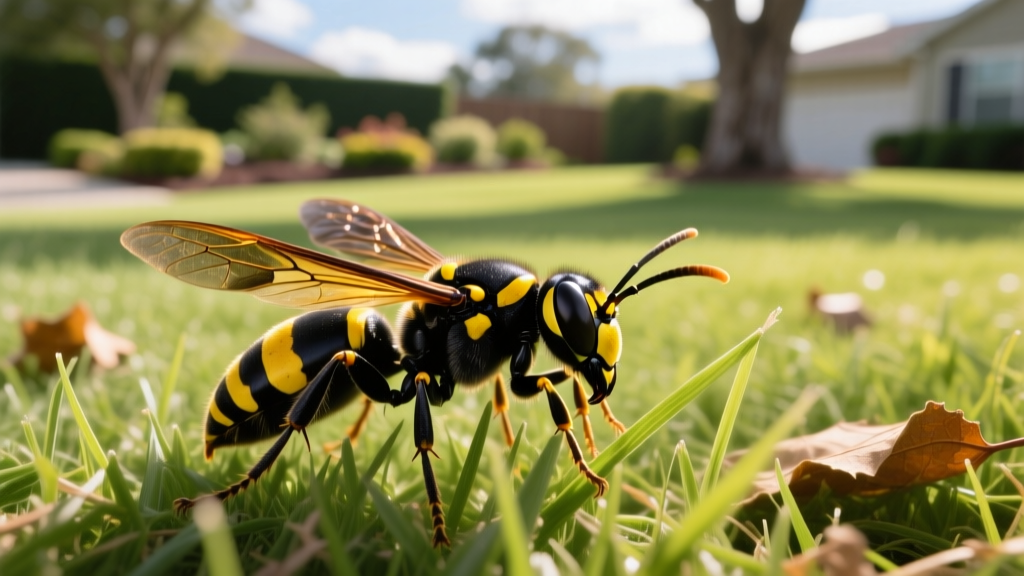
How to Get Rid of Cicada Killers: Safe Lawn Defense Strategies
The Gentle Giants Ruining Your Turf
Cicada killers (Sphecius speciosus) are among the most intimidating insects you can encounter in your yard. Measuring up to two inches in length with striking black and yellow banding, they look like oversized yellowjackets. However, despite their fearsome appearance, these solitary wasps are remarkably docile. Males lack stingers entirely, and females will only sting if physically crushed or trapped against the skin. According to Penn State Extension, the true threat cicada killers pose is not to human safety, but to lawn aesthetics and structural turf integrity.
Female cicada killers excavate extensive burrow systems to paralyze cicadas and provision their larvae. A single female can move pounds of soil over a season, leaving behind 1.5-inch diameter entrance holes surrounded by fan-shaped dirt mounds. In severe infestations, this tunneling activity undermines grass roots, creates tripping hazards, and turns a manicured lawn into a patchy, eroded minefield. If you are dealing with an active excavation site, here is a comprehensive, science-backed framework for reclaiming your turf.
Understanding the Enemy: Biology and Lawn Impact
Cicada Killer Quick Facts
- Active Season: Mid-July through August (peak emergence aligns with annual cicada hatches).
- Burrow Depth: Typically 6 to 10 inches deep, with lateral tunnels extending up to 3 feet.
- Soil Preference: Well-drained, sandy, or loose soils with sparse grass coverage and direct sunlight.
- Lifespan: Adult females live only 2 to 4 weeks; males live about 2 weeks.
The lifecycle of the cicada killer dictates your treatment window. As detailed by the University of Florida IFAS Entomology Department, females emerge slightly after males, mate, and immediately begin digging. They hunt cicadas, paralyze them with a sting, and drag them back to the burrow as a food source for their single egg per cell. Because they are solitary, you will not find a central hive or queen to destroy; instead, you are dealing with dozens of individual females who have chosen your yard for its optimal soil conditions.
The Decision Matrix: Tolerate vs. Eradicate
Before deploying chemical controls, evaluate the severity of the infestation. Because cicada killers are native pollinators and natural pest controllers (they reduce cicada populations), eradication is not always the ecologically sound choice. Use the matrix below to determine your defense strategy.
| Factor | Tolerate & Monitor | Eradicate & Treat |
|---|---|---|
| Burrow Density | Less than 5 holes per 1,000 sq ft | More than 10 holes per 1,000 sq ft |
| Turf Damage | Minor mounding, grass recovers quickly | Severe root undermining, large bare patches |
| Human/Pet Traffic | Low-traffic ornamental beds or back edges | High-traffic play areas, pathways, or front lawns |
| Soil Erosion Risk | Flat terrain with stable topsoil | Sloped lawns where mounds wash away in rain |
Phase 1: Habitat Modification (Prevention & Deterrence)
Cicada killers are highly selective about where they dig. They avoid dense, moist, and heavily thatched turf. Modifying your lawn's micro-environment is the most effective long-term defense strategy.
1. Adjust Mowing Heights and Density
Raise your mower deck to a minimum of 3.5 to 4 inches. Taller grass shades the soil surface, keeping it cooler and more humid, which deters female wasps looking for dry, sun-baked excavation sites. Overseed bare patches in the fall using a dense turf-type tall fescue blend, which develops a thick, impenetrable root mat that physically blocks burrowing.
2. Alter Soil Moisture and Composition
During peak emergence in July, increase your irrigation frequency. Cicada killers abandon burrows that flood or become overly saturated. If your soil is heavily sandy and drains too quickly, topdress your lawn with 0.25 inches of dense organic compost annually. This increases soil cohesion and makes the physical act of digging significantly harder for the wasps.
3. Mulch Landscape Beds
If wasps are targeting the edges of your lawn near garden beds, apply a 3-inch layer of heavy hardwood mulch. Avoid fine pine straw or loose peat moss, which they can easily navigate. The dense, interlocking structure of shredded hardwood acts as a physical barrier.
Phase 2: Targeted Nest Treatment (Eradication)
If habitat modification is insufficient or the infestation poses a safety hazard in a play area, targeted chemical intervention is required. Broadcast spraying the lawn is ineffective and ecologically damaging; you must treat the individual burrows.
Safety Protocol: Never treat burrows during the heat of the day. Female wasps are actively hunting, and males will aggressively patrol the area. All treatments must be executed between 9:00 PM and midnight when females are inside the burrows and males are roosting in nearby trees.
Step-by-Step Burrow Treatment Flow
- Locate and Mark: During the afternoon, walk the lawn and place a small landscaping flag or golf tee next to each active 1.5-inch entrance hole. Do not block the hole.
- Select the Right Formulation: Liquid sprays pool at the surface and fail to reach the lateral tunnels. You must use an insecticidal dust. DeltaDust (0.05% Deltamethrin, approx. $24 per pound) is the industry standard because it is waterproof and will not degrade if the soil gets wet. A budget alternative is Sevin Dust (5% Carbaryl, approx. $10), though it requires reapplication after heavy rain.
- Equip a Bellow Duster: Do not shake dust from the bottle. Purchase a specialized hand bellow duster (like the JT Eaton 430-2, approx. $18) or a bulb duster. Insert the duster's extended nozzle about 2 inches into the burrow entrance.
- Puff and Retreat: Give the duster two firm puffs to coat the interior shaft with a fine layer of dust. The wasp will track the dust deep into the lateral nesting cells as she enters or exits. Immediately cap the hole with a small clod of dirt or a stepping stone to prevent the dust from blowing away.
- Monitor and Re-treat: Check the marked sites 48 hours later. If fresh soil has been pushed out of the cap, the wasp survived. Re-treat the burrow using the same dusting method.
Phase 3: Lawn Repair and Soil Rehabilitation
Once the burrows are confirmed inactive (usually by late August), the physical damage to the turf must be addressed. Left alone, the empty tunnels can become habitats for secondary pests like rodents or overwintering spiders.
Use a stiff-tine rake to aggressively break apart the dried dirt mounds, dispersing the soil back into the surrounding grass canopy. For the entrance holes, fill them with a 50/50 mix of topsoil and fine compost, tamping it down firmly with the handle of a garden tool or a hand tamper. If the surrounding grass has died back due to root severing, overseed the repaired divots with a fast-germinating perennial ryegrass for immediate cover, followed by your primary turf species during the standard fall aeration and seeding window.
Frequently Asked Questions
Will cicada killers sting my dog if it snaps at them?
While females are reluctant to sting, a dog snapping at or stepping on a female carrying a cicada can provoke a defensive sting. The venom is less toxic than a yellowjacket's, but it will cause localized swelling and pain. Keep pets indoors during peak mid-day activity if an infestation is severe.
Do cicada killers kill honeybees or beneficial pollinators?
No. They are highly specialized predators that exclusively hunt large, flying cicadas. They do not view bees, butterflies, or other garden insects as prey, making them safe to coexist with in pollinator gardens.
Why are they digging in my sandbox or volleyball court?
Cicada killers are attracted to loose, finely tilled, or disturbed sand. To protect recreational sand areas, you must either cover them with tarps during July and August or treat the perimeter with a liquid barrier spray containing Lambda-cyhalothrin (such as Cyzmic CS, approx. $45 for 8 oz) applied to the surrounding soil edges.

