
Pest Control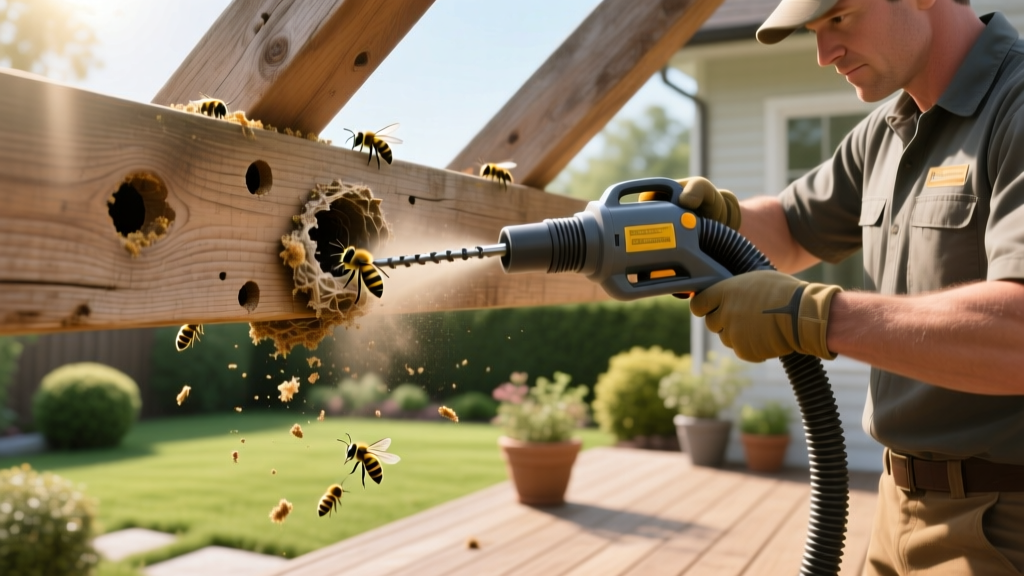
How to Get Rid of Borer Bees in Wood Structures Safely
Understanding the 'Borer Bee' Threat to Your Yard
When homeowners search for ways to get rid of borer bees, they are almost always referring to carpenter bees (Xylocopa species). Unlike termites or carpenter ants, carpenter bees do not consume wood for sustenance. Instead, the females use their powerful mandibles to excavate perfectly round, 1/2-inch diameter tunnels into wooden structures to create brood galleries. Over successive seasons, these tunnels expand, compromising the structural integrity of eaves, fascia boards, deck railings, and wooden siding.
⚠️ Diagnostic Check: Is it a Borer Bee or a Termite?
- Carpenter Bees: Leave behind coarse, sawdust-like excrement (frass) directly beneath a perfectly circular 1/2-inch entry hole. The wood surface remains intact except for the entry point.
- Termites: Create mud tubes, leave behind pellet-like droppings, and hollow out the wood from the inside, often causing the surface to blister or sound hollow when tapped.
According to the University of Kentucky Entomology Department, the Eastern Carpenter Bee (Xylocopa virginica) is the most destructive species in North America, heavily favoring unpainted, weathered softwoods like pine, cedar, and redwood. To effectively get rid of borer bees, you must target the hidden gallery network, not just the foraging adults.
The 3-Step Protocol to Eradicate Active Nests
Liquid sprays are largely ineffective for deep gallery treatment because they absorb into the wood grain, leaving the center of the tunnel untreated. Professional pest control operators rely on desiccant and pyrethroid dusts. Follow this exact sequence for complete eradication.
Step 1: Map the Galleries and Time Your Attack
Inspect your property in early spring (March to May) when females are establishing new nests, and in late summer (August to September) when new adults are emerging. Look for the telltale 1/2-inch holes and piles of fresh frass. Listen closely to the wood; a distinct, rhythmic chewing or buzzing sound from inside the timber confirms an active gallery.
Step 2: Apply Residual Insecticidal Dust
You must use a dust formulation that clings to the bees' bodies as they crawl through the tunnel, transferring the toxin to the larvae and other adults.
- Top Product Pick: Drione Dust (Silica gel + pyrethrin) or DeltaDust (Deltamethrin). Both cost between $25 and $35 per pound and remain active in dry voids for up to 8 months.
- Application Tool: Use a bellows hand duster ($12-$18) or a specialized dust-injector tube.
- Technique: Carpenter bee tunnels typically go straight in for 1 to 2 inches, then make a sharp 45-to-90-degree turn upward or downward. Insert the duster nozzle into the hole and puff 2 to 3 times. Do not pack the hole with dust; a light coating on the tunnel walls is sufficient.
Step 3: Seal the Entry Points (The 48-Hour Rule)
Do not plug the hole immediately. The NC State Extension advises leaving the treated hole open for 48 to 72 hours. This allows foraging bees to return, track the dust deep into the brood cells, and ensures the resident female receives a lethal dose. After the waiting period, plug the hole tightly using a 1/2-inch wooden dowel, a cork, or a wad of copper mesh (steel wool will rust and stain the wood). Seal the plug flush with exterior-grade wood putty or caulk, then sand and paint.
Treatment Matrix: Dusts vs. Sprays vs. Traps
Choosing the wrong intervention method is the primary reason homeowners fail to get rid of borer bees. Use this matrix to select the right tool for your specific infestation level.
| Method | Best Use Case | Pros | Cons & Limitations |
|---|---|---|---|
| Insecticidal Dust (DeltaDust, Drione) |
Active nests with visible entry holes and frass. | Reaches deep, angled galleries; long residual life (8+ months); transfers between bees. | Requires a bellows duster; ineffective if the wood is damp or wet inside. |
| Liquid Sprays (Bifenthrin, Cypermethrin) |
Surface deterrence and killing foraging adults on contact. | Easy to apply with a standard pump sprayer; covers large surface areas quickly. | Absorbs into wood grain; fails to treat the inner brood gallery; short residual life outdoors. |
| Wooden Traps (Pre-drilled cedar boxes) |
Population reduction in open yard areas away from the house. | Chemical-free; catches males and foraging females; low maintenance. | Will not draw bees out of an existing, established nest; requires emptying every 2 weeks. |
Long-Term Wood Defense and Prevention
Once you get rid of borer bees, you must alter the environment to prevent re-infestation. Carpenter bees are highly selective; they bypass treated wood in favor of exposed, weathered timber. According to research published by Penn State Extension, physical barriers and specific chemical finishes are your best defense.
💡 Pro-Tip: The Paint vs. Stain Debate
Paint is vastly superior to stain for carpenter bee prevention. A thick coat of 100% acrylic latex or oil-based alkyd enamel paint (such as Zinsser Perma-White or Sherwin-Williams Duration) creates a hard, impenetrable film that bees cannot chew through. If you prefer the natural wood look, you must use a heavy-duty polyurethane sealant or a stain fortified with urethane (like Thompson's WaterSeal Advanced Natural Wood Protector). Standard penetrating oil stains offer zero protection against borer bees.
- Replace vulnerable trim: If your fascia boards are repeatedly targeted, replace them with PVC composite trim (like Azek or Trex). Carpenter bees cannot bore into cellular PVC.
- Fill existing cracks: Use a high-quality elastomeric caulk to seal joints, knot holes, and weather-checking cracks in log cabins or cedar siding before spring emergence.
- Deploy preventative traps: Hang untreated wooden carpenter bee traps on the perimeter of your property (e.g., on fence posts or detached sheds) in early March to intercept scouting females before they reach your home's eaves.
Edge Case: What If They Are Ground-Boring Mining Bees?
Occasionally, homeowners use the term "borer bee" to describe the small mounds of soil appearing in their lawns during early spring. These are ground-nesting mining bees (Family Andrenidae), not carpenter bees.
Mining bees bore into the soil, not wood. They are solitary, highly docile, and exceptionally rare to sting. More importantly, they are vital native pollinators that are active for only 4 to 6 weeks in the spring. Do not apply insecticides to ground borer mounds. Instead, deter them naturally by altering the lawn environment: mining bees prefer dry, sparse, bare soil. Implement a deep, infrequent irrigation schedule and overseed bare patches with dense turfgrass (like Tall Fescue or Kentucky Bluegrass) to naturally crowd them out for the following year.
Frequently Asked Questions
Will borer bees cause my deck to collapse?
While a single season of tunneling rarely causes structural failure, multi-year infestations can severely compromise load-bearing joists. Furthermore, the entry holes allow moisture to penetrate the wood core, accelerating fungal rot and attracting woodpeckers, which cause massive secondary damage while hunting the bee larvae.
Do male carpenter bees sting?
No. Male carpenter bees are highly territorial and will aggressively hover and dive-bomb intruders near their nests, but they lack a stinger. Only the females possess a stinger, and they are generally docile unless physically handled or trapped against the skin.
Can I use WD-40 or citrus oil to get rid of borer bees?
DIY remedies like WD-40, almond oil, or citrus sprays act only as temporary repellents. They do not kill the larvae deep inside the gallery, and the scent dissipates within a few days, leading to immediate re-infestation. Always rely on residual insecticidal dusts for permanent eradication.

