
Pest Control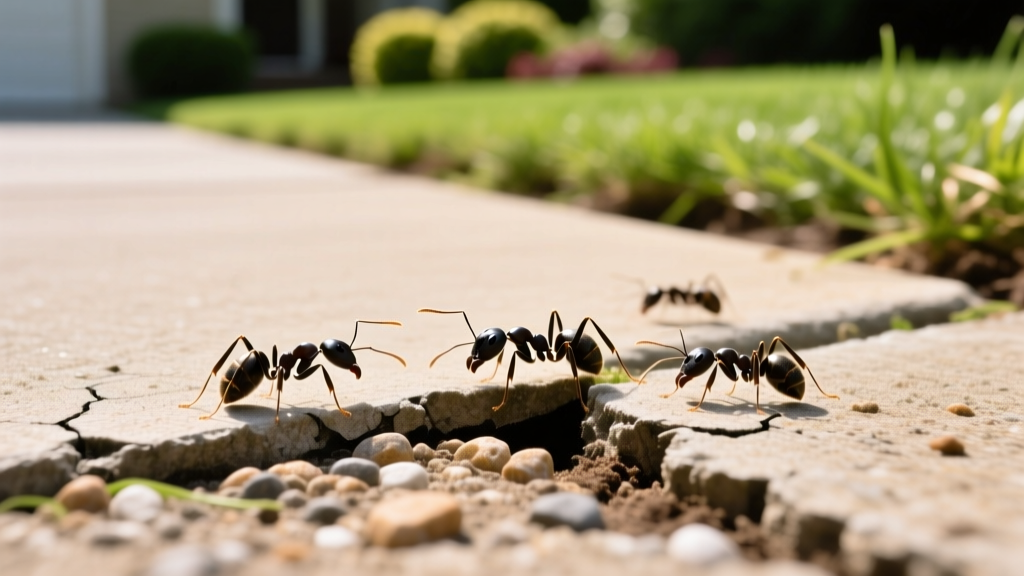
How to Get Rid of Pavement Ants in Your Yard and Driveway
Identifying the Invader: Is It Actually a Pavement Ant?
Before deploying any chemical or organic controls, accurate identification is mandatory. Pavement ants (Tetramorium immigrans) are notorious for excavating soil from beneath hardscapes, leaving behind distinctive 2-to-3-inch craters of fine dirt along driveway expansion joints, patio pavers, and sidewalk edges. Misidentifying them as carpenter ants or odorous house ants will lead you to purchase the wrong baits, wasting weeks of treatment time.
| Feature | Pavement Ant | Odorous House Ant | Carpenter Ant |
|---|---|---|---|
| Size | 1/10 to 1/8 inch | 1/16 to 1/8 inch | 1/4 to 1/2 inch |
| Color | Dark brown to blackish | Dark brown to black | Black, red, or bicolored |
| Key Visual Trait | Parallel lines (striations) on head and thorax; two distinct nodes on the petiole | Unevenly shaped thorax; single hidden node | Large mandibles; smooth, rounded thorax |
| Nesting Habit | Under pavement, mulch, and foundation slabs | Shallow soil, under rocks, indoor wall voids | Inside moist, decaying wood (does not eat wood) |
| Crushed Scent | No distinct odor | Rotten coconut / blue cheese | No distinct odor |
The Biology of the Colony: Why Over-the-Counter Sprays Fail
The most common mistake homeowners make when learning how to get rid of pavement ants is reaching for a contact aerosol spray like Raid or Ortho Home Defense. According to Penn State Extension, pavement ant colonies frequently feature multiple queens (polygyny). When a colony is stressed by a fast-acting, repellent contact spray, the queens initiate a survival mechanism known as 'budding.' The colony splinters into three or four satellite colonies, effectively multiplying your infestation overnight.
WARNING: Avoid Repellent Sprays
Never spray visible pavement ant trails with pyrethroid-based contact killers (e.g., bifenthrin, permethrin). These chemicals kill the foragers instantly but alert the colony to seal off the treated entrance and route workers to a new, untreated crack in your driveway.
The 3-Phase Eradication Protocol
To permanently eliminate the colony, you must exploit their foraging cycles and utilize horizontal toxicity. This three-phase approach targets the queens deep within the sub-slab soil matrix.
Phase 1: Exploit the Foraging Cycle (Days 1–7)
Pavement ants alternate between seeking carbohydrates (sugars) and proteins/fats depending on the colony's reproductive cycle. You must offer both bait types simultaneously to ensure acceptance.
- Carbohydrate Bait: Use Terro Liquid Ant Baits (T300B). The active ingredient is sodium tetraborate (borax). At roughly $6 for a 12-station pack, it is highly cost-effective. Place stations directly over the soil mounds and along the pavement cracks where trailing is heaviest.
- Protein/Grease Bait: Use Syngenta Advion Ant Gel (active ingredient: Indoxacarb 0.05%). A 4-pack of 30g tubes costs approximately $28. Indoxacarb is a pro-insecticide; it only becomes lethal after the ant's digestive enzymes bio-activate it. This delayed action allows foragers to return to the nest and share the bait via trophallaxis (mouth-to-mouth feeding) with the queens and larvae.
Application Tip: Apply Advion gel in small, pea-sized drops on a piece of cardboard or directly into the crack. Do not draw a continuous line; pavement ants prefer to swarm discrete droplets.
Phase 2: Non-Repellent Transfer Treatment (Days 8–14)
Once baiting has slowed the visible surface activity, apply a non-repellent liquid transfer insecticide to the perimeter and deep into the hardscape joints. BASF Alpine WSG (Dinotefuran) is the industry standard for this phase. It retails for about $45 for a 50-gram bottle, which yields dozens of gallons of finished solution.
- Mix 0.71 ounces (one packet) of Alpine WSG per gallon of water.
- Using a pump sprayer, drench the perimeter of your home's foundation in a 3-foot wide band.
- Inject the solution directly into the driveway expansion joints and patio cracks using a spray wand with a pin-stream nozzle. You will need roughly 1 to 2 gallons of mixed solution per 100 linear feet of cracking.
Because Dinotefuran is undetectable to the ants, they will walk over the treated concrete, pick up the microscopic residue on their tarsi (feet), and carry it back to the nest, poisoning the brood.
Phase 3: Mound Drenching for Severe Infestations
If you are dealing with massive, 4-inch wide soil volcanoes in your lawn or gravel driveway, baiting alone may take too long. The University of Kentucky Entomology Department recommends mound drenching using a fast-acting, non-repellent liquid like fipronil (e.g., Termidor SC or Taurus SC) specifically labeled for outdoor ant mounds. Mix at the label rate of 0.8 fl oz per gallon, and slowly pour 1 to 2 gallons directly onto the center of the mound, allowing it to percolate down to the queen's chamber.
Hardscape Exclusion and Prevention
Chemical eradication is temporary if the physical habitat remains inviting. Pavement ants require easy access to sub-slab soil and moisture. Sealing their entry points is the ultimate long-term defense.
- Re-Sand Paver Joints: If you have a paver patio, the ants are likely mining the jointing sand. Sweep out the loose sand and replace it with high-quality polymeric sand. When misted with water, polymeric sand binds together into a flexible, concrete-like barrier that ants cannot excavate. Expect to spend $120–$180 in materials to resand a 400-square-foot patio.
- Caulk Expansion Joints: For poured concrete driveways, clean out the rotting backer rod and old tar from the expansion joints. Fill the gap with a self-leveling polyurethane sealant (such as Sikaflex Self-Leveling Sealant). This blocks the primary highway the ants use to move between the soil and the surface.
- Manage Moisture: Pavement ants thrive in damp soil. Ensure your downspout extenders discharge at least 4 feet away from your driveway edges and patio foundations. Trim back shrubs that are casting deep, permanent shade over the pavement, as this prevents the concrete from drying out after rainstorms.
Frequently Asked Questions
Do pavement ants cause structural damage to my house?
No. Unlike carpenter ants or termites, pavement ants do not eat or destroy wood, nor do they compromise the structural integrity of concrete. Their damage is purely cosmetic and mechanical—they wash out the soil supporting your pavers, which can lead to minor settling or uneven walking surfaces over several years.
Why do I see hundreds of pavement ants fighting on my sidewalk in the spring?
These are territorial turf wars. In early spring, adjacent pavement ant colonies expand their foraging boundaries. When two colonies meet at a territorial border (often a sidewalk crack), they engage in massive, slow-motion battles, locking mandibles and stinging one another. While alarming to watch, these battles naturally regulate population densities.
Can I use boiling water to kill a pavement ant mound?
Pouring boiling water into a driveway crack will kill the workers near the surface, but it rarely penetrates the 18-to-24-inch depth where the queens reside. Furthermore, boiling water can damage the mortar between bricks or kill the roots of adjacent ornamental grasses. Stick to targeted baits and non-repellent transfer chemicals for complete colony elimination.

