
Pest Control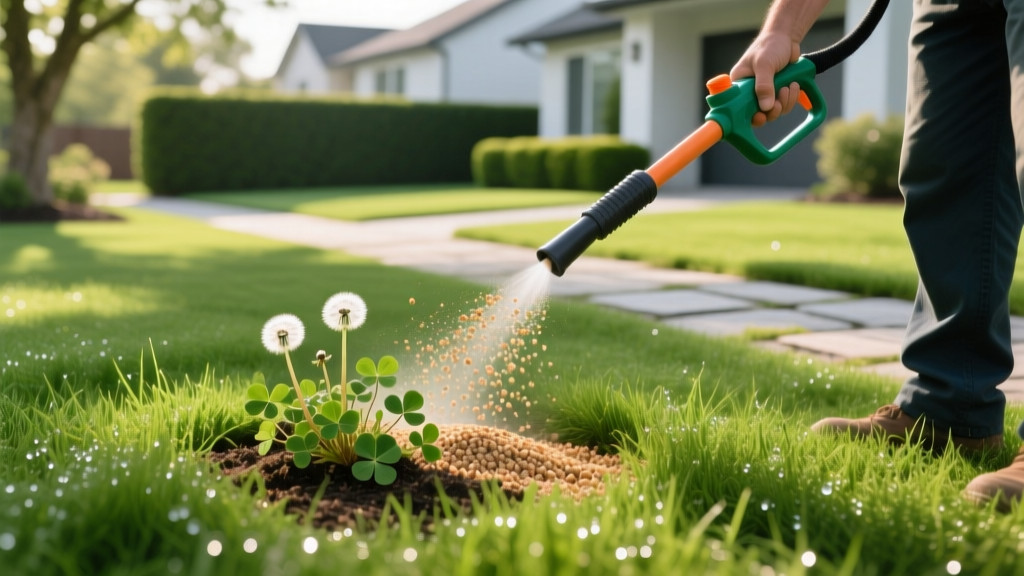
Targeted Spot-Treatment: Using Granular Weed Killer for Lawns
The Granular Spot-Treatment Paradox
Most homeowners and even many landscaping professionals assume that granular herbicides are strictly for broadcast applications via a walk-behind push spreader. However, utilizing a granular weed killer for lawns as a targeted spot-treatment is a highly effective, cost-saving, and environmentally responsible strategy when executed with precision. While liquid herbicides dominate the spot-treatment market due to their immediate foliar absorption, granular formulations offer distinct advantages: zero drift risk, extended soil residual activity, and a significantly lower upfront equipment cost.
The challenge lies in the mechanics of granular adhesion. Unlike liquids that coat a leaf upon contact, granular post-emergent herbicides (such as those containing 2,4-D, MCPP, and Dicamba) rely on physical adherence to the weed's foliage. If applied incorrectly, the granules bounce off the leaf, hit the soil, and degrade without ever entering the plant's vascular system. This guide breaks down the exact methodologies, spreader calibrations, and species-specific matrices required to turn granular products into surgical weed-control tools.
The Moisture Mandate: Post-emergent granular weed killers will fail 100% of the time if applied to dry foliage. The granules require surface moisture—either from morning dew, a light irrigation cycle, or recent rainfall—to melt and adhere to the weed's cuticle. Never apply granular spot-treatments during the heat of the afternoon when leaves are bone-dry.
Weed Species Decision Matrix: Granular vs. Liquid
Not all weeds respond equally to granular spot-treatments. Broadleaf weeds with large, textured, or hairy leaves capture and hold granules effectively, while grassy weeds and sedges allow the particles to slide off to the soil. According to turfgrass management guidelines from University of Minnesota Extension, matching the herbicide formulation to the weed's physical morphology is critical for efficacy.
| Weed Species | Leaf Morphology | Granular Efficacy | Recommended Approach |
|---|---|---|---|
| Dandelion | Broad, deeply lobed, textured | Excellent | Post-emergent granular (e.g., Trimec blend) |
| Broadleaf Plantain | Large, oval, prominent veins | Excellent | Post-emergent granular on wet foliage |
| White Clover | Small, trifoliate, smooth | Moderate | Requires heavy dew; liquid preferred |
| Crabgrass | Narrow, smooth, angled blades | Poor (Post) / Great (Pre) | Use granular pre-emergent for localized banding |
| Yellow Nutsedge | V-shaped stem, smooth, waxy | Zero | Liquid Halosulfuron-methyl required |
Step-by-Step Execution for Foliar Granular Spot-Treatment
To treat isolated patches of broadleaf weeds without broadcasting chemicals across your entire turf, you need a calibrated handheld spreader. The Scotts Whizz Rotary Spreader is the industry standard for this task due to its adjustable deflector shield, which allows you to direct the granular payload precisely onto the weed cluster.
Calibration and Application Protocol
- Timing the Moisture: Schedule your application for early morning (between 6:00 AM and 8:00 AM) when natural dew is present. If morning dew is absent, run your irrigation system for exactly 3 minutes to moisten the foliage, then wait 15 minutes for the water to settle.
- Spreader Setup: Load a 3-way granular herbicide (such as Scotts Turf Builder Weed & Feed) into your handheld spreader. Set the dial to Setting 2. This setting delivers approximately 2.87 lbs per 1,000 square feet, which is the precise rate required to achieve a lethal dose of 2,4-D on broadleaf weeds without causing phytotoxicity (chemical burn) to surrounding cool-season grasses like Kentucky Bluegrass or Fescue.
- Deflector Engagement: Close the deflector shield on the side of the spreader facing your desirable turf. This creates a 180-degree broadcast pattern, shielding your grass while concentrating the granules onto the weed patch.
- The Sweep Technique: Walk at a steady pace of 3 miles per hour, keeping the spreader exactly 18 inches above the weed canopy. Sweep the spreader in a smooth, overlapping pendulum motion to ensure the heavy carrier granules (often limestone or fertilizer-based) coat the weed leaves evenly.
- Post-Application Fasting: Do not irrigate or allow rain to wash the lawn for at least 24 hours. The active ingredients require 12 to 18 hours to translocate from the leaf surface down into the weed's taproot.
Localized Banding: Pre-Emergent Spot Prevention
While post-emergent granulars target existing weeds, granular pre-emergents (like those containing Prodiamine or Dithiopyr) are the ultimate spot-treatment tool for prevention. Turfgrass researchers at Purdue University note that crabgrass and Poa annua seeds primarily infiltrate lawns via hardscape borders, curbs, and driveways where the soil heats up faster and turf is thin.
Instead of broadcasting a pre-emergent across 10,000 square feet, you can perform localized banding. By applying a granular pre-emergent in a 3-foot wide band along the perimeter of your driveway, sidewalks, and street curbs, you create a chemical barrier that intercepts 80% of wind-blown and water-washed weed seeds. This targeted approach reduces your total chemical usage by up to 70%, saves money, and preserves soil microbiome health in the center of your lawn.
Temperature Trigger: Granular pre-emergent banding must be applied when 2-inch soil temperatures consistently reach 55°F for three consecutive days. Applying too early degrades the chemical barrier; applying too late allows the crabgrass germination window to open.
Cost Analysis: Granular Spot-Treatment vs. Liquid Herbicides
Transitioning to granular spot-treatments fundamentally alters your annual lawn care budget. Below is a comparative cost breakdown for treating a 5,000 square foot lawn with isolated weed pressure (approximately 10% weed coverage).
| Metric | Liquid Spot-Spray (Ester-based) | Granular Spot-Treatment |
|---|---|---|
| Equipment Required | Pump sprayer, PPE, surfactant ($85+) | Handheld rotary spreader ($25) |
| Material Cost (Per Application) | $18 - $25 | $6 - $9 (using Weed & Feed) |
| Drift Risk | High (wind-dependent) | Zero |
| Secondary Benefit | None | Fertilizes surrounding turf |
Troubleshooting Common Application Failures
Even with perfect timing, granular spot-treatments can fail if environmental variables are ignored. Here are the most common failure modes and their immediate fixes:
- Symptom: Granules are visible on the soil beneath the weed, but the weed remains healthy.
Cause: Foliage was too dry, causing 'bounce-off'.
Fix: Lightly mist the weed patch with a hose nozzle set to 'shower' before your next application to ensure the carrier granules melt onto the leaf cuticle. - Symptom: Surrounding desirable grass shows yellowing or tip-burn 48 hours after application.
Cause: Over-application or overlapping passes. Granular herbicides are heavily concentrated; applying a double dose to 'ensure coverage' will overwhelm the turf's metabolic ability to process the 2,4-D.
Fix: Rely on the spreader's calibration (Setting 2). One smooth pass is sufficient. Do not linger over a single weed cluster. - Symptom: Heavy rain occurs 4 hours after application, and weeds do not die.
Cause: The herbicide was washed into the soil before translocation occurred.
Fix: Check the local weather radar. Ensure a minimum 12-hour dry window post-application. If washed off, you must wait 14 days before reapplying to avoid soil toxicity.
By mastering the nuances of moisture adhesion, spreader calibration, and species-specific targeting, you can leverage granular weed killer for lawns as a surgical, budget-friendly alternative to liquid herbicides, keeping your turf pristine without the hassle of mixing and spraying chemical concentrates.

