
Pest Control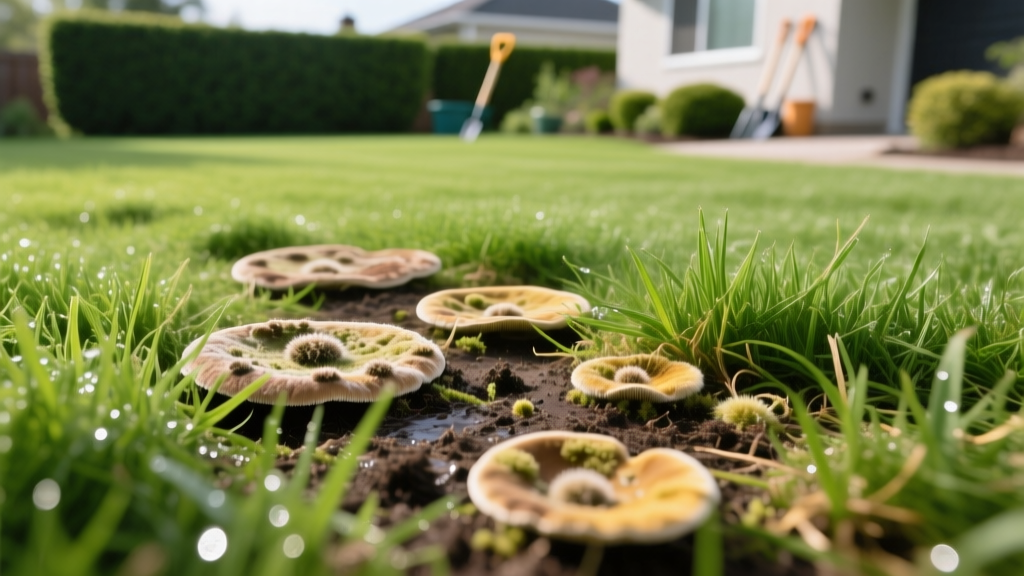
Grass Fungus Pictures & Diagnosis: Identify and Rescue Your Lawn
When brown spots or strange rings appear on your turf, guessing the pathogen leads to wasted money and dead grass. Visual diagnosis is the most critical first step in turfgrass pathology. By comparing your lawn's symptoms against verified grass fungus pictures and structural matrices, you can pinpoint the exact pathogen and deploy targeted rescue treatments before the mycelium destroys the root crown.
The Visual Diagnosis Matrix: Match Your Symptoms
Before purchasing any chemical controls, cross-reference your lawn's visual cues with this diagnostic matrix. Environmental triggers and grass species susceptibility are just as important as the physical shape of the damage.
| Pathogen | Visual Signature | Peak Environmental Trigger | Primary Grass Targets |
|---|---|---|---|
| Brown Patch (Rhizoctonia solani) | Large irregular circles (up to 3 ft), dark 'smoke-ring' border on outer edge | Night temps > 68°F + high humidity | Tall Fescue, Perennial Ryegrass, Bentgrass |
| Dollar Spot (Clarireedia jacksonii) | Silver-dollar sized straw-colored spots, distinct hourglass lesions on blades | Warm days (60-85°F), cool nights, heavy dew | Bermudagrass, Zoysia, Fescue, Bluegrass |
| Fairy Ring (Basidiomycetes) | Dark green stimulated growth rings, dead hydrophobic centers, mushroom fruiting bodies | Spring and Fall moisture fluctuations | All cool-season and warm-season turfgrasses |
| Pythium Blight (Pythium spp.) | Greasy, matted patches, rapid spread following 'cottony' white mycelium in morning | Peak summer heat (85-95°F) + saturated soil | Perennial Ryegrass, Bermudagrass, Bentgrass |
Top 4 Lawn Fungi: Visual Cues & Rescue Protocols
1. Brown Patch (Rhizoctonia solani)
Brown patch is the most destructive summer disease for cool-season lawns. The defining visual cue is the "smoke ring"—a dark, water-soaked margin at the outer edge of the patch that is only visible in the early morning. According to NC State Extension, the fungus attacks the leaf sheath, causing the blade to pull away easily from the runner when tugged.
Rescue Fix: Apply a preventative or curative fungicide containing Azoxystrobin (0.31%) or Propiconazole. A product like Scotts DiseaseEx Lawn Fungicide costs approximately $18 to $24 per 10lb bag and covers 5,000 square feet. Apply at a rate of 2.87 lbs per 1,000 sq ft. For severe active outbreaks, use a liquid spray application of Heritage SC (professional grade) at 0.4 oz per 1,000 sq ft for faster systemic absorption.
2. Dollar Spot (Clarireedia jacksonii)
Dollar spot begins as small, straw-colored circles roughly the size of a silver dollar, which eventually coalesce into large dead zones. The definitive diagnostic feature is the hourglass-shaped lesion on the individual grass blade, featuring a bleached center and dark brown borders. Penn State Extension notes that this pathogen thrives when soil moisture is low but foliar humidity (dew) is high.
Rescue Fix: Immediate rescue requires a contact plus systemic fungicide combination. Look for products containing Boscalid or Flutolanil. BioAdvanced Fungus Control for Lawns (Propiconazole) is highly effective and costs around $22 for a concentrate that yields 16 gallons of spray. Apply in the early evening so the active ingredient dries on the leaf tissue overnight. Follow up with a nitrogen application (0.5 lbs N per 1,000 sq ft) to push the turf through the stress period.
3. Fairy Ring
Fairy rings manifest as expanding arcs or circles of unusually dark green, fast-growing grass, often bordered by a thin ring of dead, brown turf. In advanced stages, the soil inside the ring becomes completely hydrophobic (water-repellent) due to dense fungal mycelium mats. University of Minnesota Extension advises that simply watering the dead center will fail because the water cannot penetrate the fungal mat.
Rescue Fix: Fungicides are largely ineffective against the deep soil mycelium of Fairy Ring. The rescue protocol requires physical disruption and surfactant therapy. First, core aerate the affected ring using a hollow-tine aerator to a depth of at least 3 inches. Next, apply a professional-grade soil wetting agent like Cascade Plus or Revive at 6 oz per 1,000 sq ft to break the soil's hydrophobic tension. Hand-water the area deeply with a sprinkler for 45 minutes daily for two weeks to flush the mycelium and rehydrate the root zone.
4. Pythium Blight (Pythium spp.)
Pythium blight moves with terrifying speed, capable of destroying an entire lawn in 48 hours under the right conditions. The grass initially looks water-soaked and dark green, rapidly turning black and greasy to the touch. In the early morning, you will see a distinct white, cottony mycelium webbing the blades together.
Rescue Fix: Standard azoxystrobin fungicides will not stop Pythium. You must use a chemistry specifically targeting oomycetes, such as Mefenoxam or Fosetyl-Al. Apply immediately at the first sign of greasy matting. Reduce irrigation instantly; Pythium requires free water to spread zoospores. Raise your mowing height to 3.5 inches to reduce canopy humidity.
⚠️ Diagnostic Warning: Fungus vs. Abiotic Stress
Before applying expensive fungicides, rule out abiotic causes. Dog urine spots feature a dead center with a ring of dark green, hyper-stimulated growth at the edges (due to nitrogen salts). Fungal brown patch does not have this bright green outer halo. Drought stress causes uniform wilting and footprinting (grass doesn't bounce back when stepped on) across the entire lawn, whereas fungus appears in distinct, localized geometric patterns.
Before applying expensive fungicides, rule out abiotic causes. Dog urine spots feature a dead center with a ring of dark green, hyper-stimulated growth at the edges (due to nitrogen salts). Fungal brown patch does not have this bright green outer halo. Drought stress causes uniform wilting and footprinting (grass doesn't bounce back when stepped on) across the entire lawn, whereas fungus appears in distinct, localized geometric patterns.
Step-by-Step Rescue Application Guide
Applying fungicide incorrectly can result in chemical burn or pathogen resistance. Follow this exact protocol for liquid and granular rescue treatments.
- Calibrate Your Equipment: For granular spreaders, test your output on a 10x10 ft (100 sq ft) driveway section. If the product calls for 3 lbs per 1,000 sq ft, you must dispense exactly 0.3 lbs over that test area. Adjust the dial until the math aligns.
- Timing the Application: Apply systemic fungicides between 6:00 AM and 9:00 AM. The morning dew helps dissolve granular prills and carries liquid active ingredients down into the leaf sheath. Never apply during the heat of the day (above 85°F) to avoid phytotoxicity.
- Nozzle Selection for Liquids: Use a flat-fan nozzle (such as a TeeJet 8002VS) calibrated to 40 PSI. This produces medium-fine droplets that coat the grass blade evenly without excessive runoff into the soil.
- The 24-Hour Watering Rule: For contact fungicides, do not water for 24 hours to allow the chemical to bind to the leaf cuticle. For systemic fungicides targeting crown and root diseases (like Fairy Ring or Take-All Patch), water in immediately with 0.25 inches of irrigation to push the chemical into the thatch layer.
- Rotate Chemistries: Fungi mutate rapidly. If you use an FRAC Group 11 fungicide (like Azoxystrobin) for your first rescue application, your follow-up application 21 days later must be an FRAC Group 3 (like Propiconazole) to prevent chemical resistance.
Preventative Cultural Controls Post-Rescue
Chemical rescues only buy time. To prevent the pathogen from returning next season, implement these non-negotiable cultural practices:
- Deep, Infrequent Irrigation: Water only when the turf shows signs of wilting (purplish-gray hue, folded blades). Apply 0.5 to 0.75 inches of water in a single session to encourage deep rooting and allow the topsoil to dry out between waterings.
- Thatch Management: Fungi overwinter in the thatch layer. If your thatch exceeds 0.5 inches, schedule a power-raking or dethatching session in the early fall (for cool-season grasses) or late spring (for warm-season grasses).
- Mower Blade Sanitation: Fungal spores cling to mower decks. After mowing an infected zone, spray the underside of your mower deck with a 10% bleach solution or a commercial quaternary ammonium disinfectant before moving to a healthy section of the lawn.
Frequently Asked Questions
Can I use grass fungus pictures from the internet to definitively diagnose my lawn?
Visual guides are excellent for narrowing down suspects, but many pathogens share overlapping symptoms. For a 100% definitive diagnosis, pull a 4x4 inch sod plug from the margin of the damaged area (where healthy and dead grass meet), place it in a sealed plastic bag with a damp paper towel, and mail it to your local university extension plant pathology lab. Most state labs process turf samples for $25 to $40.
How long does it take for a lawn to recover after a fungicide rescue treatment?
Fungicides halt the spread of the disease within 48 to 72 hours, but they do not "cure" already dead tissue. You must wait for the grass to generate new tillers from the surviving crown. In peak growing season (soil temps above 65°F), expect visual recovery and fill-in to take 14 to 21 days. If the crown was destroyed, you will need to overseed or lay sod over the bare patches.
Is it safe for pets to walk on the lawn after a fungicide rescue application?
Yes, but only after the product has completely dried. For liquid applications, this typically takes 2 to 4 hours depending on humidity and wind. For granular applications that require watering-in, keep pets off the lawn until the grass blades are dry to the touch to prevent them from ingesting granules stuck to wet foliage.

