
Pest Control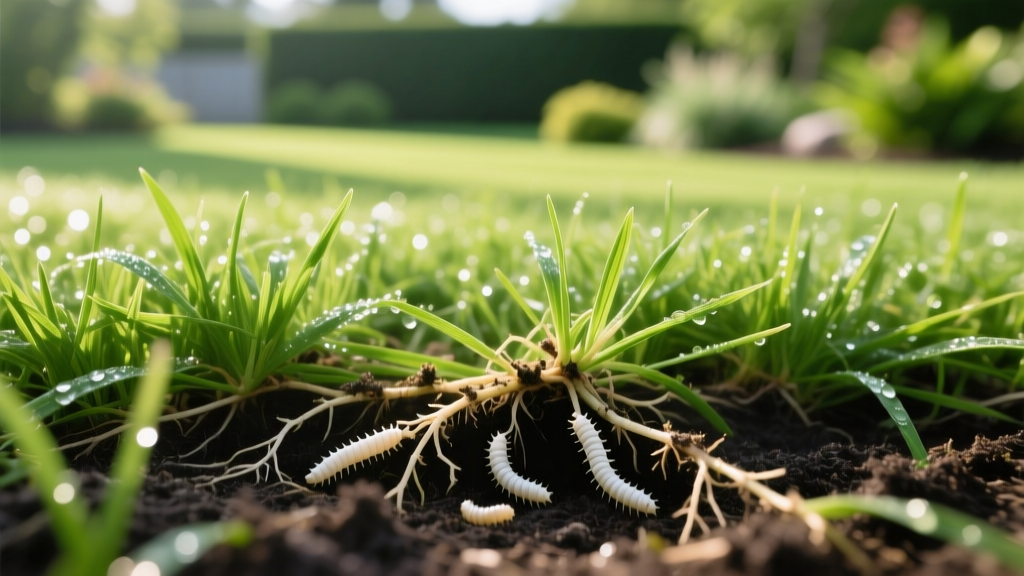
Best Grass Grubs Treatment Strategies: Timing and Product Guide
Identifying the Enemy: Are You Dealing with Grass Grubs?
Grass grubs—the larval stage of scarab beetles like Japanese beetles, June bugs, and European chafers—destroy lawns by severing grassroots just below the soil surface. Before initiating any grass grubs treatment, you must confirm their presence. Damage often mimics drought stress, appearing as irregular brown patches that fail to green up after irrigation.
The 'Tug Test' Diagnostic: Grasp a handful of brown turf and pull gently. If the grass rolls up like a loose carpet with no root resistance, grubs have likely eaten the root system. Peel back the sod and count the C-shaped, white larvae in the top three inches of soil. Finding more than 8 to 10 grubs per square foot warrants immediate chemical or biological intervention.
Secondary indicators include increased foraging activity from crows, skunks, and raccoons, which tear up the turf to feed on the protein-rich larvae. According to Penn State Extension, animal digging damage often causes more structural harm to the lawn than the grubs themselves, making early treatment critical.
The Critical Timing Matrix: Preventive vs. Curative
The single most common reason for grass grubs treatment failure is applying the wrong product at the wrong time. Grub control products are strictly divided into two categories: preventives (which target young, newly hatched larvae) and curatives (which kill larger, actively feeding grubs).
| Treatment Type | Active Ingredients | Application Window | Target Life Stage |
|---|---|---|---|
| Preventive | Chlorantraniliprole, Imidacloprid, Clothianidin | April through July | Newly hatched 1st and 2nd instars |
| Curative | Trichlorfon, Carbaryl | August through October | Large 3rd instars (fall feeding) |
Top Preventive Products (The Proactive Route)
Preventives are the most cost-effective and reliable grass grubs treatment strategy. They must be applied before the eggs hatch in mid-summer and require irrigation to activate.
Chlorantraniliprole (Scotts GrubEx 1)
This is the gold standard for residential preventive care. Chlorantraniliprole is highly targeted, meaning it controls grubs without decimating beneficial earthworm populations. It takes 60 to 90 days to fully translocate into the root zone, meaning you must apply it in April or early May. A standard 10,000 sq ft bag costs around $32. It provides up to four months of residual control.
Imidacloprid (BioAdvanced 24 Hour Grub Killer Plus)
Imidacloprid acts faster than chlorantraniliprole and can be applied slightly later, ideally in June or early July. However, it is more toxic to non-target insects, including pollinators, so avoid applying it to lawns with flowering weeds like clover or dandelions. Pricing averages $25 for a 5,000 sq ft coverage area.
Top Curative Products (The Emergency Route)
If you missed the preventive window and your lawn is actively being destroyed in late summer or early fall, you need a fast-acting curative. According to the UC IPM Pest Notes, curative treatments are essential when threshold populations are detected after August.
Trichlorfon (Dylox 6.2 Granular)
Dylox is the most potent curative available to homeowners. It begins killing grubs within 24 to 72 hours of ingestion and contact. However, it has a very short soil half-life (degrading completely within 7 to 10 days), meaning it leaves no residual protection. A 40 lb bag covering roughly 4,000 sq ft costs approximately $45.
Critical Soil pH Warning: Trichlorfon degrades almost instantly in alkaline soils. If your soil pH is above 7.5, Dylox will be neutralized before it reaches the grubs. Always conduct a soil test before purchasing curative chemicals. If your pH is high, rely on Carbaryl instead.
Carbaryl (Sevin Granular)
Carbaryl is slightly less effective than Trichlorfon but performs much better in high-pH soils. It is highly toxic to earthworms and aquatic life, so strict adherence to buffer zones near storm drains and ponds is mandatory.
Organic and Biological Grass Grubs Treatment Options
For homeowners managing organic landscapes or those with severe environmental restrictions, biological controls offer a viable, albeit slower, alternative.
- Beneficial Nematodes (Heterorhabditis bacteriophora): These microscopic worms seek out grubs and release bacteria that kill them within 48 hours. They must be applied at dusk to avoid UV degradation and require the soil to remain consistently moist for two weeks post-application. Cost: ~$40 per 10 million nematodes (covers 3,000 sq ft).
- Milky Spore (Paenibacillus popilliae): A bacterial disease that specifically targets Japanese beetle grubs. It is not effective against June bugs or European chafers. Milky spore takes 3 to 5 years to build up in the soil to effective levels, making it a long-term investment rather than a quick fix. Once established, it can provide control for up to 15 years.
Post-Treatment Lawn Recovery Protocol
Killing the grubs is only half the battle. Severed roots will not magically reattach. Follow this exact protocol to restore the turf:
- Hydrate Immediately: After applying any granular treatment, apply exactly 0.5 inches of water to wash the active ingredient off the grass blades and into the thatch layer.
- Core Aeration: Two weeks after the grubs are eliminated, run a core aerator over the damaged patches to relieve compaction and prepare the soil for seed.
- Overseed with Resistant Cultivars: Avoid Kentucky bluegrass in heavily infested zones. Instead, overseed with endophyte-enhanced tall fescue or perennial ryegrass. Endophytes are naturally occurring fungi inside the grass blades that produce alkaloids, which are highly toxic to surface-feeding insects and mildly deterrent to root-feeding grubs.
- Apply Starter Fertilizer: Use a high-phosphorus starter fertilizer (e.g., 10-18-10) to force rapid root development in the new seedlings before winter dormancy.
Common Grass Grubs Treatment Failures (And How to Avoid Them)
Even experienced landscapers make mistakes when dealing with scarab larvae. Avoid these three critical errors:
Failure 1: Applying Preventives Too Late. Applying Imidacloprid in late August will not kill 3rd-instar grubs. The chemical is only lethal to 1st-instar larvae. If it is August, you must switch to a curative like Dylox.
Failure 2: Skipping the Watering Step. Granular products sit harmlessly on the thatch layer until dissolved. If you fail to irrigate 0.5 inches of water immediately after application, the sun will degrade the chemical, and the grubs deep in the soil will never ingest it.
Failure 3: Treating in Late November. By late autumn, soil temperatures drop below 50°F, and grubs migrate 6 to 8 inches deep into the soil profile to overwinter. Curative chemicals cannot penetrate that deeply, and the grubs' metabolism is too slow to ingest a lethal dose. Stop curative treatments by mid-October.

