
Pest Control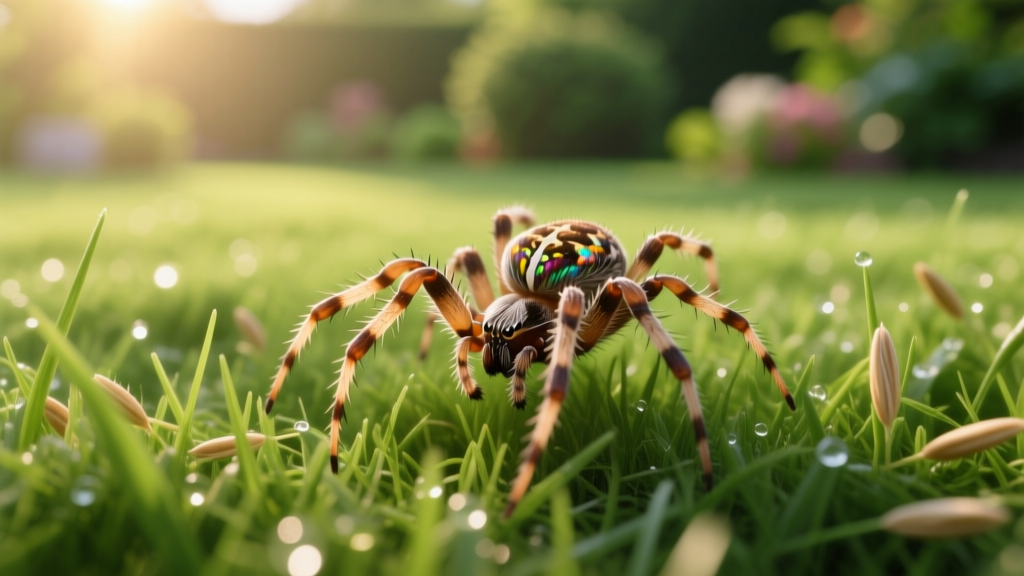
Grass Spider Size and Identification: Yard Defense Guide
Decoding the Grass Spider Size and Physical Traits
When homeowners spot spiders darting across their lawn, the immediate concern is often whether the arachnid poses a threat to humans or pets. The term 'grass spider' generally refers to the funnel weavers of the family Agelenidae, most notably the Agelenopsis genus. Understanding the exact grass spider size and anatomical features is the first step in effective yard defense and pest identification.
Adult grass spiders exhibit distinct sexual dimorphism in size. Female Agelenopsis typically feature a body length ranging from 10 to 20 millimeters (0.4 to 0.8 inches), while males are noticeably smaller, averaging 8 to 12 millimeters. However, their leg span tells a different story. A mature female can boast a leg span of up to 2 inches (50 mm), which often leads to misidentification as larger, more dangerous species. Their cephalothorax usually displays two distinct dark longitudinal stripes against a tan, brown, or grey background, and their abdomen features a mottled pattern with prominent spinnerets extending past the rear of the body.
Grass Spiders vs. Common Lookalikes
Accurate identification prevents unnecessary pesticide use and protects beneficial arachnids. According to Penn State Extension, distinguishing between common ground-dwelling spiders relies on eye arrangement, web structure, and precise measurements.
| Species | Body Length | Leg Span | Web Type | Eye Pattern |
|---|---|---|---|---|
| Grass Spider (Agelenopsis) | 0.4 - 0.8 in | Up to 2.0 in | Funnel/Sheet web with retreat tube | Two rows of four (equal size) |
| Wolf Spider (Lycosidae) | 0.4 - 1.5 in | Up to 3.0+ in | No web (burrows or hunts) | Three rows (4-2-2 arrangement) |
| Hobo Spider (Eratigena agrestis) | 0.3 - 0.6 in | Up to 1.75 in | Funnel web (often near foundations) | Two rows of four (equal size) |
Critical Identification Note: Hobo spiders and grass spiders are visually similar and both build funnel webs. However, hobo spiders lack the distinct longitudinal stripes on the cephalothorax and usually build webs near structural foundations rather than out in open turfgrass. The UC Agriculture and Natural Resources Pest Notes on Spiders emphasizes that funnel weavers in the middle of a healthy lawn are almost exclusively harmless grass spiders.
The Ecological Indicator: Why Spiders Mean a Bigger Problem
Grass spiders do not feed on turfgrass, ornamental plants, or structural wood. They are obligate carnivores. A sudden boom in the grass spider population is a secondary symptom of a primary pest infestation. Spiders establish funnel webs in high-traffic insect corridors. If your lawn is hosting dozens of visible funnel webs, it indicates a dense population of prey insects thriving in your turf.
- Aphids and Leafhoppers: These sap-sucking insects thrive in over-fertilized, nitrogen-heavy lawns and garden borders.
- Fungus Gnats: A sign of overwatering or poor soil drainage, providing a steady food source for ground spiders.
- Mosquitoes and Flies: Resting in the cool, humid microclimate of dense thatch layers during the heat of the day.
By addressing the primary insect prey, the spider population will naturally collapse as they migrate to better hunting grounds or starve. Eradicating the spiders without fixing the prey issue leaves your lawn vulnerable to the actual turf-destroying insects.
Cultural Yard Defense: Modifying the Microclimate
Grass spiders require specific environmental conditions to spin effective sheet webs and hide from avian predators. Modifying the lawn's microclimate makes the habitat inhospitable for web anchoring and prey concealment.
1. Thatch Layer Management
Thatch is the interwoven layer of living and dead stems, roots, and crowns that sits between the soil surface and the green grass blades. While a thin layer (under 0.5 inches) protects soil moisture, a thick thatch layer acts as a humid bunker for both spiders and their prey.
- Perform a Core Inspection: Use a spade to cut a 3-inch deep, wedge-shaped core from your lawn.
- Measure the Brown Layer: Measure the spongy brown layer between the soil and the green canopy. If it exceeds 0.5 inches, dethatching is mandatory.
- Execute Dethatching: For warm-season grasses like Bermuda or Zoysia, use a power rake in late spring. For cool-season grasses like Tall Fescue or Kentucky Bluegrass, dethatch in early fall using a heavy manual thatching rake or a rented vertical mower.
2. Precision Mowing Heights
Allowing grass to grow excessively tall creates a permanent, shaded canopy that spiders prefer for web suspension. Conversely, scalping the lawn stresses the root system and invites weeds. Maintain optimal cutting heights: 1.0 to 1.5 inches for hybrid Bermuda, 2.0 to 2.5 inches for Zoysia, and 2.5 to 3.5 inches for Tall Fescue. Never remove more than one-third of the grass blade in a single mowing session.
3. Strategic Lighting Adjustments
Standard mercury vapor or bright white LED porch and floodlights attract massive swarms of nocturnal insects, which in turn draws spiders to the perimeters of your home and adjacent lawn edges. Replace exterior bulbs with 2700K warm LEDs or specialized yellow 'bug lights' (sodium vapor) which emit wavelengths that are largely invisible to most flying insects, severing the food supply chain near your foundation.
Targeted Chemical and Organic Barrier Treatments
While cultural controls are the long-term solution, severe spider migrations into living spaces or dense populations in high-traffic play areas may require targeted chemical intervention. Broadcast spraying the entire lawn is ecologically damaging and largely ineffective, as it kills pollinators and fails to penetrate the thatch where spiders hide. Instead, utilize perimeter banding and targeted spot treatments.
Synthetic Barrier: Bifenthrin (Bifen IT)
Bifenthrin 7.9% is a synthetic pyrethroid that provides excellent residual control (up to 90 days) against crawling insects and arachnids. It binds tightly to soil particles, preventing runoff.
- Mixing Rate: 0.5 to 1.0 fluid ounces per gallon of water per 1,000 square feet.
- Application Zone: Spray a continuous 3-foot band on the ground extending outward from the foundation, and a 3-foot band up the foundation wall.
- Nozzle Selection: Use a flat-fan nozzle to ensure even coverage over soil and mulch beds, avoiding pin-stream nozzles which inject the chemical too deeply into the soil where spiders do not travel.
Organic Alternative: Essentria IC3
For households with pets, children, or sensitive ecosystems near water features, Essentria IC3 utilizes a blend of rosemary, peppermint, and wintergreen essential oils. It acts as a contact killer and a potent olfactory repellent, though it lacks the long residual life of synthetics.
- Mixing Rate: 4 to 8 fluid ounces per gallon of water.
- Application Frequency: Requires reapplication every 14 to 21 days, or immediately after heavy rainfall exceeding 0.5 inches.
- Safety Note: While exempt from EPA registration under FIFRA 25(b) due to its minimum-risk active ingredients, essential oils can still be phytotoxic to delicate ornamental plants if sprayed during peak afternoon heat. Apply only during early morning or dusk.
Frequently Asked Questions
Do grass spiders bite humans?
Grass spiders possess venom designed to liquefy the internal organs of small insects, not mammals. Their fangs (chelicerae) are generally too small and weak to pierce human skin. In the exceedingly rare event of a defensive bite, the reaction is comparable to a mild mosquito bite, resulting in localized redness that subsides within hours.
Why do I see so many grass spiders in the autumn?
Autumn is the peak mating season for Agelenopsis. The sudden appearance of dozens of spiders running across driveways and lawns are almost entirely mature males abandoning their webs to roam in search of female pheromone trails. This transient behavior usually concludes within two to three weeks following the first heavy frost.
Will lawn aeration help reduce spider populations?
Core aeration improves soil drainage and reduces surface moisture. Since grass spiders and their prey rely on high surface humidity to survive, improving drainage through annual aeration indirectly reduces the carrying capacity of your lawn for ground-dwelling arthropods.

