
Pest Control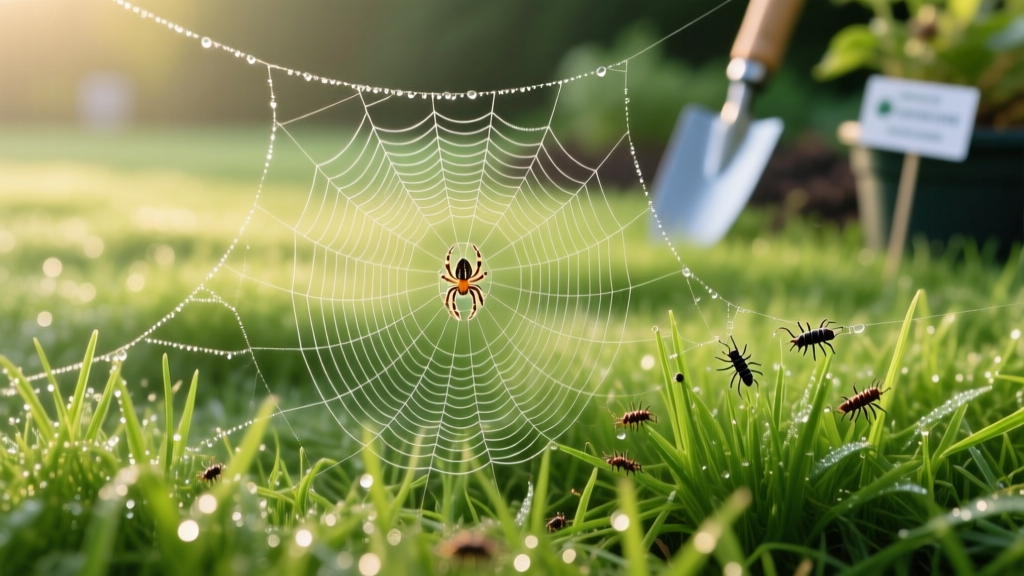
Grass Spider Web Identification: Friend, Fungus, or Lawn Pest?
The Morning Dew Illusion: Why Lawn Webs Cause Panic
Homeowners stepping onto their lawn at 6:00 AM often freeze at the sight of a silvery, dew-covered carpet stretching across the turf. The immediate instinct is to assume a massive spider infestation or a severe lawn disease. However, accurately identifying a grass spider web versus destructive sod webworm silk or fungal mycelium is the difference between nurturing a robust biological yard defense and inadvertently triggering a secondary pest outbreak. Broad-spectrum insecticides applied out of fear will eradicate beneficial predators, leaving your turf vulnerable to the very pests those predators were eating.
Diagnostic Matrix: Grass Spider vs. Sod Webworm vs. Fungus
Before purchasing any treatment, use this diagnostic matrix to identify the source of the webbing in your turfgrass.
| Feature | Grass Spider (Agelenopsis) | Sod Webworm (Herpetogramma) | Dollar Spot Fungus (Sclerotinia) |
|---|---|---|---|
| Web Structure | Horizontal sheet with a distinct funnel-shaped retreat at one edge. | Irregular, messy silken tunnels woven directly into the thatch layer. | Superficial, cobweb-like threads lacking any structural anchor or funnel. |
| Visibility | Visible year-round, highly prominent in morning dew. | Most visible in late summer/early fall; hidden in thatch during the day. | Only visible in early morning dew; disappears completely by mid-morning. |
| Turf Damage | None. Grass remains healthy and intact. | Severe. Grass blades are notched, chewed, or sheared off at the crown. | Severe. Grass develops bleached, silver-dollar-sized dead patches. |
| Yard Defense Role | Highly beneficial apex micro-predator. | Destructive turf pest requiring immediate intervention. | Pathogenic fungus requiring cultural or chemical management. |
The Grass Spider (Agelenopsis): Your Lawn’s Free Security Guard
The true grass spider web belongs to the Agelenopsis genus, commonly known as funnel weavers. These spiders are not a threat to your lawn, your pets, or your family. In fact, they are a critical component of an organic insect and rodent yard defense strategy. A single grass spider can consume up to 15% of its body weight in insects daily.
Predator Diet Profile
- Early-Instar Grubs: Intercepting Japanese beetle and June bug larvae before they burrow deep to feed on roots.
- Chinch Bugs: A primary vector for St. Augustine grass decline; grass spiders heavily prey on surface-dwelling chinch bugs.
- Armyworms & Cutworms: Spiders will drag small caterpillars into their funnels, reducing the larval population that otherwise shears grass crowns.
The funnel web itself is a marvel of biological engineering. The horizontal sheet acts as a vibration trap. When a lawn-damaging insect walks across the silk, the spider darts out from the protective funnel retreat, injects venom, and retreats. Leaving these webs intact reduces your reliance on chemical pesticides and maintains a balanced turf ecosystem.
The Real Threat: Sod Webworm Silk and Turf Destruction
If the webbing lacks a funnel, sits deep in the thatch, and is accompanied by chewed grass blades, you are likely looking at sod webworm silk. According to entomologists at Penn State Extension, sod webworms (the larval stage of lawn moths) construct silken tunnels to hide from daytime predators and birds. They emerge at night to feed, leaving behind notched grass blades and green, pellet-like frass (droppings) in the thatch.
Targeted Organic Eradication (Bt Kurstaki)
Do not use bifenthrin or carbaryl for sod webworms if grass spiders are present; you will kill the spiders and cause a secondary aphid or mite outbreak. Instead, use Bacillus thuringiensis var. kurstaki (Btk). Btk is a naturally occurring soil bacterium that specifically targets the digestive system of caterpillars, leaving spiders, earthworms, and pollinators unharmed.
- Recommended Product: Monterey B.t. or Bonide Thuricide (OMRI Listed).
- Application Rate: 2 fluid ounces per 1,000 square feet, diluted in 1 gallon of water.
- Timing: Apply in the late evening. Sod webworms feed at night, and UV light degrades Btk rapidly during the day.
- Cost: Approximately $18 to $24 for a 16 oz concentrate in 2026, which treats up to 8,000 sq ft.
Conventional Chemical Fallback
For severe infestations exceeding 5 larvae per square foot, a targeted pyrethroid like Cyfluthrin (Bayer Advanced 24 Hour Grub & Insect Killer) can be used as a spot treatment. Apply only to the affected perimeter to preserve the grass spider population in the rest of the yard.
The Fungal Mimic: Dollar Spot Mycelium
Sometimes, what appears to be a grass spider web is actually fungal mycelium. Sclerotinia homoeocarpa, the pathogen responsible for Dollar Spot disease, produces a white, cobweb-like mycelium on the turf surface during periods of high humidity and heavy morning dew. Researchers at the University of Minnesota Extension note that this mycelium is often mistaken for spider silk by homeowners.
How to differentiate: Fungal mycelium has no central anchor point, no funnel retreat, and no spider. If you part the grass and smell a distinct, damp, musty odor, you are dealing with a fungal pathogen, not an arachnid. Furthermore, the grass blades beneath the mycelium will exhibit bleached, hourglass-shaped lesions with reddish-brown margins.
Fungal Management Protocol
Dollar spot thrives in nitrogen-deficient turf with prolonged leaf wetness. To eliminate the mycelium 'webs':
- Apply a fast-acting nitrogen fertilizer (e.g., 46-0-0 urea) at a rate of 0.5 lbs of nitrogen per 1,000 sq ft to push the grass through the infection.
- Switch irrigation to deep, infrequent watering strictly between 4:00 AM and 6:00 AM to ensure grass blades dry before nightfall.
- If cultural controls fail, apply a systemic fungicide containing Fluxapyroxad (e.g., Scotts DiseaseEx) at the curative rate specified on the label.
The 4-Step Lawn Web Triage Protocol
When you encounter webbing in your yard defense perimeter, follow this exact sequence to determine your next action:
- The Dew Test (6:00 AM - 8:00 AM): Observe the web while the dew is heavy. If it vanishes completely by 10:00 AM without leaving a silk structure behind, it is fungal mycelium. Treat for Dollar Spot.
- The Thatch Parting: Use a garden trowel to part the thatch layer. If you see a distinct, horizontal sheet of silk leading to a funnel hole in the soil or deep thatch, it is a beneficial grass spider. Do nothing.
- The Blade Inspection: Examine the grass blades immediately surrounding the web. If the tips are chewed, notched, or sheared off, and you find green, seed-like frass in the thatch, you have sod webworms. Treat with Btk.
- The Soil Drench (Edge Case): If the web is attached to the base of a shrub or tree bordering the lawn and the web is a messy, chaotic tent rather than a flat sheet, you may be dealing with Eastern Tent Caterpillars or Fall Webworms. Prune the affected branch and destroy it mechanically.
Accurate identification prevents the misuse of chemical pesticides, saves money on unnecessary treatments, and leverages natural predators to maintain a resilient, pest-resistant landscape.

