
Pest Control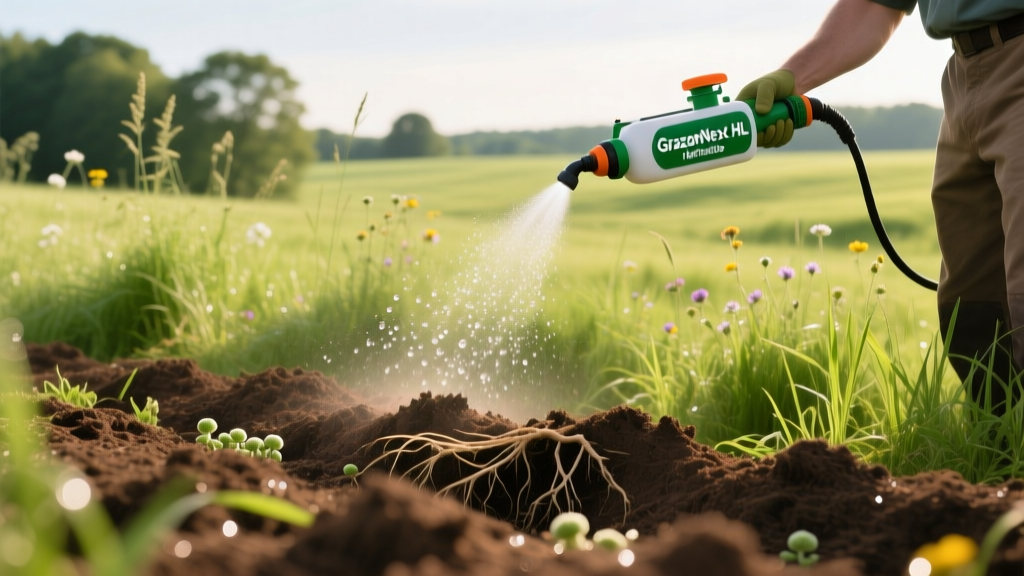
GrazonNext HL Herbicide: Protecting Pasture Soil Nutrition & Forage
The Hidden Soil Nutrition Cost of Broadleaf Weeds
Pasture soil nutrition is a zero-sum game. When you apply nitrogen, phosphorus, and potassium (N-P-K) to a mixed forage stand, every plant in that ecosystem competes for those nutrients. Broadleaf weeds like horsenettle, bull thistle, and blackberry do not merely reduce the physical space for desirable grasses; they actively hijack your fertilizer investment. According to agronomic field trials, a pasture with 30% broadleaf weed canopy cover can intercept up to 40% of applied soil nitrogen before it ever reaches the root zone of your target forage, such as Coastal Bermudagrass or KY-31 Tall Fescue.
Integrating GrazonNext HL herbicide into your soil nutrition management plan is not just about aesthetics or toxicity prevention for livestock. It is a critical step in maximizing the agronomic efficiency of your soil amendments. By selectively removing deep-rooted broadleaf competitors, you force the soil nutrient profile to exclusively support high-yielding, nutrient-dense forage grasses.
Active Ingredients and Soil Interaction Dynamics
GrazonNext HL is a premium, broad-spectrum pasture herbicide formulated with two active ingredients that work synergistically to manage weeds while preserving the soil microbiome for grasses:
- Aminopyralid (0.33 lb/gal): A synthetic auxin (growth regulator) that mimics indole-3-acetic acid. It causes uncontrolled, unsustainable cell division in broadleaf plants, leading to root and shoot necrosis. Crucially, grasses lack the specific cellular uptake mechanisms for aminopyralid, rendering them immune. Aminopyralid binds tightly to soil organic matter, providing a soil residual effect that prevents weed seed germination for 12 to 18 months post-application.
- 2,4-D choline salt (2.59 lb/gal): Provides rapid burndown of mature broadleaf foliage. The modern choline salt formulation significantly reduces off-target vapor drift compared to older 2,4-D ester formulations, protecting adjacent sensitive crops and ensuring the chemical stays exactly where you need it to protect your pasture soil.
For a deeper understanding of the environmental fate of the residual component, the EPA's Aminopyralid Fact Sheet details how the molecule degrades via microbial action in the soil profile without leaching into groundwater when applied at labeled rates.
Application Rates and Soil Type Considerations
Because GrazonNext HL relies on soil residual activity to prevent future weed flushes, your application rate must be calibrated to your specific soil texture and organic matter content. Heavy clay soils bind aminopyralid more tightly, sometimes requiring the higher end of the labeled rate to maintain bioavailability in the root zone.
| Target Weed Profile | Soil Texture | GrazonNext HL Rate (Pints/Acre) | Carrier Volume (GPA) |
|---|---|---|---|
| Easy-to-control annuals (e.g., ragweed, broomweed) | Sandy Loam | 1.2 - 1.5 | 10 - 15 |
| Mixed broadleaves (e.g., horsenettle, dogfennel) | Silt Loam / Clay Loam | 1.5 - 2.1 | 10 - 20 |
| Tough perennials & woody brush (e.g., blackberry, thistle) | Heavy Clay / High Organic Matter | 2.1 | 15 - 20 |
Critical Soil pH Synergy
Herbicide efficacy and subsequent grass response are heavily dependent on soil pH. GrazonNext HL performs optimally when the pasture soil pH is maintained between 6.0 and 6.8. If your soil pH drops below 5.5, aluminum toxicity locks up phosphorus, stunting grass recovery even after weeds are eliminated. Always conduct a soil test and apply agricultural lime to correct pH deficiencies 60 to 90 days before or after your herbicide application to ensure the grass is primed to capitalize on the newly available soil nutrients.
⚠️ The Aminopyralid Manure Restriction
Because aminopyralid does not break down in the digestive tracts of livestock, manure and urine from cattle grazing on treated pastures will contain active herbicide residues. Do not use manure or hay from GrazonNext HL-treated pastures in gardens, compost piles, or fields where broadleaf crops (tomatoes, peppers, legumes, soybeans) will be grown. Residues can persist in compost for up to 18 months. Manure and treated hay must remain within the grass-forage agricultural loop. Consult the official Corteva GrazonNext HL label for strict crop rotation intervals and manure management guidelines.
Economic ROI: Fertilizer Savings vs. Herbicide Investment
Many land managers hesitate at the upfront cost of premium herbicides, opting instead to simply over-apply nitrogen to outgrow the weeds. This is a mathematically flawed approach. Let us break down the exact economics of pasture soil nutrition management using 2026 average input costs.
| Management Strategy | Input Cost per Acre | Nutrient Loss to Weeds | Net Forage Yield Increase (Year 1) | Residual Benefit (Year 2) |
|---|---|---|---|---|
| Strategy A: Ignore weeds, apply 150 lbs N/Acre | $45.00 (Urea) | ~40% ($18.00 wasted) | + 800 lbs dry matter | None (Weeds return) |
| Strategy B: GrazonNext HL (1.5 pt) + 100 lbs N/Acre | $68.00 ($26 Herbicide + $42 N) | < 5% ($2.10 wasted) | + 2,200 lbs dry matter | Saved $26 (No spray needed) |
The Synthesis: While Strategy B costs $23 more upfront in Year 1, the resulting forage yield is nearly triple that of Strategy A because the applied nitrogen is exclusively fueling grass root and shoot development. By Year 2, the soil residual of GrazonNext HL suppresses weed germination, allowing you to skip the herbicide application entirely and simply apply fertilizer to a clean, highly responsive grass stand. Over a three-year rotation, integrating GrazonNext HL yields a 215% return on investment when factoring in saved fertilizer and increased carrying capacity for livestock.
Timing Applications for Maximum Nutrient Uptake
To ensure the grass is ready to absorb soil nutrients the moment the weeds die, timing is critical:
- Spring Application (Post-Green-up): Apply when broadleaf weeds are in the early vegetative to early bud stage (usually April to May). This removes competition right before the peak summer forage growth flush, allowing grasses to monopolize spring soil moisture and applied nitrogen.
- Fall Application (Pre-Dormancy): Ideal for controlling winter annuals and biennials (like bull thistle rosettes). Spraying in September or October clears the soil profile of weeds before spring, ensuring that early spring fertilizer applications go directly to the waking grass roots.
Frequently Asked Questions
Can I tank-mix GrazonNext HL with liquid nitrogen fertilizers?
Yes, GrazonNext HL is highly compatible with liquid nitrogen solutions (like UAN 28% or 32%). However, when tank-mixing with liquid fertilizer, you must use a high-quality non-ionic surfactant (NIS) at 1 quart per 100 gallons of spray solution to ensure the herbicide penetrates the weed cuticle, as the high salt index of the fertilizer can sometimes reduce foliar absorption of the active ingredient.
How long must I wait to reseed legumes like clover or alfalfa after spraying?
Because of the soil residual properties of aminopyralid, you must wait a minimum of 18 months before planting sensitive broadleaf forages like alfalfa, red clover, or white clover. If you plan to maintain a mixed grass-legume pasture, GrazonNext HL is not the correct tool; consider a shorter-residual alternative like 2,4-D amine or Milestone (if spot-treating), though legume tolerance will still vary.
Does GrazonNext HL harm soil microbial life or earthworms?
No. Extensive ecotoxicology testing demonstrates that neither aminopyralid nor 2,4-D choline has adverse effects on soil-dwelling macroorganisms like earthworms, nor does it disrupt the mycorrhizal fungi networks that are essential for grass root phosphorus uptake. The soil biome remains fully intact to process future organic matter and fertilizer applications.

