
Pest Control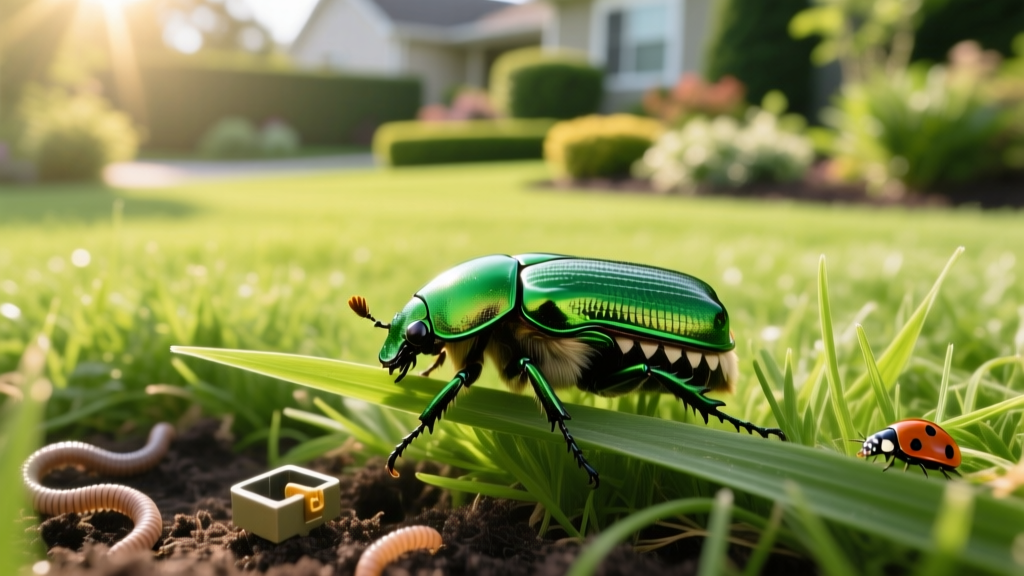
Proven Green June Beetle Control Strategies for Lawns
The Spongy Lawn Syndrome: Understanding Green June Beetle Damage
If your turf feels like a waterbed when you walk on it, and you hear a loud, clumsy buzzing sound near your fruit trees in mid-summer, you are likely dealing with Cotinis nitida, the green June beetle. Unlike other turf-destroying grubs that simply chew through root systems, green June beetle larvae cause structural devastation by tunneling. Their massive, erratic burrowing pushes the root zone upward, detaching the grass from the soil and creating a spongy, easily uprooted lawn surface. Effective green June beetle control requires a multi-phase approach targeting both the subsurface larvae and the fruit-defoliating adults.
Identification Matrix: Green June vs. Common Lookalikes
Misidentifying your grub species leads to failed treatments. Green June beetle grubs behave entirely differently from Japanese or May/June beetle grubs. Use this comparison framework to confirm your infestation before purchasing control products.
| Characteristic | Green June Beetle (C. nitida) | Japanese Beetle (P. japonica) | May/June Beetle (Phyllophaga spp.) |
|---|---|---|---|
| Adult Size & Color | 1 inch; dull metallic green, yellow margins | 0.5 inch; copper-brown wings, metallic green head | 0.5 to 1 inch; dark brown to black |
| Grub Size (Mature) | Up to 1.5 inches (massive) | Up to 0.75 inches | Up to 1.25 inches |
| Unique Grub Behavior | Crawls on its back using abdominal legs | Crawls normally on belly | Crawls normally on belly |
| Primary Turf Damage | Soil tunneling, spongy uprooting, thatch feeding | Direct root pruning, brown patches | Heavy root pruning, dead sod rolls |
| Adult Feeding Habit | Soft, overripe fruits (figs, peaches, grapes) | Skeletonizes leaves on 300+ plant species | Nocturnal; rarely feeds as adult |
According to entomologists at the University of Kentucky, the green June beetle grub's reliance on decaying organic matter means they are heavily attracted to lawns with excessive thatch layers or heavy compost applications.
Phase 1: Subsurface Grub Eradication
Timing is the single most critical variable in green June beetle control. Eggs hatch in late summer (August to early September), and the young grubs begin feeding near the surface. This is your window for maximum efficacy.
⚠️ CRITICAL TIMING WARNING: Do not apply grub treatments in June or July when adults are flying. The eggs have not yet hatched, and residual insecticides will degrade before the larvae emerge. Target late August through mid-September for optimal results.
Biological Controls: Nematodes and Bt
For organic lawn care or environmentally sensitive areas, biological agents offer excellent control without harming earthworms or soil microbiology.
- Beneficial Nematodes (Heterorhabditis bacteriophora): The Hb strain actively hunts grubs in the soil profile. Apply at a rate of 50,000 nematodes per square foot (roughly 50 million per 1,000 sq ft). Expect to pay $45 to $65 per 1,000 sq ft coverage. Failure Mode: Nematodes are highly UV-sensitive. Apply at dusk and immediately water in with 0.25 inches of irrigation to wash them into the thatch layer. Soil temperatures must be between 65°F and 85°F.
- Bacillus thuringiensis galleriae (Bt galleriae): Sold under brand names like grubGONE!, this bacterial strain produces proteins toxic specifically to beetle larvae. It is applied as a liquid or granular treatment and works best on early-instar (small) grubs in late August.
Chemical Interventions: Fast Knockdown Options
When biological controls are impractical or the infestation is severe, targeted synthetic chemicals are required. Because green June beetle grubs grow exceptionally large by late fall, standard preventative insecticides (like chlorantraniliprole) often fail to kill mature third-instar larvae.
For active, large grubs, Trichlorfon (commonly sold as Dylox 6.2G) is the industry standard curative treatment. Trichlorfon degrades rapidly in the soil (within 7-10 days), making it a short-residual knockdown agent rather than a preventative.
- Application Rate: 1.5 to 2.0 lbs per 1,000 square feet.
- Cost: Approximately $35 to $45 for a 30 lb bag (covers up to 20,000 sq ft).
- Execution: Mow the lawn short before application to ensure granules reach the soil. Water heavily immediately after spreading (0.5 inches of water) to dissolve the granules and drive the active ingredient into the top 2 inches of soil where the grubs are tunneling.
Phase 2: Managing Adults and Protecting Fruit
Adult green June beetles emerge in late June and peak in July. They are notoriously poor fliers, often crashing into structures and drowning in pools. While they do minimal damage to turf as adults, they are devastating to soft-skinned fruits like figs, peaches, plums, and grapes.
Physical Exclusion over Chemical Sprays
Spraying broad-spectrum insecticides like Carbaryl (Sevin) on fruit trees during the summer poses severe risks to native pollinators and violates pre-harvest intervals (PHI) for edible crops. The University of Georgia Extension recommends physical barriers as the most reliable defense.
- Organza Fruit Bags: Purchase 6x10 inch mesh organza bags (roughly $15 for a pack of 100). Slip the bags over individual fruit clusters or figs while they are still green and hardening. Secure the drawstring tightly around the stem to block the beetles' mandibles.
- Decoy Traps: Green June beetles are highly attracted to the volatiles of fermenting fruit. Place a bucket containing a mixture of water, overripe peaches, and a dash of yeast at the far edge of your property, at least 50 feet away from your target trees or lawn. The beetles will flock to the bucket and drown, reducing local pressure.
Phase 3: Cultural Defense and Lawn Recovery
Female green June beetles locate egg-laying sites by detecting volatile organic compounds released by decaying organic matter. A lawn with a 0.75-inch layer of thatch is essentially a beacon for egg-laying females in July.
Starving the Egg-Laying Females
To break the life cycle, you must alter the soil ecology. Schedule deep core aeration and mechanical dethatching in the early spring (April/May for cool-season grasses, May/June for warm-season grasses). By removing the thatch layer, you eliminate the primary attractant for gravid females. Furthermore, avoid top-dressing your lawn with heavy, uncomposted manure or raw compost during the summer months, as this will trigger immediate egg-laying.
Repairing Spongy, Tunnel-Damaged Turf
Once the grubs are eradicated in the fall, the lawn will still feel uneven and spongy due to the abandoned tunnel networks. Follow this recovery protocol:
- Roll the Turf: Use a half-filled lawn roller to gently press the detached root systems back into contact with the soil profile. Do not over-compact; one pass is sufficient.
- Topdress with Sand/Compost Mix: Apply a 50/50 mix of fine masonry sand and screened compost at a rate of 0.25 inches deep. This fills the macro-pores left by the grubs and restores soil-to-root contact.
- Overseed and Fertilize: For fescue or bluegrass lawns, core aerate the repaired zones and overseed at 5 lbs per 1,000 sq ft. Apply a starter fertilizer (e.g., 18-24-12) to fuel rapid root re-establishment before winter dormancy.
Frequently Asked Questions
Why are my grubs crawling on their backs?
Green June beetle grubs have adapted to life in loose, high-organic soils and compost piles. Their legs are positioned to push against the walls of their tunnels rather than walk on flat surfaces. When pulled from the soil or placed on a hard surface, they instinctively roll onto their backs and use their abdominal legs to propel themselves. This is the definitive field test for identifying Cotinis nitida.
Will Milky Spore disease kill green June beetle grubs?
No. Milky Spore (Paenibacillus popilliae) is highly host-specific and only infects Japanese beetle grubs. Applying Milky Spore for a green June beetle infestation is a waste of resources and will yield zero control. Stick to Hb nematodes or Trichlorfon for this species.
Do skunks and raccoons make the damage worse?
Yes. While green June beetle grubs are not the primary food source for foraging mammals (they prefer the smaller, protein-dense Japanese beetle grubs), the massive tunnels created by green June beetles make the turf highly susceptible to being rolled back by skunks, raccoons, and armadillos searching for other soil insects. Eradicating the grubs promptly prevents secondary wildlife destruction.

