
Pest Control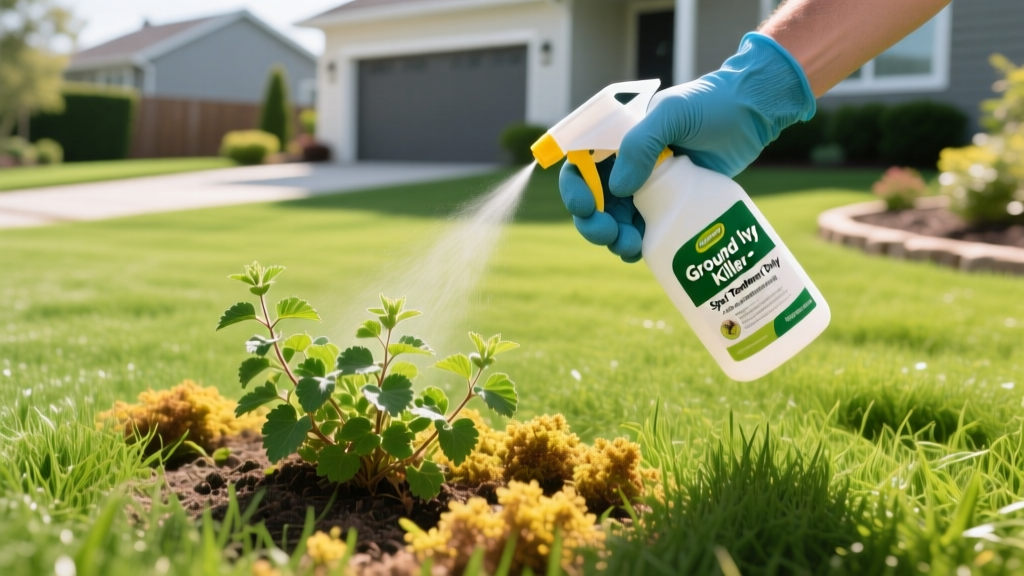
How to Choose the Right Ground Ivy Weed Killer for Spot Treatment
The Biological Defense of Ground Ivy
Ground ivy (Glechoma hederacea), commonly known as creeping charlie, defeats standard lawn herbicides through two distinct biological defenses. First, its leaves possess a thick, waxy cuticle that repels water-based sprays, causing droplets to bead up and roll off. Second, it spreads via an extensive network of stolons (above-ground runners) and rhizomes that store carbohydrates at every node. If your ground ivy weed killer only burns the top growth without translocating to the root system, the weed will regenerate from the nodes within 14 to 21 days.
Effective spot-treatment requires a systemic herbicide paired with a penetrating adjuvant, applied during specific temperature windows when the plant is actively pulling nutrients into its roots.
Identification Checklist:
- Leaves: Round to kidney-shaped with scalloped (crenate) edges.
- Stems: Square (characteristic of the mint family), rooting at the nodes.
- Odor: Emits a strong, pungent minty scent when crushed or mowed.
- Flowers: Small, bluish-purple, funnel-shaped blooms in early spring.
Active Ingredient Efficacy Matrix
Not all broadleaf herbicides are created equal. While 2,4-D is the backbone of many commercial weed killers, it is largely insufficient on its own for mature ground ivy. According to turfgrass researchers at the University of Minnesota Extension, combinations that include Triclopyr or Carfentrazone yield significantly higher eradication rates.
| Active Ingredient | Efficacy on Ground Ivy | Translocation Speed | Grass Safety Profile |
|---|---|---|---|
| Triclopyr | Excellent (90-95%) | Slow (14-21 days) | Safe for cool-season; damages warm-season |
| 2,4-D + Dicamba + MCPP | Good (75-85%) | Moderate (7-14 days) | Safe for most turfgrasses |
| Carfentrazone-ethyl | Good (Burn + Systemic) | Fast burn (24-48 hrs) | Broad spectrum safety |
| Mesotrione (Tenacity) | Poor to Fair (40-60%) | Slow (causes bleaching) | Safe for Kentucky bluegrass, damages fescue |
The Surfactant Multiplier Effect
The most common reason a ground ivy weed killer fails is the omission of a surfactant. The waxy cuticle of creeping charlie requires a chemical agent to reduce the surface tension of the spray droplet, allowing it to spread evenly and penetrate the leaf tissue.
For Triclopyr-based products, a Methylated Seed Oil (MSO) is superior to standard Non-Ionic Surfactants (NIS). MSO acts as a penetrant, dissolving the leaf wax. For 2,4-D and Dicamba blends, a standard Non-Ionic Surfactant (NIS) at a rate of 1 teaspoon (approx. 5ml) per gallon of water is sufficient. Never use dish soap as a substitute; the high salt content and degreasing agents can cause rapid leaf desiccation, trapping the herbicide on the surface before it translocates to the roots.
Top Selective Ground Ivy Weed Killers (2026 Market)
When spot-treating, you need selective herbicides that spare your surrounding turfgrass. Here are the most effective formulations currently available, categorized by their chemical approach.
1. PBI/Gordon's SpeedZone Lawn Weed Killer
Price: ~$48 per pint
Active Ingredients: Carfentrazone-ethyl, 2,4-D, MCPP, Dicamba
Best For: Rapid visual results and cool-season lawns.
SpeedZone utilizes Carfentrazone to induce rapid cell membrane disruption, causing the ground ivy to wilt and blacken within 24 to 48 hours. The remaining three ingredients provide the systemic action needed to kill the roots. Mix at a rate of 1.5 fluid ounces per gallon of water. It is highly effective but carries a high volatilization risk in hot weather due to the Dicamba content.
2. Hi-Yield Triclopyr Ester
Price: ~$38 per 8 oz bottle
Active Ingredient: Triclopyr (Ester formulation)
Best For: Stubborn, mature infestations in Kentucky Bluegrass and Fescue.
The ester formulation of Triclopyr is inherently better at penetrating waxy leaves than the amine formulation found in cheaper big-box store products. It requires the addition of an MSO surfactant. Mix at 1 tablespoon per gallon. Expect the ground ivy to yellow and curl over 14 days before dying completely. Warning: Do not use on St. Augustinegrass, Centipedegrass, or Bermudagrass, as Triclopyr will cause severe stunting and chlorosis.
3. Bonide Weed Beater Ultra
Price: ~$22 per quart (Ready-to-Spray)
Active Ingredients: Carfentrazone, 2,4-D, MCPP, Dicamba
Best For: Homeowners seeking convenience without mixing concentrates.
This hose-end or trigger-spray formulation includes the necessary surfactants pre-mixed. While slightly less potent per square foot than professional concentrates, its ease of use makes it ideal for small, isolated patches of ground ivy near garden beds.
Volatilization Warning: Herbicides containing Dicamba or 2,4-D ester can vaporize and drift when ambient temperatures exceed 85°F (29°C). This vapor can damage nearby desirable broadleaf plants, including tomatoes, grapes, and ornamental shrubs. Always spot-treat in the early morning when temperatures are between 60°F and 75°F.
Step-by-Step Spot-Treatment Protocol
Timing and preparation dictate the success of your application. According to turfgrass specialists at the University of Maryland Extension, fall applications (mid-September through late October) are vastly superior to spring applications, as the plant is actively storing carbohydrates in its roots for winter.
- Mow First: Mow the lawn 24 to 48 hours before application. This removes excess grass blade competition and ensures the herbicide reaches the low-growing ground ivy stolons.
- Check Soil Moisture: Do not apply if the lawn is drought-stressed. Water the lawn deeply 24 hours prior to application so the ground ivy is actively growing and transpiring.
- Calibrate the Sprayer: Use a 1-gallon or 2-gallon pump sprayer with a flat-fan nozzle. Adjust the tip to produce medium-coarse droplets to prevent drift.
- Apply to Point of Runoff: Spray the ground ivy until the leaves are uniformly wet and just beginning to drip. Do not soak the soil; the herbicide must enter through the foliage.
- Wait to Water: Allow the herbicide to dry completely (usually 2 to 4 hours). Do not irrigate or allow rainfall for at least 24 hours post-application.
- Delay Mowing: Wait at least 48 hours after application before mowing again to allow maximum translocation into the stolon nodes.
Post-Treatment Lawn Recovery and Overseeding
Once the ground ivy dies, it leaves bare patches in the turf that must be filled to prevent new weeds from germinating. Your overseeding timeline depends entirely on the active ingredient used:
- After 2,4-D / Dicamba / Carfentrazone: Wait 14 days before planting new grass seed.
- After Triclopyr: Wait a minimum of 21 to 28 days. Triclopyr has a longer soil residual activity that can inhibit the germination of cool-season grass seeds like tall fescue and ryegrass.
Rake out the dead creeping charlie debris, apply a starter fertilizer (e.g., 10-18-10), and overseed with a shade-tolerant turfgrass blend, as ground ivy typically thrives in the damp, shaded areas where turfgrass struggles.
Organic and Non-Chemical Realities
For homeowners strictly avoiding synthetic herbicides, options are limited and require rigorous persistence. Chelated Iron (FeHEDTA), sold under brand names like Fiesta, is the only organic compound that selectively targets broadleaf weeds. Iron causes oxidative stress and necrosis in broadleaf plants but is safely metabolized by grasses.
However, FeHEDTA only burns the top growth of ground ivy. You must apply it every 14 days for three to four consecutive cycles to exhaust the root system. Avoid using horticultural vinegar (20% acetic acid); it is non-selective, will burn your turfgrass, and fails to penetrate the stolon network. Furthermore, the historical internet myth of using Borax to kill ground ivy has been thoroughly debunked by agronomists; it causes long-term boron toxicity in the soil, preventing anything from growing in that spot for years.

