
Pest Control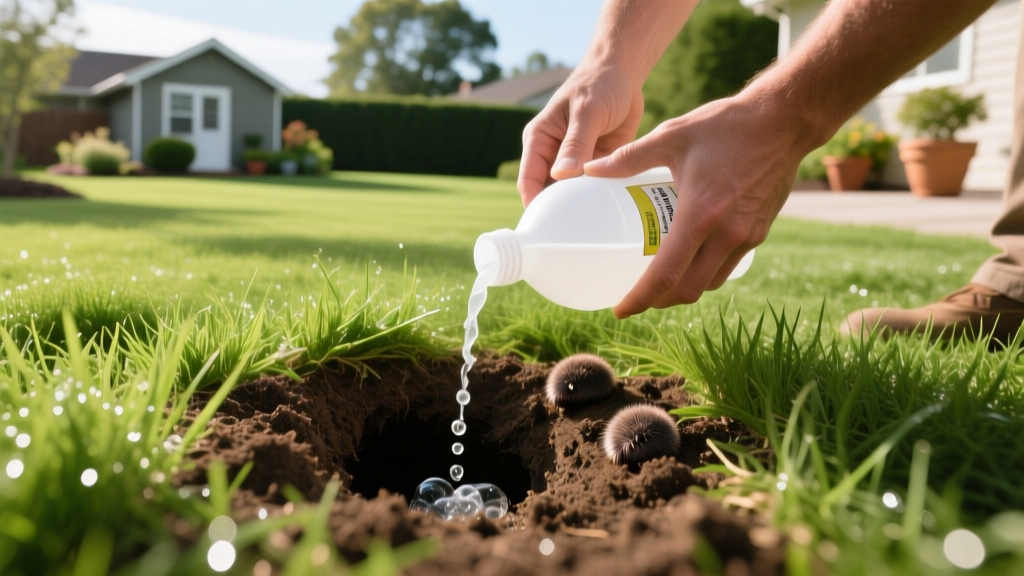
How to Get Rid of Ground Moles With Vinegar: Does It Work?
If you have searched for how to get rid of ground moles with vinegar, you have likely encountered dozens of home remedy blogs suggesting you pour white or apple cider vinegar down active mole tunnels. As an organic pest control strategy, it sounds ideal: cheap, non-toxic, and readily available in your pantry. However, from a soil science and entomology perspective, pure vinegar is entirely ineffective against subterranean mammals.
This guide breaks down the biological and chemical reasons why the vinegar myth persists, analyzes the popular "vinegar and castor oil" hybrid recipes, and provides a scientifically backed, chemical-free protocol to actually evict moles from your lawn in 2026.
The Vinegar Myth: Why Home Remedies Fail Against Moles
To understand why vinegar fails, you must understand both mole anatomy and soil chemistry. Moles (such as the Eastern mole, Scalopus aquaticus) are insectivores that construct two distinct types of tunnels:
- Surface Runways: Shallow feeding tunnels located 1 to 3 inches below the soil surface, visible as raised ridges in your turf.
- Deep Nesting Tunnels: Vertical and horizontal chambers located 6 to 24 inches underground, used for sleeping and rearing young.
Household vinegar is a dilute solution of roughly 5% acetic acid. When poured into a mole hole, three things happen that neutralize its potential as a repellent:
- Soil Buffering Capacity: Most lawn soils contain calcium carbonate, organic matter, and clay particles that act as a buffer. The soil neutralizes the weak acetic acid within hours, returning the localized pH to baseline.
- Lack of Penetration: Liquids poured into dry soil tend to channel or pool rather than permeating the dense clay walls of deep nesting chambers. The vinegar never reaches the mole.
- Volatilization: Acetic acid evaporates rapidly when exposed to air and sunlight at the tunnel entrance, leaving behind nothing but a faint, temporary odor that a mole's highly adapted olfactory system easily ignores.
Warning: Turfgrass Damage
Repeatedly pouring vinegar into your lawn lowers the soil pH locally. While moles will simply dig around the treated area, your turfgrass roots (especially acid-sensitive varieties like Kentucky Bluegrass) will suffer from aluminum toxicity and nutrient lockout, resulting in dead, yellow patches that mimic mole damage.
Repeatedly pouring vinegar into your lawn lowers the soil pH locally. While moles will simply dig around the treated area, your turfgrass roots (especially acid-sensitive varieties like Kentucky Bluegrass) will suffer from aluminum toxicity and nutrient lockout, resulting in dead, yellow patches that mimic mole damage.
The "Vinegar and Castor Oil" Recipe: Does the Hybrid Work?
The most common internet recipe for organic mole control involves mixing castor oil, dish soap, and vinegar. The standard ratio is 1 part castor oil, 1 part dish soap, and 1 part vinegar, diluted in a gallon of water.
Does this work? Yes, but the vinegar is completely irrelevant. The active repellent in this mixture is the castor oil. Moles find the taste and smell of castor oil highly offensive, and it coats their food sources (grubs and earthworms), causing mild digestive distress that prompts them to relocate.
In fact, adding vinegar to this mixture is counterproductive. Castor oil and water do not mix; the dish soap acts as an emulsifier to bind them. The high acidity of vinegar can break down the soap's emulsifying bonds, causing the castor oil to separate and float to the top of your sprayer tank, resulting in uneven application. According to the UC Davis Integrated Pest Management program, castor oil-based repellents can provide temporary relief, but they must be formulated correctly to penetrate the soil profile.
DIY Mole Repellent vs. Commercial Organic Alternatives
When deciding how to spend your organic pest control budget, compare the efficacy and soil impact of DIY kitchen remedies versus commercially formulated organic products.
| Treatment Method | Active Ingredient | Estimated Cost (per 5,000 sq ft) | Soil Penetration & Efficacy |
|---|---|---|---|
| Pure White Vinegar | 5% Acetic Acid | $3 - $5 | Poor. Neutralized by soil; damages grass roots. |
| DIY Castor/Soap/Vinegar | Castor Oil (emulsion broken) | $10 - $15 | Moderate. Uneven distribution due to acid breaking soap bonds. |
| Commercial Castor Oil (e.g., Bonide Molemax) | Castor Oil + Surfactants | $25 - $35 | High. Surfactants carry oil deep into soil profile. |
| Beneficial Nematodes (Hb) | Heterorhabditis bacteriophora | $40 - $60 | High. Eliminates grub food source, forcing moles to leave. |
If Not Vinegar, What Organic Methods Actually Evict Moles?
If you are committed to chemical-free lawn care, you must shift your strategy from attempting to burn or poison the mole to altering its environment. The Internet Center for Wildlife Damage Management emphasizes that modifying the habitat and food supply is the most sustainable long-term organic control method.
1. Target the Food Source (Biological Grub Control)
Moles eat 70% to 100% of their body weight daily, primarily feasting on white grubs and earthworms. By eliminating the grubs, you remove the mole's reason to stay. Avoid synthetic pesticides like imidacloprid. Instead, apply Beneficial Nematodes (Heterorhabditis bacteriophora). These microscopic worms seek out grub larvae in the soil and release bacteria that kill the host within 48 hours. Apply at a rate of 1 billion nematodes per acre (roughly $45 for a standard lawn) in late summer when grubs are near the surface.
2. Commercial Castor Oil Formulations
Products like Bonide Molemax or Sweeney's Mole & Gopher Repellent use highly refined castor oil combined with proprietary surfactants. These surfactants allow the oil to bind to soil particles and travel down to the 6-inch depth where moles actually live. Apply using a hose-end sprayer immediately before a light rain, which helps pull the active ingredients deep into the root zone.
3. Mechanical Trapping (The Ultimate Organic Solution)
Repellents only push moles to your neighbor's yard. If you want permanent, chemical-free removal, trapping is the gold standard. The Victor Out O'Sight Mole Trap (approx. $25) or the Wiretek Scissor Trap are highly effective. Place the trap directly in an active, straight surface runway. Step on the tunnel to collapse it, then position the trap so the trigger pan rests in the depression. Cover with a bucket to block light and protect pets.
Step-by-Step Organic Mole Eviction Protocol
Follow this 4-week timeline to organically reclaim your lawn without resorting to ineffective kitchen acids or toxic baits.
- Week 1: Identify Active Runways. Step down all visible raised ridges in your lawn. Check them 24 hours later. The ridges that have been pushed back up indicate active feeding tunnels. Mark these with flags.
- Week 2: Apply Castor Oil Repellent. Using a commercial castor oil concentrate, spray the entire lawn, focusing heavily on the flagged active zones. Water the lawn deeply for 20 minutes immediately after application to drive the oil into the soil.
- Week 3: Deploy Nematodes. Order live H. bacteriophora nematodes. Apply them at dusk (UV light kills them) using a pump sprayer with the filter removed. Water the lawn again to wash the nematodes into the soil where grubs reside.
- Week 4: Set Traps on Stragglers. If any moles remain after the food source is gone and the castor oil has made the area unpalatable, set scissor traps on the remaining active deep tunnels to remove the final holdouts.
"Moles are incredibly sensitive to vibrations and soil disturbances. While ultrasonic spikes sold at hardware stores rarely work long-term because moles quickly habituate to the sound, the physical act of collapsing their tunnels and altering the soil chemistry with castor oil creates an environment they instinctively avoid."
Frequently Asked Questions
Will boiling vinegar kill a mole?
No. While boiling water will kill surface-dwelling insects and burn plant roots, pouring it down a mole hole will not reach the animal. The thermal mass of the surrounding soil cools the water within inches, and the mole will simply be in a deeper, branching chamber completely unaffected by the heat.
Is apple cider vinegar better than white vinegar for moles?
Neither is effective. Apple cider vinegar has the same 5% acetic acid concentration as white vinegar. The addition of fruit sugars and the "mother" (bacteria) in apple cider vinegar will actually attract secondary pests like fruit flies, ants, and wasps to your lawn, creating a new pest problem without solving the mole issue.
What smells do moles hate the most?
Moles have an acute sense of smell and are highly averse to castor oil, tar, and certain essential oils like garlic and eucalyptus. However, because they live entirely underground, surface-applied smells dissipate before reaching their nesting chambers. Any scent-based repellent must be emulsified and watered deeply into the soil to be effective.

