
Pest Control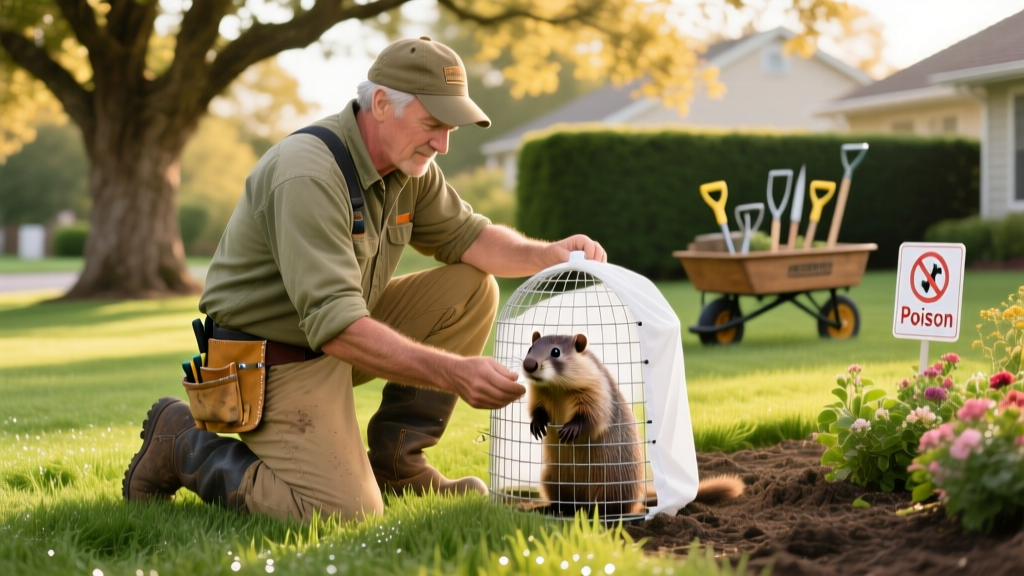
How to Poison Groundhogs: Legal Risks and Safer Lethal Alternatives
When a 10-pound woodchuck (Marmota monax) decimates your garden or undermines your shed foundation, the frustration is immediate. Many homeowners instinctively search for how to poison groundhogs, assuming toxicants are the fastest route to eradication. However, applying poison to groundhogs is a legal minefield, an ecological hazard, and, frankly, a highly ineffective strategy for burrowing mammals.
This guide breaks down the strict regulatory reality of groundhog toxicants, the severe risks of secondary poisoning, and the precise, legal lethal trapping and exclusion protocols that wildlife professionals actually use to eliminate woodchuck damage in 2026.
The Legal and Ecological Reality of Groundhog Toxicants
There are no over-the-counter, legally registered poisons specifically labeled for homeowner use on groundhogs in the United States. The primary toxicant historically used for burrowing rodents is zinc phosphide. According to the National Pesticide Information Center (NPIC), zinc phosphide is classified as a Restricted Use Pesticide (RUP).
⚠️ WARNING: Restricted Use Pesticides (RUPs)
By federal law, RUPs like zinc phosphide can only be purchased and applied by certified commercial pesticide applicators. Applying them as a homeowner is a federal offense carrying steep fines. Furthermore, using any poison off-label (e.g., using rat poison on a groundhog) violates the Federal Insecticide, Fungicide, and Rodenticide Act (FIFRA).
The Secondary Poisoning Threat
Groundhogs are a prey species. If a groundhog consumes a lethal dose of anticoagulant rodenticide or zinc phosphide and dies above ground or in a shallow bolt hole, it becomes a toxic vector. Raptors (hawks, owls), foxes, coyotes, and domestic pets that scavenge the carcass ingest the concentrated toxins. Under the Migratory Bird Treaty Act, property owners can be held liable if protected raptor species die from secondary poisoning originating on their land.
Why Poison Fails for Burrowing Mammals
Even if you could legally access agricultural-grade toxicants, poisoning is biologically mismatched to groundhog behavior. The Internet Center for Wildlife Damage Management (ICWDM) notes several behavioral barriers that make baiting nearly impossible:
- Neophobia and Bait Shyness: Groundhogs are highly suspicious of new objects and foods in their environment. If they consume a sub-lethal dose of a toxicant and feel ill, they will permanently avoid that bait profile.
- Burrow Architecture: A mature groundhog burrow system features a primary plunge hole, multiple hidden bolt holes, and a nesting chamber up to 5 feet deep and 66 feet long. A poisoned groundhog will retreat deep into the nesting chamber to die, leaving the decaying carcass inaccessible beneath your property, resulting in severe odor and fly infestations.
- Dietary Selectivity: Unlike rats, which will eat grain-based poison pellets, groundhogs prefer fresh, high-moisture vegetation (clover, alfalfa, garden produce). Formulating a stable, weather-resistant toxic bait that appeals to a woodchuck over fresh garden crops is exceptionally difficult.
Lethal Trapping: The Legal Alternative to Poisoning
Wildlife control operators (WCOs) bypass the legal and ecological nightmares of poison by utilizing mechanical trapping. Depending on your state regulations, this involves either lethal body-grip traps or live cage traps followed by humane, legal dispatch.
Option A: Cage Trapping and Legal Dispatch
For suburban environments where body-grip traps pose a risk to pets, heavy-duty cage traps are the industry standard.
- Equipment: Havahart 1084 or similar galvanized steel trap (Minimum dimensions: 32" L x 10" W x 12" H). Expect to pay $55–$75.
- Baiting Strategy: Groundhogs are highly attracted to sweet, high-moisture fruits. Use cantaloupe rinds, sweet corn, or apple slices. Spray the bait with apple extract to increase the olfactory draw.
- The "Wing" Technique: Never place a trap in the open. Use 1-inch chicken wire to build "wings" that funnel the groundhog from the burrow entrance directly into the trap opening. Groundhogs will walk around a trap if they can easily bypass it.
- Dispatch: Once captured, state law dictates dispatch methods. CO2 chambers or a precise .22 caliber firearm shot to the brain are standard. Note: Drowning is illegal in most states and considered inhumane.
Option B: Lethal Body-Grip Traps (Rural/Agricultural)
In rural settings, a #220 body-grip trap (e.g., Duke's 220 Coil Spring, ~$22) placed directly over the main burrow entrance provides instant, lethal control. These traps must be set with specialized safety tools and heavily staked to prevent drag-offs by larger predators. Check local ordinances: Many municipalities ban body-grip traps entirely within city limits.
Comparison Matrix: Toxicants vs. Trapping vs. Exclusion
To understand why professionals avoid poison, compare the core metrics of groundhog management strategies:
| Method | Legality (Suburban) | Efficacy | Non-Target Risk | Estimated Cost |
|---|---|---|---|---|
| Toxicants (Zinc Phosphide) | Illegal (RUP) | Low (Bait shyness) | Severe | $150+ (Pro only) |
| Cage Trap + Dispatch | Legal (Most areas) | High | Minimal | $60 - $90 |
| Body-Grip (#220) | Restricted | Very High | Moderate (Pets) | $25 - $40 |
| Trench Exclusion | Always Legal | Permanent | None | $150 - $400 |
Step-by-Step: Burrow Destruction and Exclusion
Removing the animal is only 50% of the solution. If you do not destroy the burrow, a transient groundhog—or worse, a rabid skunk—will claim the vacant real estate within 48 hours. Follow this protocol immediately after trapping:
- Locate All Entrances: Identify the main plunge hole (usually marked by a large crescent-shaped mound of fresh dirt) and sweep the perimeter for 100 feet to find hidden, flush-to-the-ground bolt holes.
- Excavate the Plunge Hole: Use a trenching shovel to dig out the first 2 feet of the main tunnel. This removes the structural integrity of the entrance.
- Fill with Crushed Stone: Pour 3/4-inch crushed angular gravel into the excavated tunnel and all bolt holes. Angular gravel locks together, making it impossible for a new groundhog to dig through. Do not use round pea gravel or dirt, as they will simply dig it back out.
- Cap with Topsoil and Sod: Cover the gravel with 4 inches of topsoil and replace the sod to restore the lawn aesthetic.
- Install Trench Exclusion (For Gardens/Sheds): Dig a 12-inch deep trench around the perimeter of the threatened structure. Install 14-gauge welded wire mesh (1/2-inch hardware cloth), burying it 12 inches down and bending the bottom 6 inches outward in an "L" shape. This prevents digging animals from burrowing under the barrier.
💡 Pro-Tip: Scent Masking
Before setting cage traps, boil them in water with a handful of dirt and leaves, or leave them outside in the rain for a week. Human sweat and manufacturing oils on the metal trigger plate will trigger a groundhog's neophobia, causing them to avoid the trap entirely.
When to Call a Professional Wildlife Control Operator
If the burrow system is located directly beneath a concrete slab, a home foundation, or a critical utility line, DIY trapping and excavation can cause structural collapse or sever gas/water lines. In these scenarios, hire a licensed WCO. Expect to pay between $250 and $450 for a comprehensive groundhog removal package, which includes trapping, legal dispatch, burrow destruction, and a warranty against immediate re-infestation.
While the search for a quick chemical fix is understandable, relying on poison for groundhog control is illegal, ecologically damaging, and ultimately ineffective. By pivoting to targeted mechanical trapping and rigorous burrow destruction, you permanently solve the damage problem while remaining fully compliant with state and federal wildlife regulations.

