
Pest Control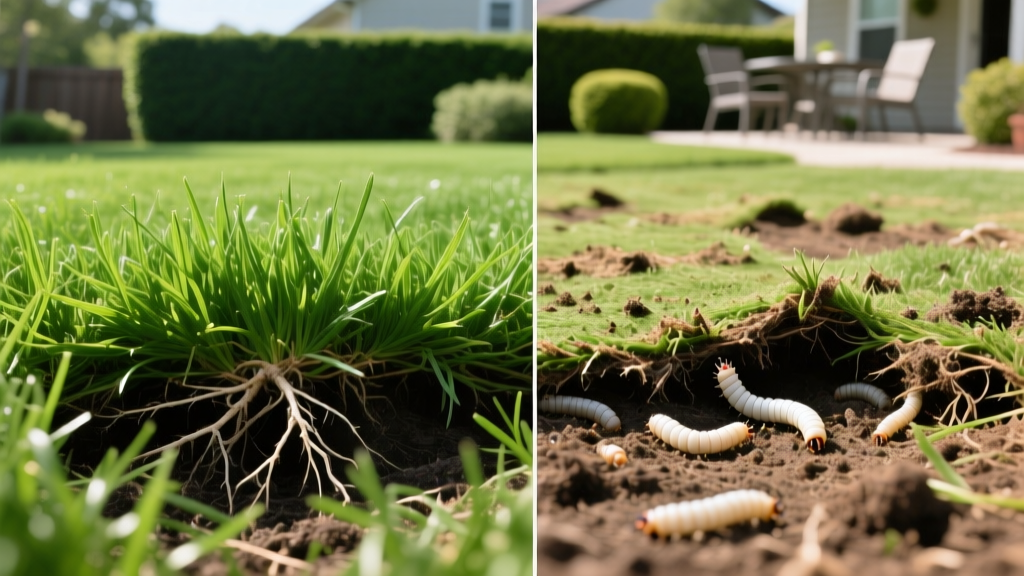
Grub Damage vs Fungus: How to Diagnose and Rescue Your Lawn
The Core Differences: Grub Damage vs Fungus at a Glance
When your lawn develops irregular brown patches, the immediate instinct is often to apply a generic pesticide or fertilizer. This is a costly mistake. The two most common culprits for sudden turf decline—soil-dwelling insect larvae (grubs) and opportunistic pathogens (turfgrass fungi)—require entirely different chemical interventions and cultural corrections. Misdiagnosing the problem leads to wasted money, chemical resistance, and dead grass.
Grubs sever the root system from below, causing the turf to detach from the soil. Fungi attack the blade tissue and crown, disrupting photosynthesis and rotting the plant from the top down or at the soil line. Below is a diagnostic matrix to help you separate the two before purchasing any treatments.
| Diagnostic Feature | Grub Damage (White Grubs) | Fungal Outbreak (Brown Patch/Dollar Spot) |
|---|---|---|
| Root Attachment | Roots completely severed; turf rolls up like loose carpet. | Roots remain firmly anchored in the soil. |
| Blade Inspection | Blades look healthy but wilt rapidly due to lack of water uptake. | Blades show distinct lesions, water-soaked tips, or white cobweb-like mycelium. |
| Patch Shape | Irregular, sprawling brown dead zones. | Distinct circular rings, 'frog-eye' patterns, or silver-dollar-sized spots. |
| Soil Activity | Presence of skunks, raccoons, or crows tearing up the turf at night. | No animal digging; soil surface may show fungal fruiting bodies. |
| Peak Season | Late summer to early fall (August–October). | Mid-summer during high heat and high humidity (June–August). |
Symptom Diagnosis: Is It Grubs or Fungus?
The 'Tug Test' and Soil Inspection (Grubs)
The definitive test for grub damage is the tug test. Grab a handful of the dying grass at the margin of the brown patch and pull upward. If the turf peels back effortlessly with no soil or roots attached, you have a root-severing problem. According to Penn State Extension, you must then dig into the top 3 inches of the soil profile at the edge of the damaged area. Count the C-shaped, white larvae with brown heads. The economic threshold for treatment is generally 10 or more grubs per square foot for cool-season grasses like Kentucky Bluegrass and Tall Fescue.
The Blade and Crown Inspection (Fungus)
If the tug test fails and the roots hold firm, inspect the grass blades closely. Fungal pathogens like Rhizoctonia solani (Brown Patch) leave distinct tan lesions with dark brown borders on tall fescue blades. In the early morning, when dew is heavy, you may see a smoke-colored ring of mycelium at the outer edge of the patch. Dollar spot (Clarireedia jacksonii) presents as bleached, straw-colored bands across the blades. As noted by NC State TurfFiles, fungal diseases thrive when nighttime temperatures remain above 65°F and daytime humidity is high, creating a microclimate that suffocates the turf.
Diagnostic Warning: Do not rely solely on the presence of dead grass. Drought stress, dog urine spots, and chinch bugs can mimic these symptoms. Always perform the physical tug test and blade inspection before applying curative chemicals.
Decision Tree: Pinpointing Your Lawn's Problem
Use this logical flow to confirm your diagnosis in the field:
- Step 1: Pull the brown grass. Does it lift like carpet?
- Yes: Proceed to Step 2a (Grub Path).
- No: Proceed to Step 2b (Fungus/Pathogen Path).
- Step 2a (Grub Path): Dig 3 inches deep at the patch margin. Do you find >10 white C-shaped grubs per sq ft?
- Yes: Confirmed Grub Infestation. Apply curative insecticide.
- No: Investigate drought stress, localized dry spot, or billbug damage.
- Step 2b (Fungus Path): Examine individual grass blades for lesions, banding, or rot at the crown.
- Yes: Confirmed Fungal Disease. Apply systemic fungicide.
- No: Investigate nematode damage, compacted soil, or severe nutrient deficiency.
Rescue Fixes: Treating Grub Damage
If you confirm a grub infestation in late summer, preventative products like Chlorantraniliprole (Scotts GrubEx1) will not work fast enough to save your current turf. You must use a fast-acting curative insecticide.
Curative Application: Trichlorfon
The industry standard for mid-season grub rescue is Trichlorfon (commonly sold as Dylox 6.2G). Trichlorfon acts as a contact and stomach poison, paralyzing the grubs within 24 to 48 hours.
- Application Rate: 3 lbs per 1,000 square feet.
- Cost: Approximately $35 to $45 for a 30 lb bag (covers 10,000 sq ft).
- Critical Execution Step: Trichlorfon degrades rapidly in high-pH soils and sunlight. You must water it in immediately with at least 0.5 inches of irrigation to push the active ingredient into the root zone where the grubs are feeding.
Pro-Tip for 2026: If you missed the curative window in late fall, apply a preventative containing Clothianidin or Chlorantraniliprole in May or early June of the following year. This breaks the life cycle before the next generation of eggs hatch in July.
Rescue Fixes: Treating Fungal Outbreaks
Fungal diseases spread rapidly in summer humidity. Once brown patch or dollar spot is confirmed, cultural practices (like reducing irrigation) must be paired with chemical intervention to halt the pathogen's progression.
Systemic Fungicides: Stopping the Spread
Contact fungicides (like Chlorothalonil) only protect the surface of the blade and wash off easily. For an active outbreak, you need a systemic fungicide that penetrates the plant tissue. According to University of Maryland Extension, rotating active ingredients is critical to prevent the pathogen from developing genetic resistance.
- FRAC Group 11 (QoI Inhibitors): Azoxystrobin (Heritage SC or Scotts DiseaseEx). Apply at 0.4 fl oz per 1,000 sq ft for liquid, or follow granular rates. Excellent for Brown Patch and Dollar Spot.
- FRAC Group 3 (DMI Inhibitors): Propiconazole (Honor Guard PPZ or Bayer Advanced Fungus Control). Apply at 0.2 to 0.4 fl oz per 1,000 sq ft. Highly effective against dollar spot and rusts.
- Rotation Strategy: Apply Azoxystrobin for your first application. Wait 14 to 21 days, then apply Propiconazole for your second application. Never use the same FRAC group more than twice consecutively.
Post-Rescue Lawn Rehabilitation
Chemicals stop the immediate threat, but they do not regrow dead grass. Once the grubs are eradicated or the fungus is dormant, you must rehabilitate the bare spots.
- Core Aeration: If the damage was caused by compacted soil exacerbating a fungal issue, perform core aeration in early fall to improve soil oxygenation and drainage.
- Slit-Seeding: For grub-damaged areas where the soil is exposed, use a slit-seeder to plant disease-resistant cultivars. For Tall Fescue, look for varieties with high endophyte levels (like Titan Ultra or Falcon V), which naturally deter surface-feeding insects and resist fungal penetration.
- Starter Fertilizer: Apply a starter fertilizer (e.g., 18-24-12) at a rate of 1 lb of nitrogen per 1,000 sq ft immediately after seeding to fuel rapid root establishment before winter dormancy.
Frequently Asked Questions
Can a lawn have both grubs and fungus at the same time?
Yes, though it is rare for both to peak simultaneously. Grubs peak in late summer/early fall, while fungal diseases like brown patch peak in mid-summer heat. However, a lawn weakened by a mid-summer fungal outbreak may have a compromised root system, making it more susceptible to late-summer grub feeding. Diagnose the most severe symptom first and treat accordingly, spacing chemical applications by at least two weeks.
Does watering my lawn at night cause fungus?
Watering at night extends the 'leaf wetness period' beyond 10 hours, which is the exact trigger for Brown Patch and Pythium Blight spore germination. Always program your irrigation system to run between 4:00 AM and 6:00 AM. This allows the grass blades to dry rapidly once the sun rises, starving the fungus of the moisture it needs to infect the tissue.

