
Pest Control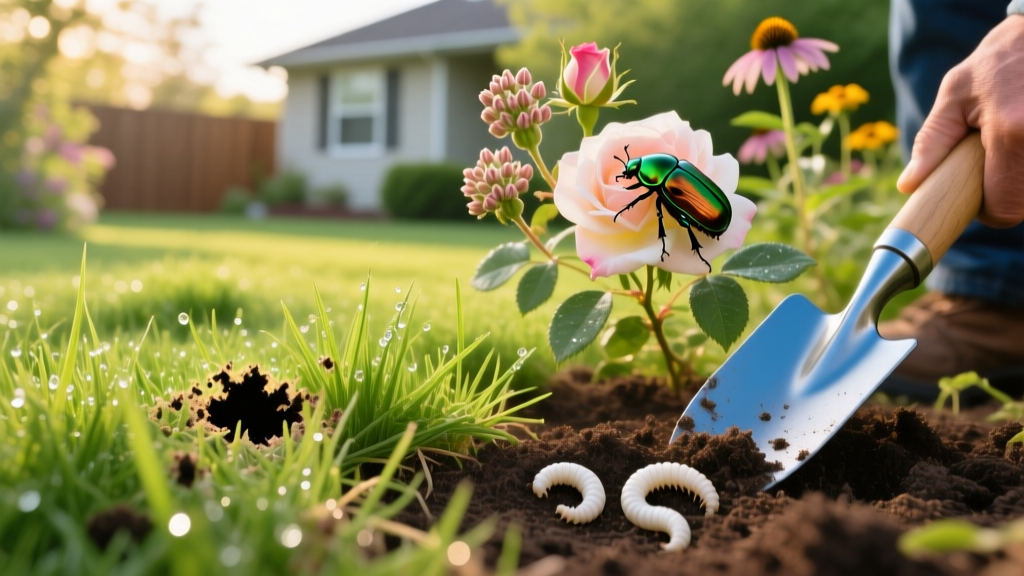
Grubs and Japanese Beetles: Complete Yard Defense Strategy
The Inseparable Link: Japanese Beetles and Grubs
Defending your yard against grubs and Japanese beetles requires understanding that they are not two separate pest problems, but two stages of the exact same biological threat. The Japanese beetle (Popillia japonica) operates on a strict one-year lifecycle that attacks your landscape from both above and below ground. Adult beetles emerge in early summer to skeletonize your ornamental plants, mate, and lay eggs directly in your turfgrass. By late summer, those eggs hatch into white, C-shaped grubs that devour your lawn's root system from beneath the soil surface.
The 12-Month Threat Cycle
June - July: Adults emerge, feed on foliage, and mate.
August: Eggs hatch into first-instar grubs; root feeding begins.
September - October: Grubs reach peak size and maximum root destruction.
November - March: Grubs burrow 4-8 inches deep to overwinter.
April - May: Grubs return to the surface to feed briefly before pupating into adults.
Damage Identification: Surface Feeders vs. Root Destroyers
Accurate diagnosis dictates your treatment timeline. Homeowners frequently misdiagnose grub damage as drought stress or fungal disease, leading to ineffective chemical applications. Use this diagnostic matrix to confirm the culprit.
| Symptom | Japanese Beetle (Adult) | White Grubs (Larvae) |
|---|---|---|
| Primary Target | Roses, grapes, linden trees, raspberries | Turfgrass roots (Kentucky bluegrass, tall fescue) |
| Visual Damage | Skeletonized leaves (lacy appearance), defoliation | Irregular brown patches, wilting despite adequate moisture |
| Physical Test | Beetles visibly clustering on foliage in warm sun | Turf rolls back like a carpet due to severed roots |
| Secondary Signs | Foul odor from crushed beetles on hard surfaces | Skunks, raccoons, or crows tearing up the lawn at night |
The Yard Defense Treatment Calendar
Treating grubs and Japanese beetles at the wrong time of year is the most common cause of control failure. Applying a curative insecticide in April, for instance, will fail because the grubs are pupating and no longer feeding. Follow this strict calendar for maximum efficacy.
- April to May (Preventative): Apply long-residual grub preventatives. The product must be watered into the soil before eggs hatch.
- June to Early July (Preventative): Apply short-residual preventatives just before the peak egg-laying period.
- Mid-July to August (Adult Control): Hand-pick adults, apply foliar sprays to prized ornamentals, or introduce biological controls.
- August to September (Curative): If you missed the preventative window and spot active grubs, apply fast-acting curative insecticides while grubs are still small (first or second instar).
Chemical and Biological Arsenal: What Actually Works
Forget generic hardware store bug killers. Effective yard defense requires targeting specific active ingredients tailored to the pest's current life stage.
Preventative Grub Control (Spring/Early Summer)
Chlorantraniliprole (Trade name: Acelepryn SC or GrubEx1): This is the gold standard for preventative control. It is highly effective, safe for earthworms, and poses minimal risk to pollinators once watered in. Apply at a rate of 0.08 to 0.11 fl oz per 1,000 sq ft. Cost: Approximately $80 for an 8 oz bottle, which treats up to 5,000 sq ft. It must be applied in April or May, as it takes 60 to 90 days to fully translocate into the root zone.
Imidacloprid (Trade name: Merit 0.5 G): A reliable, slightly faster-acting alternative. Apply 1.4 to 1.8 lbs per 1,000 sq ft in June or early July. Cost: Around $35 for a 30 lb bag. Warning: Imidacloprid is highly toxic to aquatic invertebrates and bees; never apply near water sources or before heavy rainfall runoff.
Curative Grub Control (Late Summer/Fall)
Trichlorfon (Trade name: Dylox 6.2 G): If you find more than 5-10 grubs per square foot in August or September, you need a curative knockdown. Dylox kills active grubs within 24 hours but degrades rapidly in the soil (losing efficacy in 7-10 days). Apply 3 lbs per 1,000 sq ft and water in immediately with at least 0.5 inches of irrigation. Cost: Roughly $45 for a 3 lb bag.
Biological Controls: Nematodes and Milky Spore
For organic yard defense, beneficial nematodes (Heterorhabditis bacteriophora) are highly lethal to grubs. Purchase them from specialized suppliers, keep them refrigerated, and apply at dusk when soil temperatures are between 60°F and 85°F. You must apply roughly 1 billion nematodes per acre (or ~23 million per 1,000 sq ft). Failure mode: Applying them in direct sunlight or failing to water them in immediately will result in 100% mortality of the nematodes.
Milky Spore (Paenibacillus popilliae): This bacterium specifically targets Japanese beetle grubs. However, it requires 2 to 5 years to build up sufficient spore density in the soil to provide control, and it only works on Japanese beetles—not June bugs or masked chafers. Apply using a grid pattern (1 teaspoon per 4 sq ft). Cost: $40 for a 20 oz box covering 7,000 sq ft.
Adult Japanese Beetle Management: Avoid the Pheromone Trap Trap
⚠️ Critical Warning: Pheromone Traps
Commercial Japanese beetle traps use floral lures and sex pheromones that are vastly more attractive than your actual plants. According to Penn State Extension, traps consistently attract far more beetles into your yard than they actually catch, resulting in a "halo effect" of increased damage to surrounding foliage. If you must use traps, place them at least 100 feet away from your prized ornamentals and property lines.
The Soapy Water Method: For immediate, non-toxic adult control on roses and grapevines, fill a bucket with water and add 2 tablespoons of liquid dish soap (like Dawn). Japanese beetles are sluggish in the early morning when dew is present. Hold the bucket beneath the infested foliage and tap the branches. The beetles will drop into the soapy water, where the soap breaks the surface tension, preventing them from escaping and drowning them instantly.
Cost Breakdown for a 5,000 Sq Ft Lawn
Budgeting for a full-season defense requires factoring in both preventative soil treatments and reactive adult management. Here is a realistic cost matrix for a standard 5,000 square foot turf area in the 2026 season.
| Treatment Type | Product / Active Ingredient | Estimated Cost (5k sq ft) | Application Frequency |
|---|---|---|---|
| Premium Preventative | Chlorantraniliprole (Acelepryn) | $80.00 | Once (Spring) |
| Standard Preventative | Imidacloprid (Merit) | $15.00 | Once (Early Summer) |
| Curative Knockdown | Trichlorfon (Dylox) | $75.00 | As needed (Late Summer) |
| Biological Control | Hb Nematodes | $45.00 | Once (Late Summer) |
Frequently Asked Questions
Do Japanese beetle grubs survive the winter?
Yes. As soil temperatures drop below 50°F in late autumn, third-instar grubs burrow 4 to 8 inches deep below the frost line to overwinter. They do not die off in the cold. In early spring, they migrate back to the top 2 inches of soil to feed on roots for a few weeks before pupating into adults. This is why spring preventative treatments must be applied before this feeding window peaks.
Will treating my lawn for grubs stop adult Japanese beetles from eating my roses?
No. The USDA notes that adult Japanese beetles are strong fliers capable of traveling several miles from neighboring untreated properties to find food. Killing the grubs in your soil protects your turfgrass, but you must manage adults separately using physical removal, row covers, or targeted foliar sprays (like Neem oil or pyrethrin) on your ornamental plants.
How much water is required after applying granular grub control?
Granular insecticides sit on the thatch layer and are useless until washed into the soil where the grubs feed. You must apply exactly 0.25 to 0.5 inches of irrigation immediately after application. Use empty tuna cans placed on the lawn to measure when your sprinklers have delivered the correct volume of water. Failure to water in the product will result in UV degradation of the active ingredient and total control failure.

