
Pest Control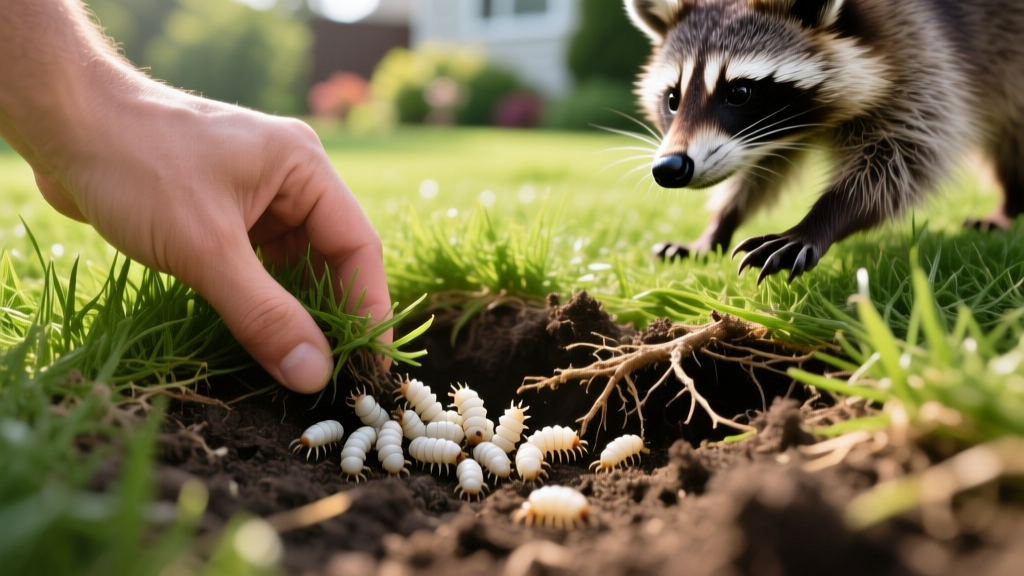
Grub Killer Plus Strategy: Stop White Grubs and Digging Mammals
The Grub-to-Mammal Damage Pipeline
Most homeowners discover a white grub infestation not by seeing the insects, but by observing the secondary destruction left behind by foraging mammals. Moles, voles, skunks, raccoons, and even armadillos are opportunistic insectivores. A single square foot of turf harboring more than 8 to 10 grubs becomes a high-value feeding ground. Skunks will peel back sod like a carpet, leaving distinct 3-inch cone-shaped divots, while moles create raised surface tunnels that sever grassroots and dry out the soil.
Effective insect and rodent yard defense requires attacking the root cause: the food supply. Standard preventative treatments applied in spring often fail to address late-summer curative needs when mammal foraging peaks. This is where a grub killer plus formulation—specifically those combining fast-acting curative insecticides with secondary soil benefits or preventative agents—becomes the linchpin of a comprehensive yard defense strategy.
Decoding the 'Plus' in Grub Killer Formulations
The term 'plus' in commercial turf products generally indicates a dual-action formulation. While standard products like Scotts GrubEx rely solely on Chlorantraniliprole (a slow-acting preventative that takes 60 to 90 days to reach peak efficacy), a true curative 'plus' product utilizes fast-knockdown chemistry.
The industry standard for curative grub control is BioAdvanced 24-Hour Grub Killer Plus, which utilizes Trichlorfon (brand name Dylox) at a 6.2% concentration. Trichlorfon is a highly soluble organophosphate that paralyzes the grub's nervous system upon contact, stopping root feeding within 24 hours and killing the larvae within 3 to 5 days. Some 'plus' formulations also integrate a starter fertilizer (like a 6-10-8 NPK ratio) to stimulate immediate root recovery after the grubs have been eradicated.
| Active Ingredient | Product Example | Action Type | Kill Speed | Target Life Stage |
|---|---|---|---|---|
| Trichlorfon (6.2%) | BioAdvanced 24-Hr Grub Killer Plus | Curative | 24 to 72 hours | 2nd & 3rd instar larvae |
| Chlorantraniliprole (0.08%) | Scotts GrubEx | Preventative | 60 to 90 days | Eggs & 1st instar larvae |
| Imidacloprid (0.15%) | Bayer Advanced Grub Control | Preventative | 30 to 60 days | Eggs & early larvae |
Precision Application Protocol for Trichlorfon
Trichlorfon is notoriously unstable. It degrades rapidly in high-pH soils (above 7.5) and breaks down when exposed to direct UV light. To ensure your grub killer plus application actually reaches the root zone where the mammals are digging, follow this exact protocol:
- Verify the Infestation: Cut a 12x12 inch square of turf with a spade and peel it back. Count the C-shaped white grubs. If you count fewer than 5, treatment is unnecessary. If you count 8 or more, proceed immediately.
- Mow the Lawn: Mow your grass to a height of 2.5 inches. This reduces the amount of product intercepted by the grass blades and allows more granules to reach the soil surface.
- Calibrate the Spreader: Set your rotary spreader to the specific setting listed on the BioAdvanced label (usually setting 5 or 6 for standard Scotts EdgeGuard spreaders). Apply at a rate of 1.8 lbs per 1,000 square feet.
- The Critical Watering Step: Trichlorfon must be watered in immediately. Apply exactly 0.25 to 0.5 inches of water using a sprinkler system or hose-end sprayer. Use an empty tuna can placed on the lawn to measure when 0.5 inches of water has accumulated. This pushes the active ingredient past the thatch layer and into the top 3 inches of soil where grubs feed.
Warning: Soil pH Limitations
If your soil pH is above 7.5, Trichlorfon will degrade before it reaches the grubs. Conduct a soil test via your local university extension before purchasing. For high-pH soils, switch to a Carbaryl-based curative product (like Sevin) instead of a Trichlorfon-based grub killer plus.
If your soil pH is above 7.5, Trichlorfon will degrade before it reaches the grubs. Conduct a soil test via your local university extension before purchasing. For high-pH soils, switch to a Carbaryl-based curative product (like Sevin) instead of a Trichlorfon-based grub killer plus.
Secondary Defense: Deterring Mammals During the Kill Window
Because Trichlorfon takes up to 72 hours to achieve total mortality in 3rd-instar grubs, foraging mammals may continue to dig during the initial kill window. To protect your turf while the insecticide works, implement these temporary physical and olfactory deterrents:
- Castor Oil Repellents: Products containing 20% castor oil (like Mole-Med) create an unpalatable environment for moles and skunks. Apply a liquid castor oil spray at a rate of 1 oz per 1,000 sq ft immediately after the grub killer has been watered in.
- Milorganite Fertilizer: This biosolid fertilizer has a strong odor that naturally repels deer, rabbits, and some digging mammals. Apply at 36 lbs per 2,500 sq ft around the perimeter of the damaged zones.
- Physical Exclusion for Skunks: Skunks are nocturnal and poor diggers compared to moles. Laying lightweight, 1-inch galvanized poultry wire over heavily damaged patches and pinning it down with landscape staples will physically block skunks from tearing up the sod while the grubs die off.
'Treating for grubs without addressing the secondary mammal damage is a half-measure. The goal isn't just to kill the insect; it's to break the behavioral loop that has trained local wildlife to treat your lawn as a reliable food source.' — Dr. David Shetlar, Urban Landscape Entomologist, Ohio State University
Cost Breakdown and ROI of Dual-Action Treatments
Investing in a high-quality curative product yields a high return on investment when weighed against the cost of lawn renovation. Here is the financial breakdown for treating a standard 5,000 square foot lawn:
Curative Treatment Costs
- BioAdvanced 24-Hour Grub Killer Plus (10 lb bag): Covers 5,000 sq ft. Retail price: $38.00 - $45.00.
- Lawn Repair (Sod/Patch): If skunks destroy 20% of the lawn (1,000 sq ft) before treatment, replacing that area with premium Kentucky Bluegrass sod costs approximately $350 to $500, plus $150 in labor and topsoil.
By deploying the $45 grub killer plus product in late August when 2nd and 3rd instar grubs are actively feeding near the surface, you prevent the $500+ secondary mammal damage. For long-term defense, follow up the next spring with a preventative application of Chlorantraniliprole to stop the next generation of eggs from hatching.
Frequently Asked Questions
Will grub killer plus harm earthworms or beneficial soil insects?
Trichlorfon is broad-spectrum and will negatively impact earthworm populations in the top 3 inches of soil where it is applied. However, earthworms deeper in the soil profile will survive. To rebuild soil biology post-treatment, apply a compost tea or mycorrhizal fungal inoculant 14 days after the grub killer application.
Can I apply grub killer plus and grass seed at the same time?
Yes. Trichlorfon does not possess pre-emergent herbicide properties and will not inhibit grass seed germination. In fact, early fall (September) is the ideal time to simultaneously apply a curative grub treatment, core aerate, and overseed with tall fescue or perennial ryegrass to repair mammal damage.
Why did I see more moles after applying the grub killer?
This is a common phenomenon known as the 'panic effect.' As the grubs die and cease emitting the vibrations and pheromones that moles track, the moles realize their food source is vanishing. They will aggressively tunnel through the topsoil in a frantic search for remaining prey before eventually abandoning the yard. This increased surface tunneling usually lasts 4 to 7 days before the moles relocate to untreated neighboring properties.

