
Pest Control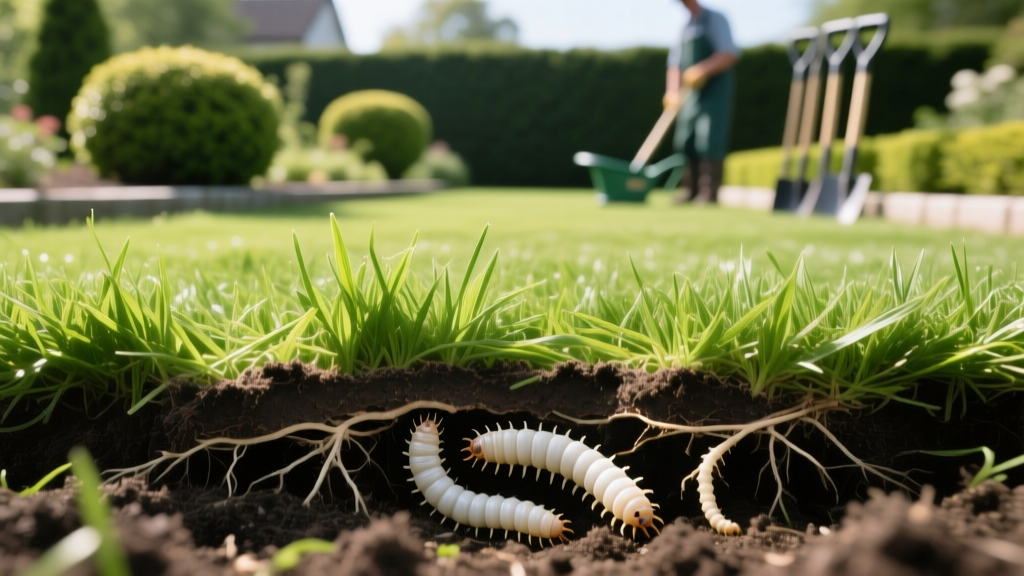
Understanding the Grub Life Cycle: When to Treat Your Lawn
The Four Stages of the White Grub Life Cycle
White grubs are the larval stage of scarab beetles, including Japanese beetles, European chafers, and June bugs. To effectively eradicate them, you must understand that their vulnerability to chemical and biological controls shifts drastically across their four distinct life stages: egg, larva, pupa, and adult. Misaligning your treatment with these biological windows is the primary reason homeowners experience repeated lawn destruction year after year.
1. The Egg Stage (Late June - Mid-July)
Adult females lay 1 to 5 eggs daily in the top 2 to 4 inches of soil. These eggs are pearly white, spherical, and roughly 1/16 inch in diameter. They require consistent soil moisture to survive; during severe summer droughts, egg mortality can exceed 80% naturally. The egg stage lasts 10 to 14 days. No chemical controls are effective or legally labeled for targeting eggs directly.
2. The Larval Stage (August - October / April - May)
This is the destructive phase. Larvae pass through three growth phases, known as instars. First-instar grubs are tiny (1/4 inch) and feed near the surface on fine root hairs. By the third instar (late September), they reach 1 to 1.5 inches in length, adopt the classic "C-shape," and consume massive amounts of primary root tissue, severing the turf from its water supply. As soil temperatures drop below 50°F in late autumn, third-instar grubs migrate 4 to 8 inches deep to overwinter, entering a state of diapause where they do not feed and are immune to soil insecticides.
3. The Pupal Stage (June)
In late spring, overwintered grubs move back to the surface, feed briefly on roots, and form an earthen cell to pupate. They are immobile and do not feed. Treatment during this stage is a complete waste of active ingredients.
4. The Adult Stage (Late June - August)
Adult beetles emerge to mate and feed on ornamental foliage (e.g., linden trees, roses). While they damage landscape plants, they do not harm turfgrass. Targeting adults with broad-spectrum sprays does not reduce the local grub population, as mated females can fly miles from neighboring properties to lay eggs in your irrigated lawn.
⚠️ Critical Failure Mode: Applying curative insecticides like Trichlorfon (Dylox) in June to kill "grubs" is ineffective. The grubs are in the pupal stage or are mature third-instars preparing to pupate, meaning their metabolism is slowed and they are not actively feeding on roots or pulling chemicals into their systems.
Species Identification and Peak Activity Matrix
Not all grubs behave identically. European chafers, for instance, are far more destructive to cool-season turf than Japanese beetles because their larvae feed later into the fall and earlier in the spring. Use this matrix to identify your primary threat based on regional emergence data compiled by University of Kentucky Entomology.
| Species | Adult Emergence | Egg Hatch Window | Peak Root Feeding | Destructive Potential |
|---|---|---|---|---|
| Japanese Beetle | Mid-June to July | Early to Mid-August | September | Moderate |
| European Chafer | Mid-June to Early July | Late July to August | Sept - Nov & April | Severe |
| June Bug (Phyllophaga) | May to June | June to July | August & May | Moderate to Severe |
| Oriental Beetle | June to July | July to August | Sept - October | Moderate |
The Chemical Arsenal: Matching Active Ingredients to Instars
Choosing the right product requires matching the chemical's half-life and mode of action to the grub's biological stage. According to EPA lawn care pesticide guidelines, proper timing minimizes environmental runoff while maximizing turf protection.
Preventative Controls (Targeting 1st and 2nd Instars)
- Chlorantraniliprole (e.g., Scotts GrubEx1, Acelepryn): The modern gold standard. It has a long soil residual (up to 4 months) and low toxicity to earthworms and pollinators. Apply between April and early June. It requires 2 to 3 weeks to fully translocate into the root zone, so early application is mandatory.
- Imidacloprid (e.g., Bayer Advanced Season Long Grub Control): A neonicotinoid that acts as a systemic nerve poison. Apply in June or early July. It degrades faster than Chlorantraniliprole and is highly toxic to bees if applied to flowering weeds (like clover) in the lawn. Mow the lawn before application to remove weed blooms.
Curative Controls (Targeting 3rd Instars and Active Damage)
- Trichlorfon (e.g., Bayer Advanced 24 Hour Grub Killer Plus, Dylox): A fast-acting organophosphate that kills via contact and stomach action within 24 hours. It has a very short soil half-life (3 to 7 days) and breaks down rapidly in alkaline soils (pH > 7.5). Use this ONLY in late August through October when you observe active turf browning and verify grubs are present.
- Carbaryl (e.g., Sevin): Often marketed for grubs, but university extension trials show it is significantly less effective than Trichlorfon against third-instar European chafers. It is generally not recommended for severe curative scenarios.
Month-by-Month Lawn Care Action Plan
Follow this chronological framework to align your lawn care calendar with the grub life cycle. This schedule assumes a transitional or cool-season turf zone (e.g., Tall Fescue, Kentucky Bluegrass).
- April - May (The Preventative Window): Apply Chlorantraniliprole (GrubEx1) at a rate of 3.5 lbs per 5,000 sq ft. Water the lawn immediately with 1/2 inch of irrigation to wash the granules off the grass blades and into the soil profile. Cost: ~$25 per 5,000 sq ft.
- June (The Secondary Preventative Window): If you missed the spring application, apply Imidacloprid before the end of June. Ensure soil temperatures at a 2-inch depth are consistently above 65°F.
- July (The Waiting Game): Adult beetles are active. Do not apply soil insecticides. Monitor ornamental plants for skeletonized leaves, which indicates high local beetle populations and a high probability of egg-laying in your turf.
- August (The Scouting Phase): Perform the "Tug Test." Grab handfuls of turf that appears drought-stressed and pull upward. If the grass rolls back like a loose carpet, severing at the soil line, grubs are feeding. Dig 2 inches down into the soil. A threshold of 5 to 10 grubs per square foot warrants immediate curative action.
- September - October (The Curative Strike): Apply Trichlorfon (Dylox) at the heavy infestation rate specified on the label. Water heavily (up to 1 inch) to drive the chemical deep into the soil where the large third-instar grubs are feeding. Repeat in 14 days if damage continues.
Real-World Troubleshooting: Misdiagnosed Grub Damage
Homeowners frequently misdiagnose grub damage, leading to unnecessary chemical applications. Before purchasing curatives, rule out these common edge cases:
Animal Digging
Skunks, raccoons, and crows will tear up lawns to eat grubs. However, they also dig for earthworms and sod webworms. If you find deep, conical holes (skunks) or large peeled-back sod flaps (raccoons) but the Tug Test reveals zero grubs, the animals are likely hunting earthworms after heavy rains. Use motion-activated sprinklers to deter them.
Fungal Pathogens
Brown patch (Rhizoctonia solania) and dollar spot create brown, irregular patches that mimic grub damage. The difference is in the roots. Fungal diseases rot the leaf blade or crown, but the root system remains anchored in the soil. If the turf does not roll back like a carpet, you are dealing with a fungus, not insects.
Cost Breakdown: DIY vs. Professional Application
Deciding between DIY and professional pest control depends on your lawn's square footage and your equipment capabilities. Here is a realistic cost analysis for a standard 10,000 sq ft lawn.
| Method | Product / Service | Estimated Cost | Cost per Sq Ft | Pros & Cons |
|---|---|---|---|---|
| DIY Preventative | Scotts GrubEx1 (2 bags) | $50.00 | $0.005 | Highly cost-effective; requires owning a broadcast spreader and strict watering discipline. |
| DIY Curative | Bayer 24-Hour Grub Killer (3 bags) | $65.00 | $0.0065 | Fast results; Trichlorfon degrades quickly, requiring precise timing and heavy irrigation. |
| Professional | Licensed Lawn Care Service | $450 - $750 | $0.045 - $0.075 | Commercial-grade products (Acelepryn); includes guarantee and re-treatment if damage occurs. |
For lawns under 5,000 square feet, DIY application of Chlorantraniliprole in May offers the highest return on investment. For properties exceeding 15,000 square feet with a history of European chafer infestations, professional application of commercial Acelepryn via liquid boom sprayers ensures uniform soil penetration that granular spreaders often miss.

