
Pest Control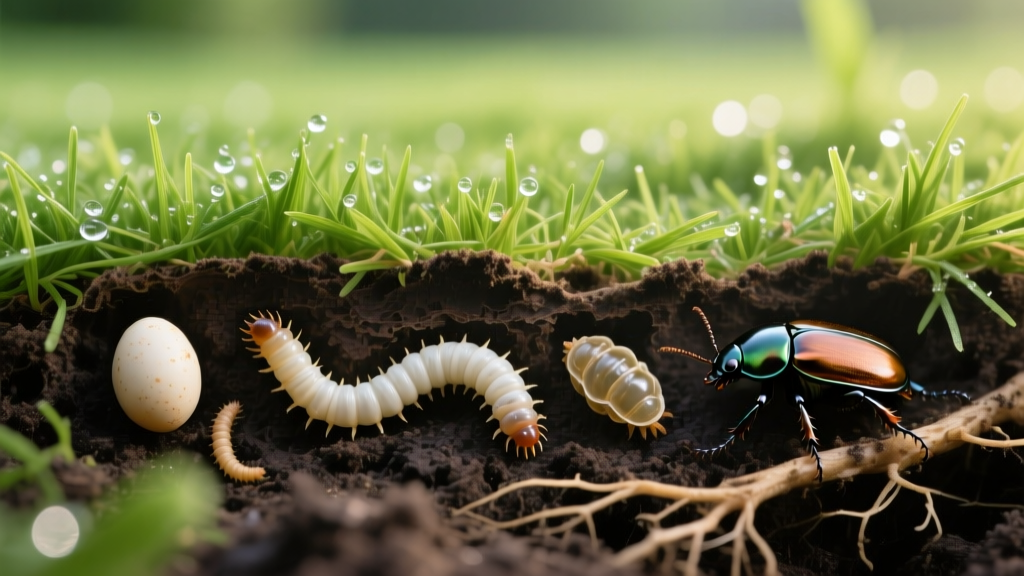
The Grub Worm Life Cycle: How to Identify and Treat Lawn Grubs
Understanding the Grub Worm Life Cycle
Grub worms are the subterranean larval stage of scarab beetles, including Japanese beetles, European chafers, and June bugs. Because they feed exclusively on turfgrass roots beneath the soil surface, damage is often mistaken for drought stress or fungal diseases until the turf is entirely detached. To effectively manage these pests, homeowners must align their chemical or biological interventions with the specific stages of the grub worm life cycle. Applying a preventative insecticide when grubs are in the pupal stage, or using a slow-acting biological agent during a late-summer curative window, will result in total treatment failure and severe lawn loss.
According to Penn State Extension, the most destructive lawn grubs in North America belong to three primary species: the Japanese beetle (Popillia japonica), the European chafer (Rhizotrogus majalis), and the Oriental beetle (Exomala orientalis). While their adult behaviors differ, their subterranean life cycles and vertical soil migration patterns are nearly identical.
The 4 Stages of Subterranean Development
The scarab beetle life cycle spans exactly one year for most turf-destroying species. Understanding the vertical migration of the larvae is the most critical factor in determining when to apply soil-drench insecticides.
| Life Stage | Duration | Soil Depth | Feeding Activity & Lawn Impact |
|---|---|---|---|
| Egg | 2 to 3 weeks (July - August) | 1 to 3 inches | No feeding. Eggs require high soil moisture to hatch; drought conditions naturally suppress populations. |
| Larva (Grub) | 9 to 10 months (August - May) | 1 to 8 inches (migrates) | Peak root consumption occurs in early fall (Sept/Oct) and late spring (April/May). Causes primary turf death. |
| Pupa | 2 to 4 weeks (May - June) | 4 to 6 inches | Metamorphosis stage. Grubs do not feed. Insecticides applied now are entirely ineffective. |
| Adult Beetle | 3 to 5 weeks (June - July) | Emerges to surface | Feeds on ornamental foliage and mates. Females lay 40-60 eggs in irrigated, healthy turfgrass. |
Winter Survival Mechanism: As soil temperatures drop below 50°F in late November, third-instar grubs migrate 4 to 8 inches deep into the soil profile to escape the frost line. They remain dormant until soil temperatures rise above 50°F in April, at which point they move back to the top 2 inches to feed on recovering grass roots before pupating.
Diagnostic Identification: Grubs vs. Drought vs. Fungus
Before purchasing treatment products, you must confirm a grub infestation. Brown patches caused by Rhizoctonia (brown patch fungus) or localized dry spots mimic grub damage visually. The definitive diagnostic tool is the 'Tug Test' combined with a soil core sample.
Step-by-Step Lawn Scouting Protocol
- The Tug Test: Grab a handful of brown, dying grass at the edge of a damaged patch and pull upward. If the turf rolls back easily like a loose carpet with no root resistance, grubs have severed the root system.
- Core Sampling: Use a flat-headed shovel to cut a 12-inch by 12-inch square of turf, 3 inches deep, and peel it back.
- Count and Identify: Count the C-shaped, milky-white grubs with brown head capsules. Species identification dictates your damage threshold.
Species-Specific Damage Thresholds
Not all grubs cause equal damage. The University of Kentucky Entomology Department outlines specific treatment thresholds based on grub size and species aggressiveness:
- Japanese Beetle Grubs: Treat if you find 5 to 7 grubs per square foot.
- European Chafer Grubs: Treat if you find 8 to 10 grubs per square foot (they are highly aggressive feeders).
- Oriental Beetle Grubs: Treat if you find 10 to 15 grubs per square foot.
- May/June Beetle Grubs: Treat if you find 3 to 5 grubs per square foot (these are larger, multi-year lifecycle grubs that consume massive root volumes).
Seasonal Treatment Framework: Preventative vs. Curative
Timing is the single most important variable in grub control. The Purdue University Turfgrass Entomology guidelines divide chemical interventions into two distinct categories based on the grub worm life cycle.
1. Preventative Treatments (Spring / Early Summer)
Preventatives target first-instar grubs as they hatch from eggs in July and August. These chemicals must be applied before the eggs hatch and require 60 to 90 days to bind to soil organic matter and move into the root zone.
- Active Ingredient: Chlorantraniliprole (0.08%).
- Top Product: Scotts GrubEx1.
- Application Window: April 15 to June 1.
- Cost: ~$5.60 per 1,000 sq. ft.
- Crucial Rule: Must be watered in with 0.5 inches of irrigation immediately after application to move the granule into the soil profile.
2. Curative Treatments (Late Summer / Early Fall)
If you missed the preventative window or discover an active infestation in August, you must use a fast-acting contact insecticide. Curative products kill second- and third-instar grubs that are actively feeding near the surface.
- Active Ingredient: Trichlorfon (6.2%) or Carbaryl.
- Top Product: BioAdvanced 24 Hour Grub Killer Plus.
- Application Window: August 1 to September 15.
- Cost: ~$4.40 per 1,000 sq. ft.
- Limitation: Trichlorfon degrades rapidly in soil with high pH (above 7.2) and has a short residual life of 7 to 14 days. It will not protect against next year's hatch.
Organic & Biological Alternatives: For homeowners avoiding synthetic neonicotinoids, Heterorhabditis bacteriophora (beneficial nematodes) are highly effective when applied in late August. The nematodes seek out grubs, penetrate their bodies, and release bacteria that kill the host within 48 hours. Apply at a rate of 1 billion nematodes per acre, strictly in the evening or on overcast days, as UV light destroys them. Expect to pay ~$35 to $45 for a 2,000 sq. ft. coverage pack.
Common Application Failures and Edge Cases
Even with the correct product, homeowners frequently experience treatment failure due to physical barriers and soil chemistry.
| Failure Mode | The Science Behind the Failure | Corrective Action |
|---|---|---|
| Thatch Barrier | A thatch layer thicker than 0.5 inches binds the active ingredient, preventing it from reaching the soil where grubs feed. | Core aerate or use a dethatching rake before applying any granular grub control. |
| High Soil pH | Trichlorfon (curative) undergoes rapid alkaline hydrolysis in soils with a pH above 7.2, losing efficacy in hours. | Test soil pH. If alkaline, use a Chlorantraniliprole preventative next spring instead of a fall curative. |
| Skipping Irrigation | Granules left on dry turf degrade under UV light and never reach the root zone. | Run sprinklers for 20-30 minutes (delivering 0.5 inches of water) within 24 hours of application. |
| Wildlife Foraging | Skunks, raccoons, and crows dig up treated lawns to eat the grubs, destroying the turf in the process. | Apply a liquid castor oil repellent to the lawn perimeter to deter foraging mammals while the insecticide takes effect. |
Long-Term Biological Control: Milky Spore
Paenibacillus popilliae (Milky Spore) is a naturally occurring bacterium that specifically targets Japanese beetle grubs. When a grub ingests the spores, the bacteria multiply, turning the grub's hemolymph (blood) milky white, eventually killing it and releasing billions of new spores into the soil. While the upfront cost is high (approximately $45 per 1,000 sq. ft. for powder, or $15 for granular inoculants), a single application establishes in the soil and provides 10 to 15 years of localized suppression. Note that Milky Spore is entirely ineffective against European chafers and Oriental beetles.
Frequently Asked Questions
Do grub worms turn into June bugs?
Yes. 'June bug' is a colloquial term for several species of scarab beetles (primarily Cotinis nitida and Phyllophaga species). The C-shaped white grubs found in your lawn are the juvenile larval stage of these adult beetles.
Will watering my lawn in summer prevent grubs?
No. In fact, adult female beetles actively seek out irrigated, lush lawns to lay eggs because the moist soil ensures high egg survival rates. Drought-stressed lawns actually experience lower initial egg hatch rates, though the surviving grubs will cause severe damage to the already weakened grass.
Can I apply GrubEx and grass seed at the same time?
Yes. Chlorantraniliprole (the active ingredient in Scotts GrubEx1) is highly targeted toward the insect nervous system and has no pre-emergent herbicide properties. It will not inhibit the germination of Kentucky bluegrass, fescue, or ryegrass seed.

