
Pest Control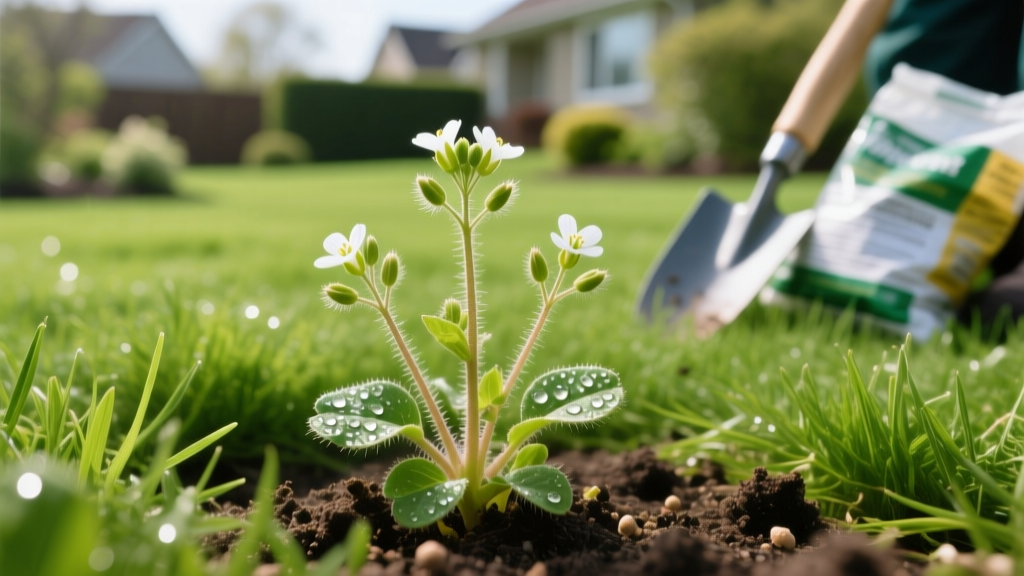
Hairy Bittercress Herbicide Guide: Timing With Spring Fertilizer
The Spring Conflict: Weed Control vs. Soil Nutrition
Hairy bittercress (Cardamine hirsuta) is a notorious winter annual weed that catches homeowners off guard every early spring. Germinating in the autumn, it overwinters as a small, palmate rosette before rapidly bolting and producing explosive seed pods as soil temperatures rise above 50°F. For lawn care professionals and dedicated homeowners, this aggressive lifecycle creates a distinct scheduling conflict: the exact window required to apply a post-emergent hairy bittercress herbicide overlaps perfectly with the optimal timing for your first spring nitrogen fertilizer application.
Mismanagement of this overlap leads to two common failures. First, applying high-nitrogen, fast-release fertilizers too early fuels the bittercress rosette, accelerating its bolt and seed production before the herbicide can translocate. Second, applying pre-emergent herbicides too late in the spring misses the primary germination window, wasting money and leaving the soil vulnerable. This guide details the precise intersection of soil nutrition and chemical control to eradicate bittercress while building a resilient, deeply rooted turf canopy.
The Soil Nutrition Link: Why Bittercress Invades
While hairy bittercress is often dismissed as a mere nuisance in landscape beds and thin turf margins, its presence is a direct bioindicator of specific soil conditions. According to turf pathology data from NC State TurfFiles, this weed thrives in moist, highly compacted soils with fluctuating nutrient profiles and poor drainage.
Soil Diagnostic Insight: Bittercress does not strictly indicate low nitrogen. Instead, it exploits areas where soil structure has collapsed, leading to surface moisture retention. If your soil test reveals a pH below 5.5 and high magnesium-to-calcium ratios, the resulting compaction creates the exact anaerobic microclimate bittercress prefers over your turfgrass.
To outcompete this weed long-term, your fertilization strategy must prioritize soil structure over sheer nitrogen volume. Targeting a soil pH between 6.2 and 6.8 optimizes nutrient uptake for cool-season and warm-season grasses while making the environment less hospitable for winter annual broadleaves.
Selecting the Right Hairy Bittercress Herbicide
Because bittercress germinates in the fall and early spring, standard crabgrass pre-emergents applied in mid-April are entirely ineffective against the current year's population. You must deploy a targeted chemical strategy based on the weed's current growth stage.
Post-Emergent Options (Spring Eradication)
When the weed has already bolted and produced white flowers, you need a systemic broadleaf herbicide. The industry standard for rapid knockdown without stunting spring turf growth is a multi-active-ingredient formulation containing carfentrazone, 2,4-D, MCPP, and dicamba (commonly sold under trade names like SpeedZone or Trimec Southern).
- Application Rate: 1.5 to 2.0 fl oz per gallon of water per 1,000 sq ft.
- Cost: Approximately $45 to $55 per pint in 2026, treating up to 20,000 sq ft.
- Surfactant Requirement: Always add a non-ionic surfactant (NIS) at 0.25% v/v to break the waxy cuticle of the mature leaves.
Pre-Emergent Options (Fall Prevention)
To stop the next generation, you must apply a pre-emergent in late August to early September. Isoxaben (Gallery 75 DF) is the premier active ingredient for broadleaf winter annuals, outperforming prodiamine for bittercress control.
- Application Rate: 0.5 lbs per 1,000 sq ft.
- Cost: Roughly $120 for a 5 lb bag, covering 10,000 sq ft.
The Spring Application Calendar: Herbicide vs. Fertilizer
Timing is everything. Applying herbicide and fertilizer on the same day can cause chemical antagonism or turf burn. Follow this sequenced framework to manage both soil nutrition and weed control.
| Timeline | Action | Product / Input | Watering Requirement |
|---|---|---|---|
| Late Feb / Early March | Post-Emergent Herbicide | Carfentrazone + 2,4-D mix | None (keep foliage dry for 24h) |
| Mid-March | Soil Test & Amendment | Pelletized Lime (if pH < 6.0) | 0.5 inch to incorporate |
| Late March / Early April | First Spring Fertilization | 16-4-8 Slow-Release (SCU/PCU) | 0.25 inch to activate |
| Late August | Pre-Emergent Herbicide | Isoxaben (Gallery 75 DF) | 0.5 inch immediately after |
Warning: Avoid 'Weed and Feed' Combos
Granular 'Weed and Feed' products rely on the herbicide sticking to the weed's foliage. Because hairy bittercress grows low to the ground in dense rosettes, granular broadleaf herbicides (like 2,4-D esters) often bounce off the leaves and fail to translocate. Furthermore, the high salt index of the accompanying synthetic nitrogen can burn emerging spring turf if soil moisture is inadequate. Always separate liquid post-emergent spraying from granular fertilization by at least 7 to 10 days.
Granular 'Weed and Feed' products rely on the herbicide sticking to the weed's foliage. Because hairy bittercress grows low to the ground in dense rosettes, granular broadleaf herbicides (like 2,4-D esters) often bounce off the leaves and fail to translocate. Furthermore, the high salt index of the accompanying synthetic nitrogen can burn emerging spring turf if soil moisture is inadequate. Always separate liquid post-emergent spraying from granular fertilization by at least 7 to 10 days.
Post-Herbicide Soil Recovery & Fertilization
Once the bittercress has been chemically eradicated, the soil is left with bare patches and a disrupted microbial network. Your spring fertilizer must be selected carefully to fill these voids before new weed seeds blow in.
Avoid fast-release urea or ammonium sulfate for this specific application. These nitrogen sources cause rapid, succulent top growth that is highly susceptible to late-spring fungal pathogens like brown patch. Instead, utilize a methylene urea or sulfur-coated urea (SCU) fertilizer with an N-P-K ratio of 16-4-8 or 20-5-10. Apply at a rate of 0.75 to 1.0 lbs of actual nitrogen per 1,000 sq ft. This slow-release mechanism feeds the recovering turf steadily over 8 to 10 weeks, promoting deep root growth that naturally chokes out late-germinating summer annuals.
For landscape beds where bittercress was pulled or sprayed, apply a 2-inch layer of double-shredded hardwood mulch over the exposed soil. Research highlighted by University of Maryland Extension confirms that physical light blockage combined with a pre-emergent barrier reduces bittercress germination in ornamental beds by up to 85%.
Expert Troubleshooting: The Explosive Seed Pod Problem
The most common failure mode when treating mature hairy bittercress in April is the mechanical triggering of its seed pods. Bittercress produces silicles that build immense hydrostatic pressure. When mature, even the physical impact of a high-pressure sprayer nozzle can cause the pods to dehisce (explode), launching seeds up to three feet away before the herbicide has time to kill the parent plant.
The Low-Pressure Solution
To prevent spreading the infestation while spraying, you must alter your application mechanics:
- Switch Nozzles: Remove your standard flat-fan nozzle and install an air-induction nozzle (such as a TeeJet AI11004). This produces large, coarse droplets that hit the plant with less kinetic force.
- Drop the PSI: Reduce your backpack sprayer pressure to 20-25 PSI. High pressure (40+ PSI) creates fine mists that shatter the seed pods.
- Add Methylated Seed Oil (MSO): Instead of a standard NIS, use an MSO surfactant. MSO penetrates the cuticle faster, causing rapid cellular collapse (burn-down) within hours, which neutralizes the plant's ability to maintain the turgor pressure required for seed explosion.
Frequently Asked Questions
Can I use vinegar to kill hairy bittercress instead of synthetic herbicides?
Horticultural vinegar (20% acetic acid) will burn off the top growth of bittercress, but it is strictly a contact burn-down. It will not kill the taproot, and the plant will often resprout within two weeks. Furthermore, spraying high-concentration vinegar repeatedly lowers soil pH and harms beneficial soil microbes, directly conflicting with your spring soil nutrition goals.
Does aerating the lawn help prevent bittercress?
Yes, but timing is critical. Core aeration in the spring opens the soil profile and can actually expose dormant bittercress seeds to light and oxygen, triggering a flush of germination. Aeration should be performed in the fall for cool-season grasses, paired immediately with your fall isoxaben pre-emergent application and fall compost top-dressing to build soil structure without inviting weeds.
Why is bittercress growing in my mulch beds even though I used Preen?
Standard Preen (trifluralin) is highly volatile and breaks down quickly when exposed to UV light and high soil moisture. If your mulch layer is less than 2 inches thick, or if the trifluralin was not watered in immediately after application, the chemical barrier will fail. Switching to a liquid isoxaben spray in the fall provides a much more stable, long-lasting barrier in ornamental beds.

