
Pest Control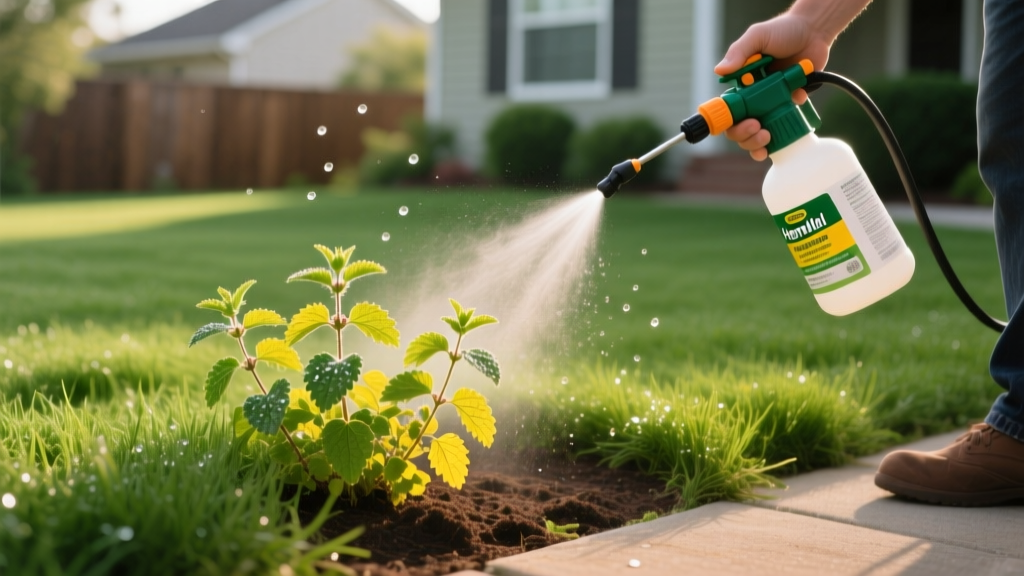
How to Choose the Right Henbit Weed Killer for Spot Treatment
The Lifecycle of Lamium amplexicaule: Why Timing is Everything
Henbit (Lamium amplexicaule) is a winter annual broadleaf weed belonging to the mint family. Unlike summer annuals that germinate in spring and die in autumn, henbit follows an inverted lifecycle. Seeds germinate in early fall (September through November), the plant establishes a shallow taproot and overwinters as a small rosette, and it aggressively bolts and flowers in early spring (March through May). By the time summer heat arrives, the plant naturally dies, but not before dropping thousands of seeds into your soil profile.
Understanding this lifecycle is the foundation of effective spot treatment. Many homeowners make the critical mistake of reaching for a henbit weed killer in late April or May when the plant is in full purple bloom. At this stage, the plant is already senescing (dying back) and has likely dropped its seed. Applying post-emergent herbicides to mature, flowering henbit yields poor translocation, wastes chemical, and fails to prevent the next generation. According to the Penn State Extension, the most vulnerable stages for chemical intervention are the young rosette stage in late fall and the early vegetative growth stage in late winter.
Identification Checklist
- Stem: Distinctly square (characteristic of the mint family), often sprawling or upright, reaching 4 to 16 inches.
- Leaves: Opposite, circular to heart-shaped with deeply scalloped (crenate) margins. Upper leaves clasp the stem directly (amplexicaul).
- Flowers: Tubular, pinkish-purple, appearing in whorls around the upper stem nodes in early spring.
- Odor: Crush a leaf to release a faint, distinct minty aroma.
Selecting Your Henbit Weed Killer: Active Ingredients Compared
Not all broadleaf herbicides perform equally on henbit. Because it is a winter annual with a waxy leaf cuticle that thickens as temperatures drop, you need a formulation that penetrates quickly and translocates down to the taproot. The NC State Turfgrass Program recommends three-way or four-way herbicide blends for optimal control in cool-season and warm-season transition lawns.
| Product / Brand | Active Ingredients | Safe For Grasses | Speed of Burn | Est. Cost per 1k sq ft |
|---|---|---|---|---|
| SpeedZone | 2,4-D, MCPP, Dicamba, Carfentrazone | Cool-season, Bermudagrass, Zoysia | Fast (24-48 hrs) | $0.12 - $0.18 |
| Trimec Classic | 2,4-D, MCPP, Dicamba | Cool-season (Fescue, Bluegrass) | Moderate (5-7 days) | $0.08 - $0.11 |
| Tenacity | Mesotrione | Cool-season, Centipede, St. Augustine | Slow (7-14 days, bleaches white) | $0.25 - $0.35 |
| Celsius WG | Thiencarbazone, Iodosulfuron, Dicamba | Warm-season (Bermuda, Zoysia, St. Aug) | Moderate (5-10 days) | $0.30 - $0.45 |
Why Carfentrazone Matters in Cold Weather
When spot-treating henbit in late fall or late winter, ambient temperatures are often between 45°F and 60°F. Standard 2,4-D and Dicamba blends (like Trimec) rely on active plant growth to translocate the chemical to the roots. In cold weather, henbit's metabolic rate slows, making standard herbicides sluggish. SpeedZone includes Carfentrazone-ethyl, a PPO-inhibitor that causes rapid cell membrane disruption. This provides a fast visual burn even in cooler temperatures, while the 2,4-D and Dicamba work systemically over the following week to kill the taproot.
Step-by-Step Spot Treatment Protocol
For isolated patches of henbit, a 1-gallon or 2-gallon pump sprayer is vastly superior to a hose-end sprayer. It allows for precise targeting, reducing chemical waste and preventing damage to desirable landscape plants.
1. Calibration and Mixing
To achieve the correct application rate of 1.5 gallons per 1,000 square feet, you must calibrate your sprayer. Fill the tank with half the required water, add the herbicide, and agitate. For SpeedZone, the standard spot-treatment rate is 1.4 fluid ounces per gallon of water to treat 1,000 square feet.
2. Add a Non-Ionic Surfactant (NIS)
Henbit leaves develop a thick, waxy cuticle to retain moisture during winter. If your chosen herbicide does not contain a built-in surfactant (check the label), you must add a Non-Ionic Surfactant. Use 1 teaspoon (approx. 0.33 fl oz) of NIS per gallon of mixed solution. This breaks the surface tension, allowing the droplet to spread and penetrate the leaf tissue rather than beading up and rolling off.
3. Application Technique
- Nozzle Selection: Use a flat-fan nozzle (e.g., TeeJet 8004 or 11004) to produce medium-to-coarse droplets. Fine mist nozzles increase the risk of drift.
- Pressure: Keep pump pressure between 20 and 30 PSI. Higher pressures create fine droplets that can drift onto ornamental shrubs.
- Coverage: Spray until the henbit leaves are uniformly wet, but not to the point of runoff. Dripping leaves mean you are wasting chemical and increasing soil contamination.
Warning: Temperature and Volatility Limits
Never apply 2,4-D or Dicamba-based henbit weed killers when daytime temperatures are forecast to exceed 85°F within 48 hours of application. At high temperatures, these chemicals can vaporize (volatilize) and drift as a gas, causing severe twisting and cupping damage to nearby tomatoes, grapes, and ornamental trees. If treating in late spring, spray in the early morning when temperatures are below 80°F.
Pre-Emergent Defense: Breaking the Seed Cycle
Post-emergent spot treatment only solves the immediate visual problem. Because a single henbit plant can produce over 2,000 seeds, your lawn's seed bank will remain heavily infested unless you deploy a pre-emergent herbicide. Henbit seeds germinate when soil temperatures drop to approximately 60°F to 70°F in the fall.
Apply a pre-emergent like Prodiamine 65 WDG (Barricade) or Dithiopyr (Dimension) in early September. For Prodiamine, a standard preventative rate is 0.184 oz per 1,000 square feet. Water the granular product in with 0.5 inches of irrigation within 48 hours to activate the chemical barrier in the top inch of the soil profile, preventing henbit seeds from establishing roots.
Frequently Asked Questions
Can I use Glyphosate (Roundup) to kill henbit?
Glyphosate is a non-selective herbicide that will kill any green plant tissue it contacts. You should only use Glyphosate on henbit if your warm-season lawn (like Bermudagrass or Zoysia) is completely dormant and brown in the middle of winter. Spraying Glyphosate on a cool-season lawn (Fescue, Kentucky Bluegrass) or a partially green warm-season lawn will result in dead patches.
Should I pull henbit by hand instead of spraying?
Hand-pulling is viable for very small, isolated patches. Because henbit has a shallow, fibrous root system rather than a deep taproot, it pulls relatively easily when the soil is moist. However, if the plant is already flowering, you must carefully bag the pulled plants immediately. Dropping flowering henbit on the lawn will deposit viable seeds right back into the soil.
How long should I wait to mow after applying a henbit weed killer?
To maximize herbicide absorption, do not mow for 48 hours before application (to ensure maximum leaf surface area) and wait at least 48 hours after application before mowing. This gives the systemic active ingredients sufficient time to translocate from the leaves down to the root system.

