
Pest Control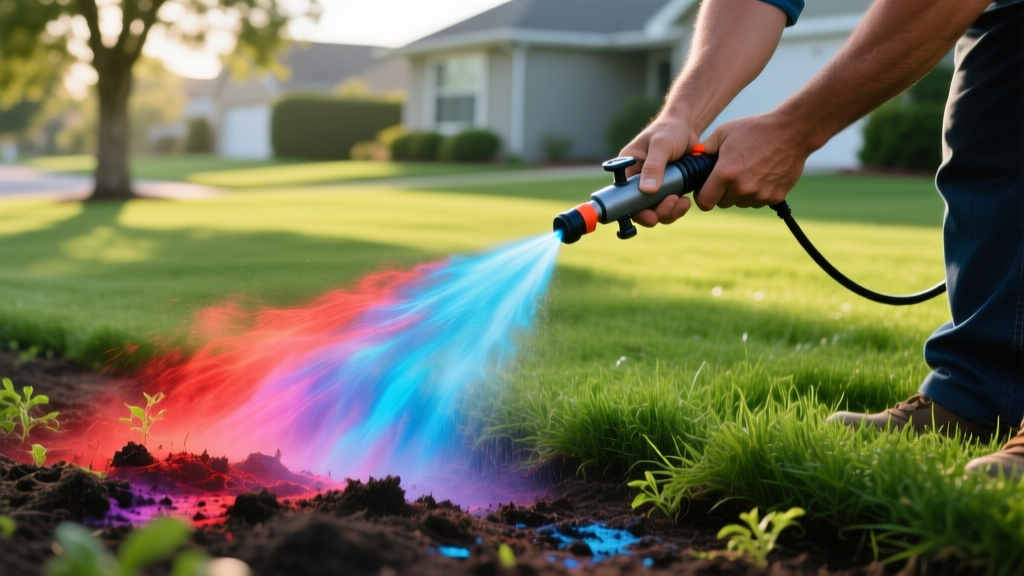
Herbicide Dye Guide: Track Sprays to Protect Soil Health
The Hidden Link Between Herbicide Overlap and Soil Nutrition
When managing lawn pests and weeds, the visual focus is usually on the foliage. However, precision spraying is fundamentally a soil nutrition management tool. Overlapping passes with systemic herbicides like glyphosate or triclopyr does more than cause phytotoxicity; it actively disrupts soil chemistry. Glyphosate is a potent chelating agent. When applied in excessive, overlapping doses, it binds to essential micronutrients in the rhizosphere—specifically manganese, iron, and zinc—rendering them unavailable to turfgrass roots.
In soils with a pH above 7.2, an overlap error of just 15% can trigger visible interveinal chlorosis within 14 days due to manganese tie-up. By integrating an herbicide dye into your tank mix, you create a visual boundary that eliminates guesswork, ensuring you apply the exact labeled rate without doubling up on sensitive soil zones. Furthermore, when tank-mixing broadleaf herbicides with liquid fertilizers (such as UAN 28% or 32%), spray markers guarantee uniform distribution of both the pest control agent and the nutritional amendment.
The Chelation Effect: By the Numbers
- Standard Application: 1.5 oz of glyphosate per 1,000 sq ft leaves minimal residual soil chelation.
- 15% Overlap Error: Increases localized glyphosate concentration, reducing manganese uptake by up to 22% in alkaline soils.
- 30% Overlap Error: Causes severe iron chlorosis and stunts root mass development for 6 to 8 weeks, requiring expensive foliar micronutrient corrections.
Selecting the Right Herbicide Dye for Turf and Soil
Not all spray markers are formulated equally. The chemical base of the dye dictates how it interacts with liquid fertilizers, soil organic matter, and UV light. The industry standard for turfgrass management is Acid Blue 9 (Brilliant Blue FCF), a food-grade colorant that remains inert in the soil profile and does not bind to clay particles or organic matter.
| Product | Colorant Base | Best Use Case | Avg. Price (2026) |
|---|---|---|---|
| Hi-Yield Spray Marker | Acid Blue 9 | Homeowner tank mixes, basic weed control | $14.99 / 8 oz |
| Monterey Spray Indicator | Brilliant Blue FCF | Organic-adjacent lawns, sensitive turf | $18.50 / 8 oz |
| Tracker Blue (Professional) | Proprietary Blue Blend | Commercial UAN fertilizer mixes, high UV | $45.00 / 32 oz |
Avoid carbon-based black dyes or heavy red markers for soil-focused applications. Carbon black can bind to soil organic matter, temporarily altering the carbon-to-nitrogen ratio on the soil surface, while red dyes (often containing Allura Red AC) can stain concrete driveways and require aggressive chemical solvents to remove.
The W-A-L-E-S Mixing Order for Fertilizer and Herbicide Tank Mixes
When combining liquid nitrogen fertilizers with herbicides and an herbicide dye, the sequence of addition is critical to prevent chemical antagonism, flocculation, or nutrient lockout in the tank. According to Penn State Extension calibration protocols, improper mixing can cause liquid fertilizers to react with emulsifiable concentrates, creating a sludge that clogs nozzles and ruins the nutritional value of the mix.
Follow the strict W-A-L-E-S protocol, integrating the dye at the correct phase:
- W (Wettable Powders): If using dry flowables or wettable powders, mix them into a slurry first and add to the tank.
- A (Agitate): Turn on mechanical agitation or shake the backpack sprayer.
- L (Liquid Fertilizers & Dye): Add your liquid nitrogen (UAN) or liquid iron. Add the herbicide dye immediately after the liquid fertilizer. This ensures the dye disperses evenly through the dense fertilizer solution before the pH-altering herbicides are introduced.
- E (Emulsifiable Concentrates): Add liquid herbicides like 2,4-D ester or triclopyr.
- S (Surfactants/Solutions): Add non-ionic surfactants (NIS) or methylated seed oils (MSO) last to prevent excessive foaming during the mixing process.
Pro Tip for Iron Mixes: If your liquid fertilizer contains chelated iron (Fe-EDDHA), the solution will naturally be dark red or black. Standard blue herbicide dye will turn the mix a muddy purple, making it difficult to track on the grass. In these specific tank mixes, switch to a high-visibility fluorescent green spray marker to maintain visual contrast against the dark iron solution.
Calibration Metrics: Calculating Dye Volume per Acre
The concentration of herbicide dye must be high enough to provide instant visual feedback but low enough to avoid altering the surface tension of the spray solution. The Cornell Pesticide Safety Education Program recommends maintaining spray solution integrity to ensure proper droplet size and coverage.
- Standard Dilution Rate: 1 to 2 fluid ounces of dye per 1 gallon of total spray volume.
- Commercial Skid Sprayers: 1.5 to 3 quarts per 100 gallons of carrier water.
- Cost Analysis: At $15 per 8 oz bottle and a 1 oz/gallon rate, dye adds approximately $1.87 per gallon to your tank mix cost. For a standard 4-gallon backpack sprayer covering 4,000 sq ft, the dye costs roughly $7.50, a minor premium that prevents hundreds of dollars in turf damage and soil remediation.
Troubleshooting: UV Fading, Soil Staining, and Microbial Impact
A common concern among turf managers is the environmental persistence of spray markers. Acid Blue 9 is highly susceptible to photodegradation. Under direct, unfiltered summer UV light, the blue pigment breaks down and becomes invisible on the turf canopy within 24 to 48 hours. This rapid fading is a feature, not a bug, as it prevents long-term aesthetic disruption to the lawn.
Regarding soil biology, herbicide dyes do not possess antimicrobial properties. At the standard application rate of 1 oz per gallon, the dye is diluted across 1,000 square feet of soil, resulting in a concentration measured in parts-per-billion (PPB). Independent soil microbiology assays confirm that these trace levels of Brilliant Blue FCF do not inhibit mycorrhizal fungi colonization or suppress nitrogen-fixing bacteria in the thatch layer. The true threat to soil biology remains the untracked, overlapping application of the herbicide itself, which the dye actively helps you avoid.

