
Pest Control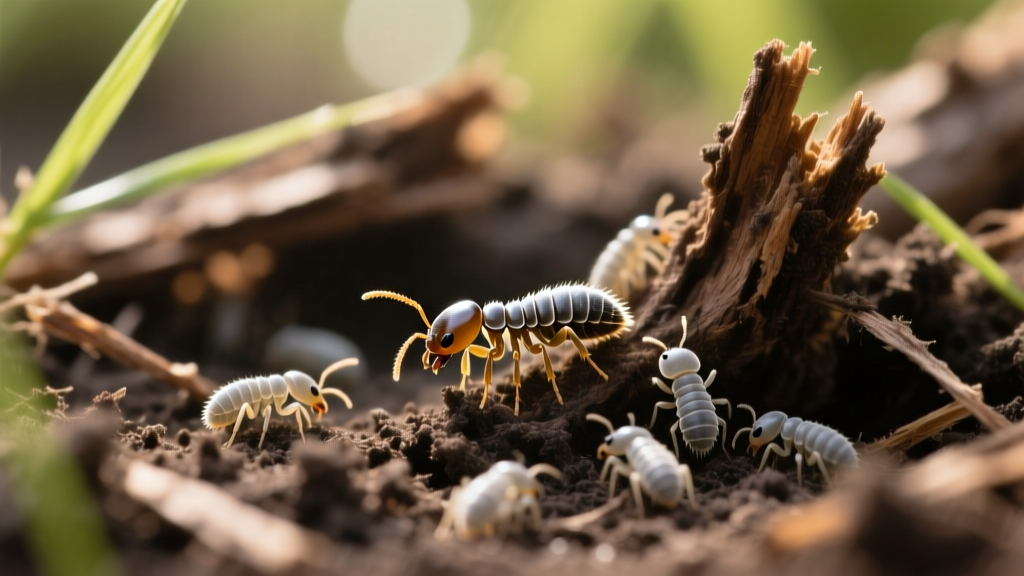
How Small Are Termites? Exact Sizes & Yard Defense Tactics
How Small Are Termites? The Micro-Scale Threat in Your Yard
When homeowners ask, "how small are termites," the answer depends entirely on the species and the caste of the insect. However, the most destructive yard invaders—subterranean termite workers—are astonishingly tiny, typically measuring between 1/8 and 1/4 of an inch (3 to 6 millimeters) in length. To put that in perspective, a single worker termite is roughly the size of a grain of uncooked white rice, but significantly thinner and softer.
Their microscopic footprint is precisely what makes them so dangerous to residential structures and landscaping. Because they are so small, termites can exploit micro-fissures in concrete foundations, hide entirely within the hollow cores of wooden fence posts, and travel through pencil-width mud tubes without ever being exposed to daylight or predators. Understanding their exact dimensions is the first step in designing an effective yard defense perimeter.
Termite Size Spectrum: Species and Caste Breakdown
Termites are not a monolith; their physical dimensions shift dramatically based on their role in the colony and their genetic lineage. Below is a precise measurement matrix of the most common yard-invading termites in North America.
| Species & Caste | Average Length | Metric (mm) | Visual Size Comparison |
|---|---|---|---|
| Eastern Subterranean Worker | 1/8" - 3/16" | 3 - 5 mm | Grain of short-grain rice |
| Eastern Subterranean Soldier | 1/4" - 1/2" | 6 - 12 mm | Small sunflower seed |
| Formosan Subterranean Swarmer | 1/2" - 5/8" | 12 - 16 mm | Housefly with long wings |
| Drywood Termite Worker | 1/8" - 1/4" | 3 - 6 mm | Matchstick head |
| Dampwood Termite Soldier | 1/2" - 3/4" | 12 - 20 mm | Large pill bug |
According to the National Pest Management Association (NPMA), while the reproductive swarmers (alates) are the largest and most visible—often measuring up to an inch including their wings—they only appear above ground for a few hours a year during mating flights. The true yard damage is inflicted by the blind, pale, 3-millimeter workers that remain hidden in the soil and wood 24/7.
The Micro-Gap Vulnerability: Why Size Dictates Defense
The core challenge of yard defense is that subterranean termites can infiltrate a structure through a gap as narrow as 1/32 of an inch (0.8 mm). This is thinner than a standard credit card. When planning your landscaping and perimeter defenses, you must assume that any hairline crack in your foundation, mortar joint, or plumbing penetration is a wide-open highway for a 3mm insect.
⚠️ Landscaping Warning: Never pile organic mulch higher than 2 to 3 inches, and always maintain a strict 6-inch vertical gap between the top of the mulch and your home's wooden siding or brick weep holes. Mulch retains the exact moisture levels 4mm termite workers require to survive above the soil line, effectively creating a hidden bridge over your chemical soil treatments.
Strategic Yard Defense: Protecting the Perimeter
Defending a yard against insects you can barely see requires a combination of biological disruption and physical exclusion. Here are the industry-standard protocols for securing your property's exterior.
1. Advanced Bait Station Placement (Sentricon & Trelona)
Modern bait systems do not rely on spotting the termites; they rely on the termites' natural foraging behavior. Systems like Sentricon Always Active (using noviflumuron) or Trelona ATBS are installed directly into the soil.
- Spacing: Stations must be placed no more than 10 feet apart around the entire perimeter of the structure.
- Offset: Install stations 2 to 3 feet away from the foundation to intercept foragers before they reach the concrete slab.
- Cost Expectation: Professional installation typically ranges from $1,200 to $1,800 for an average 2,000 sq. ft. home footprint, which includes annual monitoring and bait matrix replacements.
2. Liquid Soil Trenching & Treatment
For immediate, continuous chemical barriers, non-repellent termiticides like Termidor SC (9.1% fipronil) remain the gold standard. Because termites are so small and travel through soil pores, the chemical must be applied in a way that creates an unbroken toxic zone.
- Dig a trench exactly 6 inches deep and 6 inches wide directly against the foundation footer.
- Apply the termiticide mixture at a rate of 4 gallons per 10 linear feet of trench.
- Backfill the trench with the treated soil. The non-repellent nature of fipronil means the 4mm workers will pass through the treated zone, pick up a microscopic lethal dose, and transfer it to the colony via trophallaxis (food sharing).
3. Physical Barriers for Hardscaping and New Additions
If you are building a new retaining wall, patio, or deck in your yard, consider installing a physical termite barrier. Termimesh is a marine-grade stainless steel mesh engineered with precise 0.66mm apertures. Because the largest termite workers cannot compress their heads through a 0.66mm gap, the mesh physically blocks entry around pipe penetrations and concrete joints without the use of soil chemicals.
Yard Inspection Framework: Finding the Unseen
Because individual workers are only 3 to 5 millimeters long, you will rarely see the insects themselves unless you break open a mud tube or an infested log. Instead, your yard inspection must focus on the evidence of their micro-movements. The Environmental Protection Agency (EPA) recommends routine perimeter checks focusing on wood-to-soil contacts.
The DIY Cardboard Trap Test:
If you suspect a localized termite presence near a specific tree stump or garden bed but cannot find them, use their biology against them. Termites are highly attracted to the cellulose in corrugated cardboard and require high moisture.
- Take a 12x12 inch piece of corrugated cardboard and soak it thoroughly in water.
- Bury it flush with the soil surface in the suspected area, covering it lightly with an inch of dirt.
- Wait 10 to 14 days. Dig up the cardboard and peel back the layers. If termites are foraging within a 20-foot radius, the 3mm workers will have migrated into the damp corrugated flutes, making them visible against the dark, wet paper.
Summary: Size Dictates Strategy
Answering "how small are termites" reveals the core vulnerability of residential yards. You are not defending against a macro-pest that can be easily fenced out; you are defending against a 3-millimeter hydrostatic organism that moves through soil pores and 1/32-inch concrete fissures. By maintaining strict mulch clearances, deploying 10-foot-spaced bait matrices, and utilizing 6-inch chemical trenches, you create a multi-layered perimeter that neutralizes the threat regardless of their microscopic size.

