
Pest Control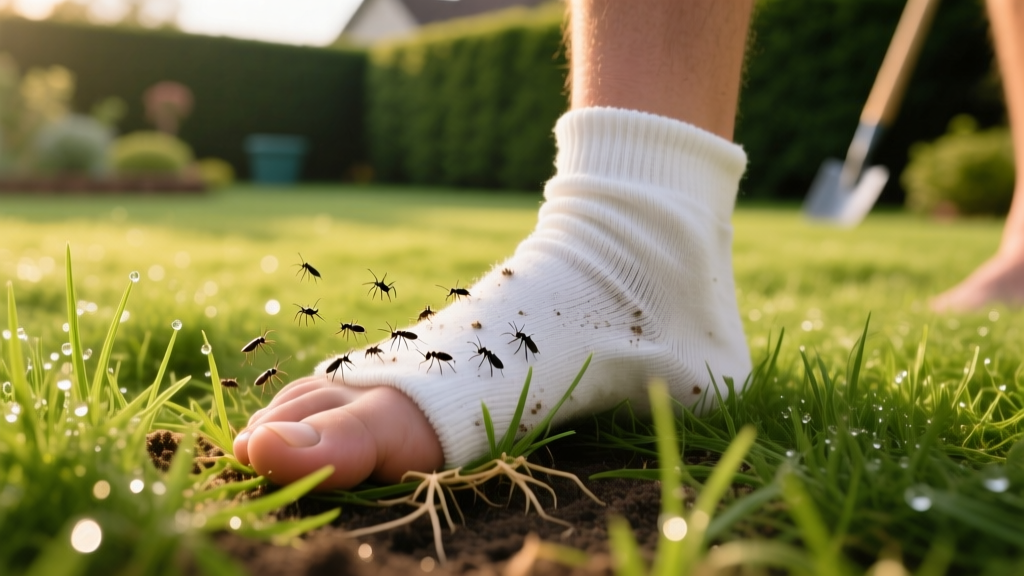
How to Check for Fleas in Your Yard: The Sock Test & 4 Pro Tips
The 95% Environmental Rule: Why Your Yard is the Real Battleground
When homeowners discover fleas on their pets, the immediate instinct is to apply a topical spot-on treatment or administer an oral chewable like NexGard or Bravecto. However, adult fleas living on a host account for only 5% of the total flea population. The remaining 95%—eggs, larvae, and pupae—exist entirely within your yard and home environment. According to UC Agriculture and Natural Resources, failing to address the outdoor environment guarantees a reinfestation cycle every 14 to 21 days as new adults emerge from their protective pupal cocoons.
Before spending $50 to $100 on broad-spectrum yard sprays, you must accurately map the infestation. Fleas are not evenly distributed across a lawn; they are highly localized to specific microclimates. Learning how to check for fleas in your yard saves money, prevents unnecessary chemical exposure, and targets the root of the problem.
The White Sock Test: Your Primary Detection Method
The most reliable, zero-cost method for detecting adult fleas in an outdoor environment is the White Sock Test. Fleas are visually attracted to high-contrast objects and are triggered by the heat and carbon dioxide emitted by a walking host.
Step-by-Step Execution
- Timing and Weather: Conduct the test in the early morning or late afternoon when temperatures are between 70°F and 85°F. Fleas become dormant and retreat deep into the soil when temperatures exceed 95°F or drop below 55°F. Ensure the relative humidity is above 50%; flea larvae desiccate and die in arid conditions.
- The Gear: Pull a pair of 100% white cotton crew socks up to your mid-calf. Avoid synthetic blends, as cotton retains heat and moisture better, mimicking a mammalian host.
- The Walk: Walk slowly through your yard for 10 to 15 minutes. Do not just stick to the open lawn. Shuffle your feet slightly to create vibrations, which trigger fleas to emerge from their pupal stage.
- The Inspection: Stop every three minutes to visually scan the socks from the ankle to the mid-calf. Look for dark, fast-moving specks (adult fleas) or tiny black specks that resemble ground pepper (flea dirt).
Decoding the Catch: Flea Dirt vs. Lookalikes
Homeowners frequently misidentify other insects or debris as fleas. If you find specks on your socks or in shaded soil patches, use the Wet Paper Towel Test. Place the specks on a damp white paper towel. If they dissolve and leave a reddish-brown halo, it is flea dirt (feces composed of digested host blood). If they remain black or grey, it is likely soil or a different pest.
| Specimen Found | Visual Characteristics | Wet Paper Towel Test Result | Yard Implication |
|---|---|---|---|
| Flea Dirt | Black, pepper-like granules | Reddish-brown halo (blood) | Active adult fleas feeding nearby |
| Springtails | 1-2mm, dark, jumps erratically | No color change (remains dark) | Excess soil moisture; harmless to pets |
| Tick Nymphs | 1mm, teardrop shape, 8 legs | No color change, crushes with a pop | Tick habitat present; requires acaricide |
| Thrips | Slender, tiny, dark brown/black | No color change | Plant pest; usually found on foliage, not ground |
High-Risk Yard Microclimates: Where to Focus
Flea larvae are blind and highly susceptible to ultraviolet (UV) radiation and desiccation. They will not survive in open, sun-baked lawn areas. When performing your inspection, dedicate 80% of your time to these specific microclimates:
- Underneath Structures: Decks, porches, and sheds provide the exact 75°F, high-humidity environment larvae require. Crawl underneath with a flashlight to check the soil surface.
- Dog Runs and Kennel Runs: The soil in these areas is heavily compacted and shaded, often containing high concentrations of organic matter (feces and shed hair) that larvae feed on.
- Foundation Perimeters: The north and east-facing sides of your home receive less direct sunlight. Check the first 12 inches of soil and mulch directly against the siding.
- Leaf Litter and Compost Edges: Decomposing organic matter generates mild heat and retains moisture, creating an ideal incubator for the pupal stage.
⚠️ Insect & Rodent Defense Warning: The Rodent Vector
If you do not own pets but are finding fleas in your yard, you likely have a rodent issue. The Centers for Disease Control and Prevention (CDC) notes that rodents like rats, mice, and ground squirrels act as primary hosts for various flea species. Before applying chemical flea sprays, inspect your yard for burrows, droppings, or gnawed irrigation lines. Treating the yard without eliminating the rodent host via bait stations (e.g., Tomcat Bait Chunx) or snap traps will result in immediate reinfestation.
If you do not own pets but are finding fleas in your yard, you likely have a rodent issue. The Centers for Disease Control and Prevention (CDC) notes that rodents like rats, mice, and ground squirrels act as primary hosts for various flea species. Before applying chemical flea sprays, inspect your yard for burrows, droppings, or gnawed irrigation lines. Treating the yard without eliminating the rodent host via bait stations (e.g., Tomcat Bait Chunx) or snap traps will result in immediate reinfestation.
Treatment Thresholds & Product Selection
Not every positive sock test requires a full-yard chemical bombardment. Use this decision matrix to determine your intervention level based on your catch rate during a 15-minute walk.
Tier 1: 0 to 5 Fleas (Cultural & Botanical Control)
Action: Modify the environment. Mow the lawn to a height of 2.5 inches to increase sunlight penetration to the soil surface. Remove leaf litter and prune overhanging branches. Apply a botanical spray like Wondercide Flea & Tick Yard Spray (active ingredient: Cedarwood oil, approx. $35 for 32oz). This repels adults and mildly disrupts the larval stage without harming beneficial nematodes.
Tier 2: 5 to 20 Fleas (Targeted IGR Application)
Action: You have an established breeding population. You must use an Insect Growth Regulator (IGR) to break the lifecycle. Look for products containing Pyriproxyfen (Nylar) or S-Methoprene (Precor). These mimic juvenile hormones, preventing larvae from molting into adults. Apply only to the shaded microclimates identified during your inspection. A 20oz concentrate of an IGR like Archer IGR costs around $65 and treats up to 21,000 square feet, lasting up to 7 months outdoors.
Tier 3: 20+ Fleas (Synthetic Knockdown + IGR)
Action: Severe infestation requiring immediate adult knockdown. The Environmental Protection Agency (EPA) advises combining a fast-acting synthetic pyrethroid with an IGR. Use a product containing Bifenthrin (e.g., Talstar P Professional Insecticide, approx. $45 for 3/4 gallon) mixed with an IGR. Apply using a pump sprayer at a rate of 1 oz per gallon of water per 1,000 sq ft. Keep pets and children off the treated area until the spray has completely dried (usually 2 to 4 hours).
Frequently Asked Questions
Can I use a flea fogger (bug bomb) in my yard or under my deck?
No. Foggers are entirely ineffective outdoors. The aerosolized insecticide dissipates immediately in open air and fails to penetrate the thatch layer, soil, or leaf litter where flea larvae and pupae reside. Furthermore, using a fogger under a deck poses severe inhalation risks and violates most product labels.
Will watering my lawn drown flea larvae?
Heavy, sustained irrigation can reduce flea populations by drowning larvae and promoting fungal pathogens that attack them. However, lightly watering your lawn daily actually increases soil humidity, creating a more favorable environment for flea development. If you use water as a cultural control, water deeply and infrequently, allowing the top inch of soil to dry out between sessions.
How long do flea pupae survive in the yard?
The pupal stage is the most resilient phase of the flea lifecycle. Encased in a sticky, debris-covered cocoon, pupae are highly resistant to desiccation and most chemical insecticides. They can remain dormant in the soil for up to 5 months, waiting for the vibrations and carbon dioxide of a passing host before emerging. This is why IGRs and persistent adulticides are required for long-term control.

