
Pest Control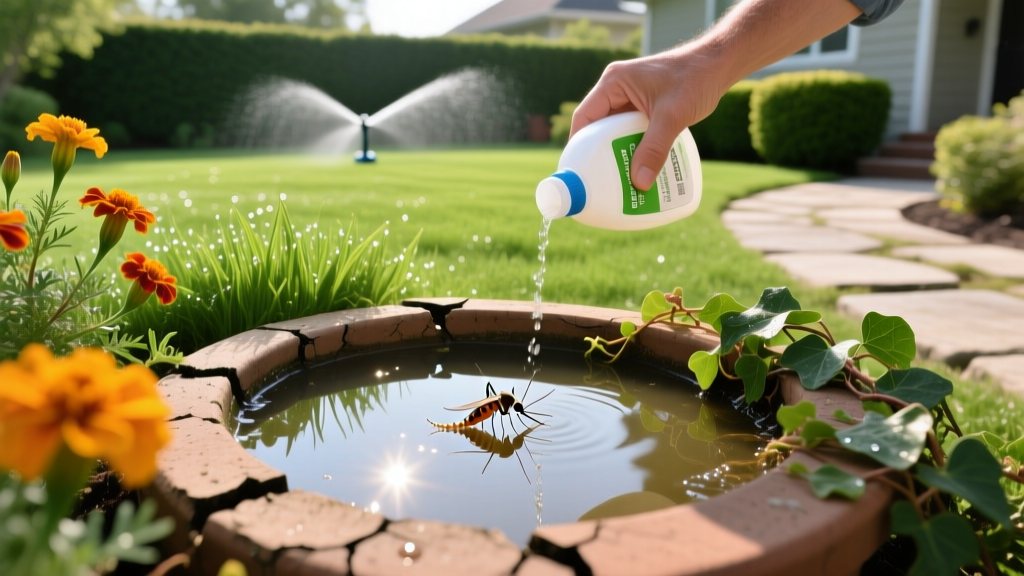
How to Destroy Mosquito Habitats and Adult Swarms in Your Yard
The Biology of the Breach: Understanding Your Enemy
To effectively eliminate mosquitoes, you must target their life cycle at two distinct vulnerabilities: the aquatic larval stage and the terrestrial adult stage. According to the American Mosquito Control Association (AMCA), a female mosquito requires only half an inch of standing water to lay a raft of up to 300 eggs. In residential yards, the primary culprits are Aedes aegypti (which breed in small, artificial containers and bite aggressively during the day) and Culex pipiens (which prefer larger, stagnant pools and bite at dusk).
Destroying a mosquito population is not a one-time event; it is a layered defense protocol. Relying solely on bug zappers or citronella candles yields a less than 5% reduction in local biting rates. True yard defense requires source reduction, biological larvicides, and residual chemical barriers.
Phase 1: Source Reduction and Habitat Destruction
Before deploying chemicals, you must eliminate the breeding infrastructure. Mosquito larvae require still water to breathe through their siphon tubes at the surface. Disrupting this environment is the most cost-effective control method available.
- Grade and Drain: Identify low-lying depressions in your turf. Core aerate and top-dress with sand to improve percolation, or install French drains to move water away from the foundation.
- Gutter Maintenance: Clogged gutters are the number one hidden breeding ground. Install micro-mesh gutter guards (stainless steel, 50-micron weave) to prevent leaf litter from creating dammed, stagnant pools.
- Catch Basins and French Drains: If your yard utilizes subterranean catch basins, the sump area at the bottom will hold permanent water. This requires targeted larvicide treatment (detailed below).
Phase 2: Deploying Biological Larvicides
For water features that cannot be drained—such as birdbaths, koi ponds, rain barrels, and drainage swales—you must deploy larvicides. The Environmental Protection Agency (EPA) heavily endorses biological controls that target mosquito larvae without harming mammals, birds, or beneficial pollinators.
Larvicide Comparison Matrix
| Active Ingredient | Product Example | Ideal Water Type | Residual Duration | Approx. Cost |
|---|---|---|---|---|
| Bti (Bacillus thuringiensis israelensis) | Summit Mosquito Dunks | Birdbaths, rain barrels, small puddles | 30 Days | $20 / 6 dunks |
| Bti (Granular) | Summit Mosquito Bits | Potting soil, swampy lawn edges, gutters | 7-14 Days | $18 / 30 oz shaker |
| Spinosad | Natrapool Mosquito Control | Large, enclosed artificial water features | 30 Days | $25 / 10 tablets |
| Methoprene (IGR) | Altosid ProG | Large retention ponds, municipal drainage | 30 Days | $45 / 2.5 lb bag |
Expert Insight: How Bti Works
Bti produces crystalline proteins during sporulation. When mosquito larvae ingest these crystals, the alkaline environment of their midgut dissolves the crystal, releasing toxins that bind to specific gut receptors, causing cellular lysis and death within 24 hours. Because birds, fish, and humans lack these specific alkaline gut receptors, Bti is entirely non-toxic to non-target species.
Phase 3: Adulticide Barrier Sprays
While larvicides stop the next generation, adulticides destroy the current swarm resting in your yard. Mosquitoes are weak fliers and spend the heat of the day resting on the undersides of leaves in dense, shaded shrubbery. Applying a residual chemical barrier to these resting sites is the most effective way to reclaim your patio.
Selecting the Right Active Ingredient
- Bifenthrin (e.g., Talstar P Professional): A suspension concentrate (SC) that leaves a visible micro-residue on foliage. It provides excellent initial knockdown and remains active for 30 to 45 days. Cost: ~$50 for 3/4 gallon.
- Lambda-cyhalothrin (e.g., Demand CS): A micro-encapsulated formulation. The active ingredient is trapped in microscopic polymer shells, protecting it from UV degradation and heavy rainfall. This is the superior choice for sunny yards or areas with frequent summer storms. Cost: ~$65 for 8 oz.
Application Protocol and Calibration
Improper application leads to phytotoxicity (leaf burn) and environmental runoff. Follow these strict parameters:
- Mix Rate: Mix 0.5 to 1.0 fluid ounces of Bifenthrin or 0.4 to 0.8 fluid ounces of Lambda-cyhalothrin per gallon of water.
- Equipment Calibration: Use a backpack sprayer pressurized to 40–60 PSI. Equip it with a flat-fan nozzle (such as a TeeJet 8004) to produce medium-coarse droplets that coat foliage without excessive dripping.
- Target Zones: Spray the undersides of leaves on perimeter shrubs, tall ornamental grasses, ivy, and the lower canopy of trees up to 10 feet high. Do not spray open lawn areas; mosquitoes do not rest on sun-baked grass.
⚠️ Pollinator Protection Warning
Pyrethroids (Bifenthrin, Lambda-cyhalothrin) are highly toxic to bees if sprayed directly. Never apply barrier sprays to blooming flowers, flowering weeds (like clover or dandelions), or active pollinator habitats. Apply treatments at dusk when bees have returned to their hives and the product can dry overnight, significantly reducing the risk to foraging pollinators the following morning.
Phase 4: Spatial Repellents for Immediate Relief
Chemical barriers take 24 hours to reach peak efficacy and may not cover open hardscapes like decks or patios. For immediate, localized destruction of the biting zone, utilize metered spatial repellents.
The Thermacell E55 Rechargeable Repeller uses a heating element to vaporize allethrin (a synthetic pyrethroid derived from chrysanthemum flowers). This creates a 20-foot invisible dome of protection that disrupts the mosquito's olfactory receptors, preventing them from locating human hosts. Unlike DEET lotions, spatial repellents protect the immediate airspace without requiring skin application. Expect to pay around $20 for the base unit and $25 for a 12-hour refill cartridge set.
Frequently Asked Questions
Will bug zappers help destroy my mosquito population?
No. Peer-reviewed entomological studies consistently show that bug zappers kill less than 1% of the biting mosquito population, while indiscriminately destroying thousands of beneficial nocturnal insects, including moths and predatory beetles. They are a poor investment for yard defense.
How long after a rainstorm do I need to reapply my barrier spray?
If you used a micro-encapsulated product like Demand CS and allowed it to dry for at least 4 hours before the rain started, the polymer shells will bind to the leaf cuticle, and no reapplication is necessary. If you used a standard suspension concentrate (Talstar P) and it rained within 24 hours of application, you must reapply the barrier.
Can I mix Bti granules into my potting soil to stop fungus gnats and mosquitoes?
Yes. Summit Mosquito Bits (Bti granules) are highly effective when mixed into the top two inches of potting soil or applied as a top-dress. When you water the plants, the Bti washes into the soil matrix, destroying both mosquito and fungus gnat larvae that thrive in moist, organic-rich environments.

