
Pest Control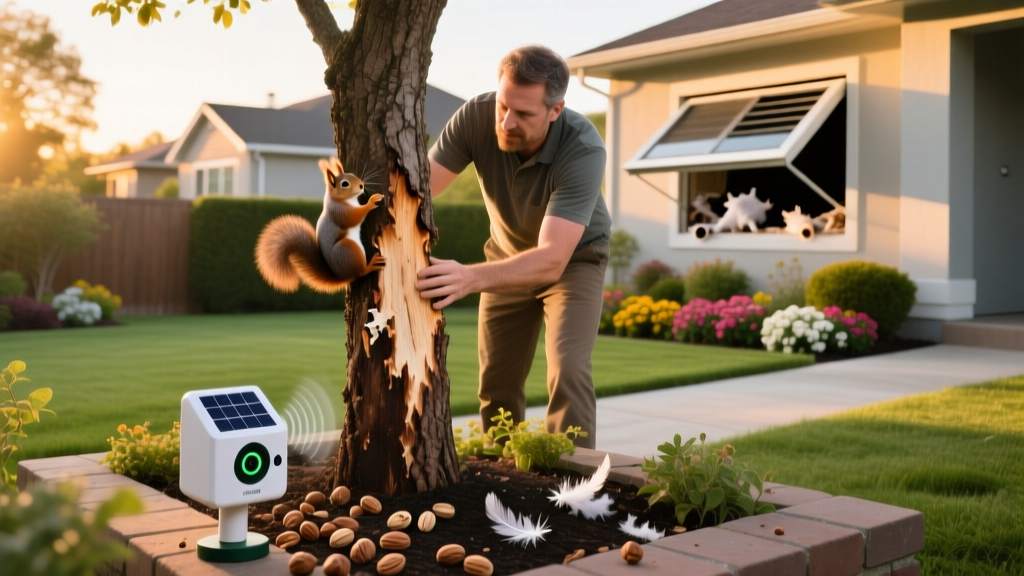
How to Get Rid of Squirrels: Yard, Garden, and Attic Deterrence
The True Cost of Squirrel Infestations
Squirrels are highly adaptable rodents that can cause severe structural and aesthetic damage to residential properties. While they may appear harmless, an Eastern Gray or Fox squirrel breaching an attic space can cause $500 to $2,500 in damage per incident. Their continuously growing incisors exert up to 7,000 PSI of bite force, allowing them to chew through standard aluminum flashing, asphalt shingles, PEX plumbing, and electrical wiring. According to the University of California Agriculture and Natural Resources, tree squirrels are among the most destructive urban wildlife pests due to their tendency to strip bark from ornamental trees and raid agricultural crops.
Successfully managing squirrel populations requires a multi-tiered approach combining physical exclusion, habitat modification, and targeted deterrents. This guide details the exact materials, measurements, and strategies required to eliminate squirrel activity from your property.
Identifying the Culprit: Squirrel vs. Other Rodents
Before deploying deterrents, confirm that squirrels are the actual source of the damage. Misidentifying the pest leads to ineffective treatment. Use this diagnostic matrix to differentiate squirrel activity from rats, mice, and raccoons.
| Indicator | Tree Squirrels | Roof Rats | Raccoons |
|---|---|---|---|
| Entry Hole Size | 1.5 to 2 inches (golf ball size) | 0.5 to 1 inch | 4+ inches (fist size) |
| Active Hours | Diurnal (dawn to dusk) | Nocturnal | Nocturnal |
| Noise Profile | Heavy scrambling, rolling nuts, daytime thumping | Light scratching, scurrying at night | Heavy thumping, vocal chattering |
| Droppings | 3/8 inch, oblong, rounded ends | 1/2 inch, spindle-shaped, pointed ends | 2-3 inches, tubular, often contains seeds |
| Damage Pattern | Stripped bark on branches, chewed fascia boards | Gnawed wires, contaminated insulation | Torn soffits, ripped ductwork |
Yard and Garden Deterrence: Protecting Landscaping and Bird Feeders
Squirrels are opportunistic foragers. If your yard provides easy access to high-calorie food sources, they will establish a territory. Modifying the environment is the first step in long-term deterrence.
Fortifying Bird Feeders
The Cornell Lab of Ornithology recommends specific physical barriers to protect bird seed from squirrel raids. Standard weight-activated feeders often fail against larger Fox squirrels. Implement these specifications:
- Pole Baffles: Install a smooth, dome-shaped baffle with a minimum diameter of 18 inches on your feeder pole. Mount it exactly 5 feet above the ground. Squirrels can jump 4 feet vertically; the 5-foot height plus the 18-inch overhang prevents them from climbing over the lip.
- Placement Geometry: Squirrels can leap 8 to 10 feet horizontally. Position feeders at least 10 feet away from rooflines, tree trunks, and fence lines.
- Seed Selection: Switch to safflower seed or nyjer (thistle). Squirrels find safflower bitter and generally ignore it. Alternatively, use suet cakes treated with capsaicin (like Cole's Hot Meats Suet, approx. $18). Birds lack the receptor for capsaicin heat, but mammals find it highly irritating.
Protecting Bulbs and Garden Beds
To stop squirrels from digging up newly planted tulip and crocus bulbs, do not rely on chemical repellents alone. Use physical subsurface barriers:
- Excavate the planting bed to the required depth.
- Line the bottom and sides of the bed with 1/2-inch galvanized hardware cloth.
- Place bulbs and cover with soil.
- Lay a second sheet of hardware cloth 2 inches below the soil surface, securing the edges with landscape staples. This prevents digging from above while allowing shoots to grow through the 1/2-inch gaps.
Attic and Roofline Exclusion: The Chew-Proof Framework
If squirrels have already breached your home, exclusion is mandatory. The Humane Society of the United States emphasizes that trapping and relocating is not only illegal in many jurisdictions without a permit, but it also results in a mortality rate exceeding 75% for relocated animals due to territorial disputes and starvation. Exclusion is the only permanent, humane solution.
Material Selection for Exclusion
Squirrels will easily destroy chicken wire, plastic netting, and expanding polyurethane foam. You must use materials that exceed their bite force capabilities.
| Material | Squirrel Resistance | Best Application | Estimated Cost |
|---|---|---|---|
| 1/2-inch 19-Gauge Galvanized Hardware Cloth | Excellent | Soffit vents, chimney caps, large gaps | $35 per 10ft roll |
| 24-Gauge Galvanized Steel Flashing | Excellent | Fascia boards, wooden corners, drip edges | $18 per 10ft piece |
| Copper Mesh (Stuf-Fit) | High (when combined with sealant) | Small weep holes, pipe penetrations | $25 per 20ft roll |
| Expanding Polyurethane Foam | Poor (Chewed through in minutes) | None (Do not use for squirrel exclusion) | N/A |
Step-by-Step Attic Sealing Protocol
- Confirm Vacancy: Never seal an entry point while squirrels are inside, especially during spring (March-May) and late summer (August-September) when flightless pups may be nested in the insulation. Use the 'paper test': stuff newspaper into the suspected entry hole. If it remains undisturbed for 48 hours, the nest is likely empty.
- Install a One-Way Exclusion Door: If animals are present, mount a commercial one-way squirrel door (e.g., Tomahawk One-Way Door, approx. $45) over the primary entry point. This allows squirrels to exit but prevents re-entry.
- Seal Secondary Gaps: Once the attic is confirmed empty, seal all secondary gaps larger than 1/2 inch. For small holes, pack copper mesh tightly into the void, then cover with a high-quality polyurethane exterior sealant. The copper mesh prevents them from pulling the sealant out.
- Cover Vents: Cut 1/2-inch hardware cloth to size, leaving a 2-inch overlap on all sides. Secure it over soffit and gable vents using 1/2-inch galvanized staples or exterior-grade construction screws with fender washers.
Warning: The Relocation Trap
Many homeowners attempt to trap and release squirrels in nearby woods. State wildlife agencies strictly regulate this. Furthermore, a relocated squirrel will attempt to return to its home range, often dying from exhaustion, vehicle strikes, or predation. If you trap a mother squirrel, you will almost certainly orphan her nest-bound pups inside your walls, leading to severe odor and secondary pest issues. Always prioritize exclusion over relocation.
Evaluating Chemical and Taste Repellents
Repellents should be viewed as temporary training tools, not permanent solutions. They are most effective when used to teach squirrels to avoid specific garden zones while physical barriers are being installed.
- Capsaicin Sprays (e.g., Bonide Hot Pepper Wax): Effective on ornamental plants and vegetable foliage. Must be reapplied every 14 days or after 1 inch of rainfall. Cost: ~$15 per 32oz bottle.
- Predator Urine (Fox/Coyote): Creates a psychological barrier. Granular forms last longer than liquid. Must be placed in scent-cup dispensers to prevent washing away. Efficacy drops significantly in urban areas where squirrels are habituated to predators. Cost: ~$20 per 16oz.
- Thiram-Based Fungicides: Used commercially to treat bulbs and seeds before planting. Provides a bitter taste deterrent. Not recommended for edible crops once harvested.
Professional Wildlife Removal: Costs and Expectations
If roofline damage is extensive or if squirrels are nested deep within wall cavities, hire a licensed nuisance wildlife control operator (NWCO). Expect the following pricing structure for professional services in 2026:
- Initial Inspection & Diagnosis: $100 - $175 (Often waived if you proceed with the repair contract).
- Exclusion & Sealing: $350 - $850 depending on the linear footage of fascia and soffit requiring hardware cloth and steel flashing.
- Attic Decontamination & Insulation Replacement: $1,200 - $3,000. Squirrel urine and feces carry pathogens like Leptospirosis and Salmonella, and their scent markers will attract new squirrels if not professionally removed with enzymatic cleaners and HEPA vacuums.
Always request proof of liability insurance and verify that the company adheres to state-specific wildlife handling regulations. Avoid companies that immediately recommend poison; rodenticides are largely ineffective against tree squirrels and pose severe secondary poisoning risks to local raptors and pets.
Frequently Asked Questions
Do ultrasonic squirrel repellents work?
No. Independent studies and university extensions have repeatedly shown that ultrasonic devices do not deter squirrels. Squirrels quickly habituate to high-frequency sounds, especially if a high-value food source or warm nesting site is present. Save your money and invest in physical hardware cloth instead.
Will mothballs keep squirrels out of my attic?
Mothballs (naphthalene or paradichlorobenzene) are illegal to use in open spaces like attics or yards, as they are classified as restricted-use pesticides. They emit toxic fumes that will permeate your living space, posing severe respiratory risks to humans and pets, and they are entirely ineffective at deterring determined squirrels.
How do I stop squirrels from stripping bark off my oak trees?
Wrap the lower 4 feet of the tree trunk with a 24-gauge galvanized steel tree guard or heavy-duty plastic tree wrap. Ensure the wrap is loose enough to allow the trunk to expand as the tree grows. Additionally, provide a distant water source during dry summer months, as squirrels often strip bark to access the moisture-rich cambium layer beneath.

