
Pest Control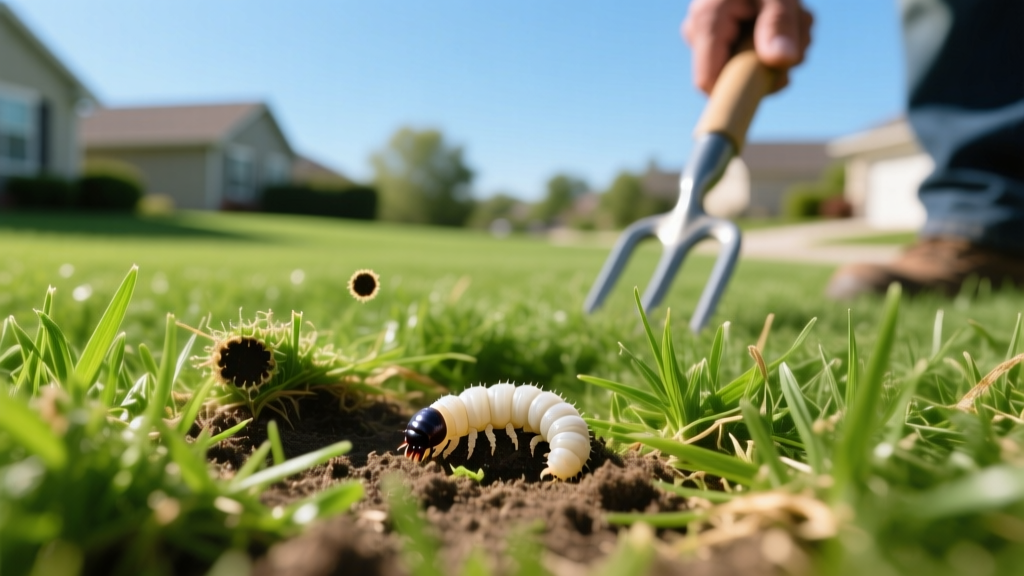
How to Get Rid of Grubs in Your Yard: A Seasonal Defense Guide
Identifying the Threat: White Grubs and Turf Destruction
White grubs—the larval stage of scarab beetles like Japanese beetles, June bugs, and European chafers—are among the most destructive subterranean pests in North American lawns. They feed exclusively on turfgrass roots, severing the plant's ability to uptake water and nutrients. The result is irregular brown patches of dead grass that feel spongy underfoot and can be rolled back like loose carpet. According to University of Kentucky Entomology, a healthy lawn can tolerate low grub populations, but once densities exceed 5 to 10 grubs per square foot, rapid turf collapse is imminent.
Before purchasing any treatment, you must confirm a grub infestation. Use a flat-edged spade to cut three sides of a 1-foot by 1-foot square of turf, about 3 inches deep. Peel the sod back and count the C-shaped, cream-colored larvae in the soil and root zone. If you find fewer than 5 grubs, no treatment is necessary. If you find 5 to 10, monitor closely. If you find more than 10, immediate intervention is required to save your lawn.
The Grub Lifecycle: Why Timing Dictates Success
Understanding how to get rid of grubs in your yard requires mapping your treatment to their biological lifecycle. Grubs are not a year-round active threat; their vulnerability shifts dramatically with the seasons.
📅 Seasonal Vulnerability Matrix:
- May – June: Adult beetles emerge, mate, and lay eggs in irrigated, full-sun turf.
- July – August: Eggs hatch. First-instar (young) grubs begin feeding near the soil surface. (Peak window for preventative controls).
- September – October: Grubs reach second and third instars, consuming massive amounts of roots. (Peak window for curative controls and maximum turf damage).
- November – March: Grubs burrow 4 to 8 inches deep to overwinter. They are inaccessible to surface-applied treatments.
- April – May: Grubs return to the surface to feed briefly before pupating into adults. Damage is minimal, and treatment is largely ineffective.
Curative vs. Preventative Grub Control: Which Do You Need?
The biggest mistake homeowners make is applying a preventative product in the fall to kill active grubs, or using a curative product in the spring before eggs hatch. You must match the active ingredient to the grub's developmental stage.
| Feature | Preventative Control | Curative Control |
|---|---|---|
| Active Ingredients | Chlorantraniliprole, Imidacloprid, Thiamethoxam | Trichlorfon (Dylox), Carbaryl |
| Application Window | May through mid-July | August through early October |
| Target Stage | Eggs and 1st-instar larvae | 2nd and 3rd-instar (large) larvae |
| Kill Speed | Slow (60–90 days to fully activate) | Fast (24–48 hours knockdown) |
| Avg. Cost (5,000 sq ft) | $25 – $35 | $15 – $22 |
Top Chemical Interventions for Grub Eradication
1. Trichlorfon (Dylox) for Active Fall Infestations
If it is September and your lawn is actively browning, you need a rapid knockdown agent. Trichlorfon, commonly sold as Bayer Advanced 24 Hour Grub Killer Plus or BioAdvanced Grub Killer Plus, penetrates the soil quickly and kills large, third-instar grubs within 24 to 48 hours. However, Trichlorfon has a very short residual life (7 to 14 days) and degrades rapidly in soils with a high pH (above 7.5). It must be watered in immediately with at least 0.5 inches of irrigation to move the chemical into the root zone where the grubs are feeding.
2. Chlorantraniliprole (Scotts GrubEx1) for Long-Term Prevention
For proactive defense, Chlorantraniliprole is the industry standard. Sold primarily as Scotts GrubEx1, this active ingredient is highly effective against all major grub species and is notably safer for non-target organisms, including earthworms and pollinators, compared to older neonicotinoids. The catch is timing: it takes 60 to 90 days to reach peak efficacy in the soil. You must apply it in May or June so it is fully activated by the time eggs hatch in August.
Biological & Organic Defense Strategies
For homeowners seeking organic lawn care, biological controls offer a highly targeted approach, though they require stricter environmental conditions to succeed.
Beneficial Nematodes (Heterorhabditis bacteriophora)
Not all nematodes kill grubs. You must specifically source Heterorhabditis bacteriophora (Hb) strains, which carry symbiotic bacteria that infect and kill white grubs within 48 hours. Apply Hb nematodes in late summer when soil temperatures are consistently above 60°F. Because nematodes are living organisms, they must be applied in the early morning or late evening to avoid UV degradation, and the lawn must be kept continuously moist for 10 to 14 days post-application to prevent the nematodes from desiccating. Expect to pay $35 to $50 for a formulation covering 3,000 square feet.
Milky Spore (Paenibacillus popilliae)
Milky spore is a naturally occurring bacterium that causes a fatal disease in Japanese beetle grubs. While heavily marketed, it has significant limitations. According to Michigan State University Extension, milky spore only targets Japanese beetle larvae—it will not control European chafers or June bugs. Furthermore, it takes 2 to 5 years to build up sufficient spore counts in the soil to provide meaningful control, making it useless for acute infestations.
⚠️ Warning: The Secondary Pest Connection
If your lawn features small, conical mounds of dirt or torn-up strips of sod, your primary problem might not be grubs—it might be the predators hunting them. Moles, skunks, raccoons, and flocks of starlings will aggressively tear through turf to forage for grubs. Applying a curative grub treatment like Trichlorfon eliminates the food source, which is often the only effective way to deter these secondary mammalian pests from destroying your yard.
Step-by-Step Application Protocol for Maximum Kill Rate
Chemical failure is almost always the result of improper application. Follow this exact protocol to ensure the active ingredient reaches the root zone:
- Mow Low: Drop your mower deck to 2 inches. Removing excess leaf blade ensures the granules reach the soil surface rather than getting trapped in the thatch layer.
- Dethatch if Necessary: If your thatch layer exceeds 0.5 inches, rent a power rake. Thick thatch will bind with the insecticide, neutralizing it before it reaches the grubs.
- Calibrate Your Spreader: Check the product label for the exact spreader setting. Over-applying wastes money and risks runoff; under-applying will fail to reach the lethal threshold.
- Apply on Dry Turf: Broadcast the granules evenly across the lawn. Avoid overlapping passes, which can cause localized chemical burn to the grass.
- Water Immediately: Run your irrigation system or sprinklers to deliver exactly 0.5 inches of water. Use a rain gauge or empty tuna cans placed on the lawn to measure. This dissolves the granule and carries the active ingredient into the top 3 inches of soil.
- Restrict Access: Keep children and pets off the treated lawn until the grass is completely dry to the touch.
Frequently Asked Questions
Can I apply grub control and grass seed at the same time?
Yes, if you are using Chlorantraniliprole or Trichlorfon. These active ingredients do not inhibit seed germination. However, avoid using products that contain broad-spectrum pre-emergent herbicides (like mesotrione) in combination with grub control if you are seeding, as they will kill your new grass seedlings.
Why did my preventative treatment fail?
The most common cause of preventative failure is late application. If you apply Scotts GrubEx1 in late July or August, the chemical will not have enough time to translocate through the soil profile before the eggs hatch and the young grubs begin feeding aggressively. You must apply preventatives in May or early June.

