
Pest Control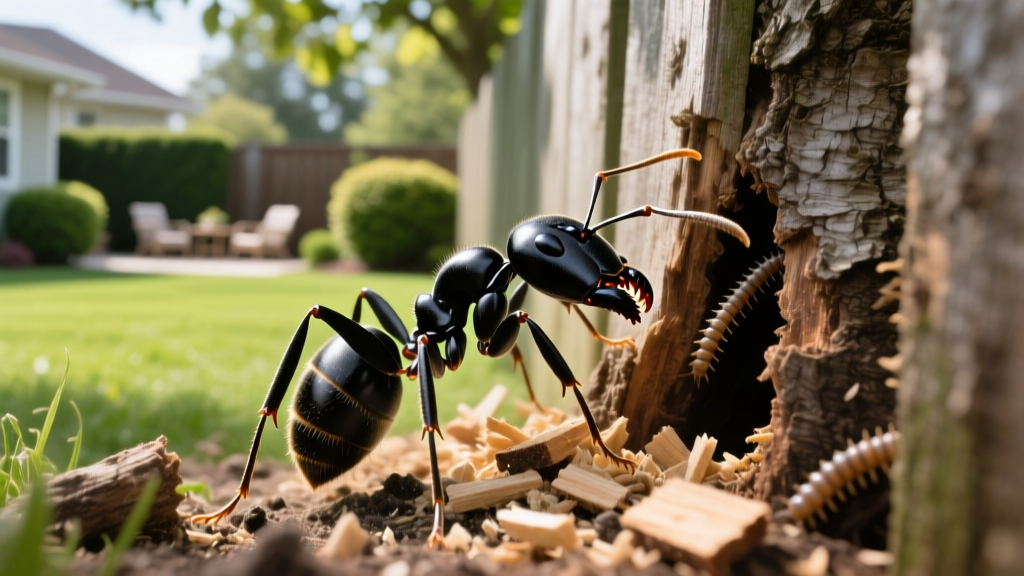
How to Get Rid of Large Black Carpenter Ants in Your Yard
Large black carpenter ants (Camponotus pennsylvanicus in the East, Camponotus modoc in the West) are among the most destructive structural pests in North America. Unlike termites, they do not consume wood; they excavate it to build sprawling galleries. When homeowners ask how to get rid of large black carpenter ants, they often focus on the interior of their homes. However, effective eradication requires an exterior-first approach. The ants you see inside are usually foragers or satellite colony members originating from a parent colony hidden in your yard.
Identifying the Threat: Carpenter Ants vs. Termites
Before deploying treatments, confirm you are dealing with carpenter ants. Misidentification leads to wasted money and ineffective chemical applications. Carpenter ants are significantly larger than most household ants, with workers ranging from 1/4 to 1/2 inch in length. They are typically uniformly black, though some western species exhibit a reddish-brown thorax.
| Feature | Large Black Carpenter Ants | Subterranean Termites |
|---|---|---|
| Antennae | Elbowed (bent) | Straight, beaded |
| Waist | Pinched, narrow node | Broad, no distinct waist |
| Wings (Alates) | Front wings longer than hind wings | Front and hind wings equal length |
| Debris (Frass) | Dry, sawdust-like shavings | Muddy, pellet-like tubes |
| Wood Damage | Smooth, clean galleries | Rough, soil-packed tunnels |
The Biology of Yard Infestations: Parent vs. Satellite Colonies
To successfully eliminate these pests, you must understand their colony structure. According to Penn State Extension, carpenter ant colonies are divided into two distinct types:
- The Parent Colony: Located outdoors in moist, decaying wood (tree stumps, buried roots, rotting landscape timbers). This colony houses the queen, brood, and young workers. It requires high moisture to survive.
- Satellite Colonies: Established in drier environments, including your home's structural wood, attic beams, or hollow doors. These contain older workers and pupae but no queen.
If you only treat the ants inside your house, the parent colony in your yard will simply send more workers to rebuild the satellite. Eradication requires targeting the outdoor parent colony and severing the foraging trails.
The Yard Defense Strategy: 4-Step Eradication Protocol
Ditch the hardware store bug sprays. Over-the-counter repellents like bifenthrin or permethrin (e.g., Ortho Home Defense) are counterproductive for carpenter ants. These chemicals kill on contact but repel the survivors, causing the colony to undergo "budding"—splintering into multiple new colonies that scatter across your yard and into your home.
Step 1: Locate the Parent Colony
Inspect your yard at dusk when carpenter ants are most active. Look for trails of large black ants marching along fence lines, utility wires, or tree branches. Probe suspected wood with a flathead screwdriver. If you uncover smooth, clean galleries and a pile of coarse sawdust (frass) laced with dead insect parts, you have found a nest. Listen closely to tree trunks and stumps; a dry rustling sound often indicates a massive colony inside.
Step 2: Deploy a Non-Repellent Liquid Barrier
Instead of repelling ants, use a non-repellent termiticide/insecticide that they cannot detect. Taurus SC (9.1% Fipronil) is the industry standard. The ants walk through the treated soil, pick up the active ingredient, and transfer it to the colony through grooming and trophallaxis (food sharing).
Mixing & Application Specifics:
Mix 0.8 fluid ounces of Taurus SC per gallon of water. Dig a trench 6 inches deep and 6 inches wide around the perimeter of your home's foundation, as well as around the base of infested yard structures or tree stumps. Pour 1 gallon of the mixed solution per 10 linear feet of trench. Backfill the soil. This creates an undetectable, lethal barrier that will collapse the colony over 30 to 60 days.
Mix 0.8 fluid ounces of Taurus SC per gallon of water. Dig a trench 6 inches deep and 6 inches wide around the perimeter of your home's foundation, as well as around the base of infested yard structures or tree stumps. Pour 1 gallon of the mixed solution per 10 linear feet of trench. Backfill the soil. This creates an undetectable, lethal barrier that will collapse the colony over 30 to 60 days.
Step 3: Bait the Foraging Trails
Liquid barriers take time to work. To accelerate the process, deploy specialized carpenter ant baits. Advance Carpenter Ant Bait (Abamectin B1 0.011%) and Maxforce Fleet are highly effective because they offer the dual-food sources (proteins and carbohydrates) that carpenter ants crave depending on the season. Place small dime-sized bait placements directly on active trails in the yard, near stumps, and along fence lines. Never spray insecticide near the bait, or the ants will avoid it.
Step 4: Direct Mound/Stump Injection (If Accessible)
If you find an exposed, heavily infested stump that you cannot immediately remove, drill 1/4-inch holes into the wood and inject a dust desiccant like Drione Dust (silica gel + pyrethrins) or a specialized aerosol like Alpine WSG. The dust clings to their exoskeletons, destroying their waxy cuticle and causing rapid dehydration.
⚠ Warning: The Boric Acid Myth Outdoors
Many DIY guides suggest using boric acid powder or sugar water mixtures in the yard. Boric acid loses its efficacy when exposed to outdoor moisture and rain. Furthermore, carpenter ants are notoriously picky eaters; generic boric acid/sugar baits rarely mimic the complex nutritional profile required to trick a mature Camponotus colony. Stick to commercial, weather-resistant gel and granular baits outdoors.
Habitat Modification: Making Your Yard Hostile
Chemical treatments will fail if your yard remains a hospitable breeding ground. The University of Minnesota Extension emphasizes that moisture control and physical barriers are critical long-term defenses. Implement these exact measurements:
- The 18-Inch Mulch Gap: Carpenter ants thrive in moist mulch. Pull all mulch, pine straw, and leaf litter at least 18 inches away from your home's siding and foundation. Replace the immediate perimeter with crushed stone or gravel, which drains rapidly and offers no nesting value.
- Firewood Management: Stack firewood at least 20 feet away from the house and elevate it 6 inches off the ground on metal racks or concrete blocks. Never store firewood directly against the house or inside the garage.
- Canopy Trimming: Trim all tree branches and shrubs so they are at least 10 feet away from your roofline. Carpenter ants use overhanging branches as aerial highways to bypass ground-level chemical barriers.
- Stump Grinding: Grind all dead tree stumps down to at least 12 inches below the soil surface. If grinding is impossible, treat the stump heavily with the Fipronil drench mentioned above.
Cost Breakdown: DIY vs. Professional Extermination (2026 Estimates)
Deciding between a DIY approach and hiring a licensed pest control operator depends on the severity of the infestation and your comfort level with trenching and chemical handling.
| Treatment Method | Estimated Cost | Pros | Cons |
|---|---|---|---|
| DIY Chemical & Bait Kit | $85 - $140 | Highly effective if applied correctly; uses professional-grade non-repellents. | Requires physical labor (trenching); precise mixing required. |
| Professional Perimeter & Yard | $350 - $650 | Warranty included; no manual labor; expert colony tracking. | Higher upfront cost; requires scheduling and home access. |
| Arborist Tree Injection | $150 - $300 / tree | Saves valuable landscape trees without soil drenching. | Expensive for multiple trees; requires certified arborist. |
Expert FAQ: Yard Defense Clarifications
Q: Will large black carpenter ants in my yard eventually destroy my house?
Yes, if left unchecked. The ants foraging in your yard are scouting for dry, protected wood to establish satellite colonies. Once they find a moisture vulnerability in your siding, roof eaves, or window frames, they will move indoors. Over several years, a mature satellite colony can compromise structural beams, causing thousands of dollars in damage.
Q: Do carpenter ants bite humans or pets?
Carpenter ants possess strong mandibles capable of pinching human skin, and they can spray formic acid into the wound, causing a sharp, burning sensation. However, they are not aggressive and will only bite if directly handled or crushed. They pose no toxic threat to pets, though ingestion of large quantities of ants may cause mild gastrointestinal upset in dogs or cats.
Q: How long does it take for Taurus SC to kill the colony?
Fipronil is a slow-acting toxicant by design. You will not see immediate dead ants on the surface. It typically takes 30 to 90 days for the transfer effect to reach the queen and collapse the entire parent colony. Do not reapply or switch to a fast-kill repellent spray during this window, or you will interrupt the trophallaxis process and ruin the treatment.

