
Pest Control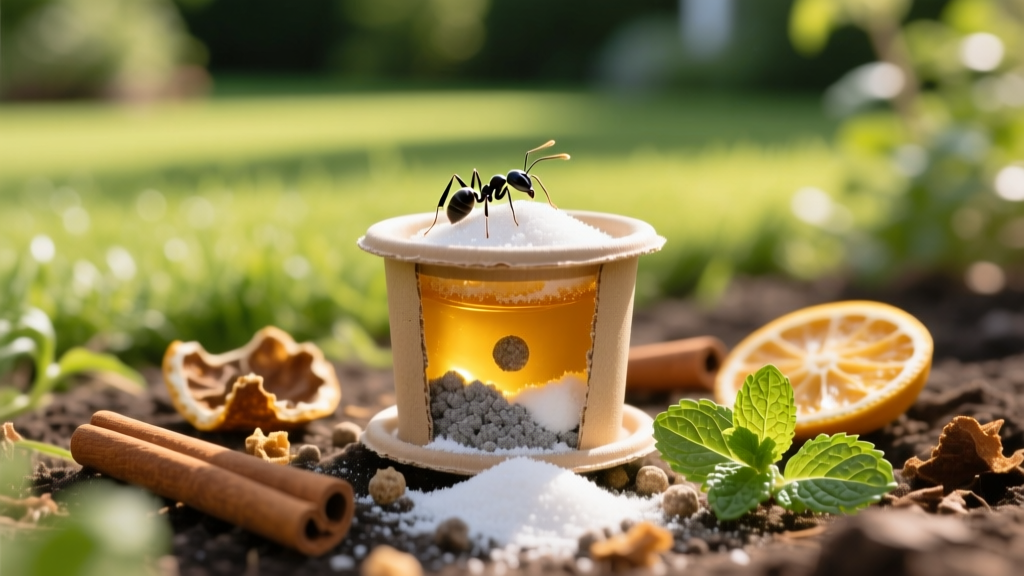
How to Make Natural Ant Bait for Lawn and Garden Pests
Why Contact Sprays Fail and Natural Baits Succeed
When homeowners spot an ant trail crossing their patio or swarming a lawn mower, the immediate instinct is to reach for a chemical contact spray. This is a tactical error. Contact insecticides only kill the foraging workers you see, which typically represent less than 10% of the total colony. Worse, applying fast-acting neurotoxins to species like Argentine ants (Linepithema humile) or Odorous house ants (Tapinoma sessile) triggers a survival mechanism called colony budding. The surviving ants sense the chemical threat, split into multiple satellite colonies, and actually multiply the infestation across your yard.
A slow-acting natural ant bait bypasses this defense. By combining a delayed-action organic toxicant with a highly attractive food carrier, foragers carry the lethal payload deep into the nest, distributing it to the queen, larvae, and other workers before they realize the food source is compromised. This results in total colony collapse within 7 to 14 days, rather than a temporary surface-level reduction.
The Trophallaxis Effect: Ants possess two stomachs. The 'social stomach' (crop) stores liquid food to be regurgitated and shared with nest-mates through mouth-to-mouth feeding (trophallaxis). Liquid natural ant baits exploit this biological imperative, ensuring the toxicant reaches the reproductive center of the colony.
3 Field-Tested DIY Natural Ant Bait Recipes
Commercial organic baits can cost upwards of $8 to $12 per small tube. As of 2026, you can formulate highly effective, targeted natural ant baits at home for less than $0.20 per batch using readily available household and garden center ingredients.
Recipe 1: Liquid Borax & Sugar Syrup (For Sweet-Foraging Ants)
This is the gold standard for Argentine, Odorous house, and Pavement ants during their spring and summer carbohydrate-foraging cycles. The key is maintaining a borax concentration between 1% and 5%. Anything higher kills the forager before it can return to the nest; anything lower fails to deliver a lethal dose to the queen.
- Ingredients: 1 cup warm water (approx. 110°F to ensure complete dissolution), 3 tablespoons granulated white sugar, 1 tablespoon 20 Mule Team Borax (sodium tetraborate).
- Preparation: Stir until completely clear. Soak standard cotton balls in the solution until saturated but not dripping.
- Deployment: Place soaked cotton balls inside punctured plastic bottle caps or specialized bait stations to prevent evaporation and protect non-target insects.
- Cost per batch: ~$0.15 (yields enough for 20+ bait stations).
Recipe 2: Peanut Butter & Borax Paste (For Protein/Grease-Foraging Ants)
In late summer and early autumn, many ant species shift their dietary preferences toward proteins and lipids to support winter larval development. If ants are ignoring your sugar bait, they are likely in a protein cycle.
- Ingredients: 2 tablespoons organic, unsweetened peanut butter, 1 tablespoon powdered sugar, 1 teaspoon food-grade Borax.
- Preparation: Microwave the peanut butter for 10 seconds to soften it, then vigorously fold in the powdered sugar and borax until a uniform paste forms.
- Deployment: Smear a pea-sized amount onto small squares of wax paper or cardboard. Place directly on ant trails.
Recipe 3: Spinosad & Honey Perimeter Trap (OMRI-Listed Organic)
For gardeners who strictly avoid Borax around sensitive soil microbiomes or specific edible crops, Spinosad is a naturally derived substance made from soil-dwelling bacteria (Saccharopolyspora spinosa). It is highly effective against fire ants and harvester ants.
- Ingredients: 1/4 cup raw honey, 1/4 cup warm water, 1/2 teaspoon liquid Spinosad concentrate (e.g., Monterey Garden Insect Spray, OMRI-listed).
- Preparation: Whisk the honey and warm water until fully emulsified, then stir in the Spinosad.
- Deployment: Apply using a squeeze bottle into soil cracks, around tree trunks, or directly onto fire ant mound perimeters (do not disturb the mound itself before baiting).
Myth Busting: The Cornmeal Stomach-Expansion Fallacy
A pervasive internet myth claims that feeding ants dry cornmeal will kill them because it 'expands in their stomachs and bursts them.' This is biologically impossible. Adult worker ants cannot digest solid food; their physical gizzard filters out particles larger than 1 micron. They carry solid cornmeal back to the nest, feed it to the larvae, and the larvae secrete digestive enzymes to liquefy it. Cornmeal alone will simply provide a new food source for the colony. It must be combined with a slow-acting toxicant (like Borax or Spinosad) to function as a natural ant bait.
A pervasive internet myth claims that feeding ants dry cornmeal will kill them because it 'expands in their stomachs and bursts them.' This is biologically impossible. Adult worker ants cannot digest solid food; their physical gizzard filters out particles larger than 1 micron. They carry solid cornmeal back to the nest, feed it to the larvae, and the larvae secrete digestive enzymes to liquefy it. Cornmeal alone will simply provide a new food source for the colony. It must be combined with a slow-acting toxicant (like Borax or Spinosad) to function as a natural ant bait.
Bait Selection and Deployment Matrix
Choosing the correct bait formulation depends on the specific ant species and the current environmental conditions. Use the matrix below to diagnose your infestation and select the appropriate organic control method.
| Target Species | Primary Diet Phase | Recommended Bait | Expected Colony Collapse |
|---|---|---|---|
| Argentine Ants | Sweets / Carbohydrates | Liquid Borax & Sugar | 10 - 14 Days |
| Pavement Ants | Grease / Proteins | Peanut Butter Paste | 7 - 10 Days |
| Red Imported Fire Ants | Omnivorous / Oils | Spinosad & Honey / Corn Grits | 14 - 21 Days |
| Carpenter Ants | Sweets / Insects | Liquid Borax (Higher Volume) | 21 - 30 Days |
Strategic Deployment and Environmental Controls
Formulating the bait is only half the battle. Improper placement is the leading cause of DIY bait failure. Follow these deployment protocols to ensure maximum forager interception:
- Map the Foraging Trails: Do not place bait randomly. Observe the ants at dusk or dawn when foraging peaks. Place bait stations directly on or within one inch of the established pheromone trails.
- Never Disrupt the Trail: Do not spray vinegar, soapy water, or step on the trail before baiting. Erasing the pheromone path will force scouts to find a new route, bypassing your bait entirely.
- The 3-Foot Grid: For heavy lawn infestations, deploy bait stations in a 3-foot by 3-foot grid across the affected turf area. Ant foraging radii rarely exceed 30 feet from the nest, so concentrate the grid near suspected nest sites (e.g., near retaining walls, tree bases, or mulch beds).
- Moisture Management: Liquid baits evaporate rapidly in direct sunlight or high heat (above 85°F). Always use a physical barrier, like an inverted plastic cup with entry notches cut into the rim, to shade the bait and maintain humidity.
Troubleshooting Common Bait Failures
If ant activity increases initially, do not panic. This is a known phenomenon called 'swarming' and indicates that scouts have found the food source and are recruiting more workers to harvest it. However, if activity persists beyond 5 days without a subsequent decline, troubleshoot using the following framework:
- Symptom: Ants approach the bait, touch it with their antennae, and walk away.
Diagnosis: Dietary mismatch or bait spoilage. The colony is currently seeking proteins, not sugars, or the liquid bait has fermented.
Fix: Discard the current batch and deploy the Peanut Butter & Borax paste (Recipe 2). - Symptom: Dead ants are found immediately surrounding the bait station, but the colony persists.
Diagnosis: Toxicant concentration is too high. The foragers are dying before completing the trophallaxis exchange.
Fix: Dilute your liquid borax recipe by 50% with plain water. A natural ant bait must be a slow kill. - Symptom: Bait dries into a hard, crystalline crust within 12 hours.
Diagnosis: Environmental evaporation.
Fix: Add 1/2 teaspoon of vegetable glycerin to the liquid recipe. Glycerin acts as a humectant, retaining moisture and keeping the bait in a liquid, harvestable state for up to 7 days.
Pet and Wildlife Safety Protocols
While natural does not mean non-toxic, the organic compounds used in these recipes have highly favorable safety profiles for mammals when deployed correctly. According to the National Pesticide Information Research Center (NPIC), boric acid (the active component in Borax) has a very low acute oral toxicity in mammals, with an LD50 in rats of roughly 2,660 mg/kg of body weight—making it roughly as toxic as table salt. However, ingestion of large quantities by small dogs or cats can cause gastrointestinal distress, vomiting, and lethargy.
To mitigate risk, the University of California Statewide Integrated Pest Management Program (UC IPM) strongly recommends utilizing commercial or improvised bait stations that restrict access to the bait itself. Never broadcast liquid borax or Spinosad directly onto lawns where pets roam freely. Always enclose cotton balls or pastes inside Tupperware containers with 1/4-inch holes drilled in the sides, or use heavy-duty plastic bottle caps weighed down with stones. Store all raw Borax and Spinosad concentrates in locked, elevated cabinets out of reach of children and animals.

