
Pest Control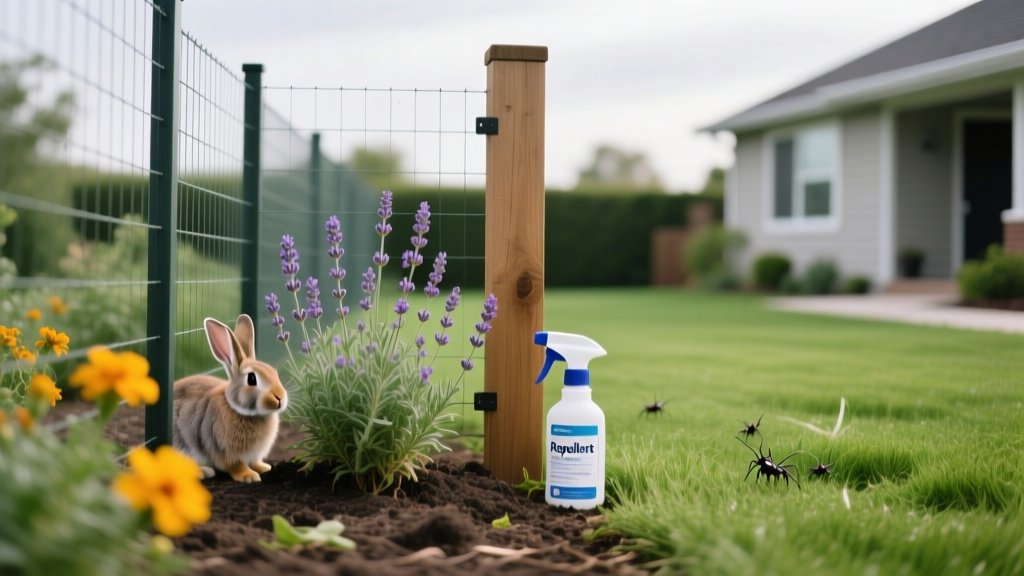
How to Repel Rabbits: Fencing, Sprays & Resistant Plants
Identifying the Threat: The 45-Degree Signature
Before deploying deterrents, confirm that lagomorphs are actually the culprits. The Eastern cottontail (Sylvilagus floridanus) is the primary garden pest across North America, capable of consuming up to two pounds of vegetation daily. Unlike deer, which lack upper incisors and leave jagged, torn stems, rabbits make clean, 45-degree angled cuts on young shoots. If you inspect your garden and find stems sheared off like a pair of pruning snips was used, you are dealing with rabbits.
According to the Internet Center for Wildlife Damage Management, a single breeding pair can produce up to six litters a year. This rapid population compounding means that early spring intervention is critical before the local population peaks in late summer.
Physical Exclusion: The L-Footer Fencing Method
When learning how to repel rabbits, physical barriers remain the only 100% effective, long-term solution. Standard hardware cloth or chicken wire works, but installation technique dictates success. Rabbits are not aggressive diggers, but they will exploit loose soil at the base of a fence.
The L-Footer Technique: Do not simply bury the fence straight down. Bend the bottom 6 inches of your wire mesh outward at a 90-degree angle, creating an 'L' shape that rests on the soil surface (or just under a layer of mulch). When a rabbit digs at the base of the fence, they hit the wire apron and stop. This prevents the need to trench deeply and protects root systems of nearby plants.
Exact Material Specifications
- Mesh Size: 1-inch hexagonal weave. Do not use 2-inch mesh; juvenile kits can easily compress their skulls and squeeze through 1.5-inch gaps.
- Wire Gauge: 18-gauge or 20-gauge galvanized steel. Thinner wire will degrade and rust within two seasons.
- Height: 24 inches above grade. Cottontails rarely jump higher than 18 inches unless chased, but a 24-inch height accounts for winter snow drifts.
- Cost Estimate: As of 2026, 1-inch galvanized poultry wire costs roughly $1.20 to $1.80 per linear foot. Enclosing a 100-square-foot garden (40 linear feet) will cost approximately $65 in materials, excluding metal U-posts ($3.50 each).
Chemical & Scent-Based Repellents: Area vs. Contact
Repellents are highly effective for ornamental beds where fencing is visually unappealing. However, rabbits quickly habituate to static scents. The University of Minnesota Extension recommends rotating active ingredients every 3 to 4 weeks to maintain the element of surprise.
Repellent Active Ingredient Matrix
| Active Ingredient | Brand Example | Mechanism of Action | Rainfastness |
|---|---|---|---|
| Putrescent Whole Egg Solids | Liquid Fence Rabbit & Deer | Olfactory fear response (mimics predator decay) | Moderate (reapply after 0.5' rain) |
| Capsaicin / Hot Pepper Wax | Bonide Hot Pepper Wax | Contact irritant to mucous membranes | High (wax-based binder) |
| Essential Oils (Peppermint/Garlic) | I Must Garden Rabbit Repellent | Strong olfactory masking and irritation | Low (requires frequent reapplication) |
Phytotoxicity Warning: Never apply liquid capsaicin or oil-based repellents when temperatures exceed 85°F or drop below 35°F. Applying these formulations in high heat will cause severe leaf burn (phytotoxicity) on tender ornamentals like hostas and impatiens. Always spray at dusk.
Motion-Activated Deterrents: The Infrared Solution
Ultrasonic sound emitters are largely ineffective against rabbits; their hearing range and the acoustic shadowing caused by dense garden foliage render high-frequency sound useless. Instead, motion-activated sprinklers provide a physical startle response that rabbits do not easily habituate to.
The industry standard is the Orbit 62100 Yard Enforcer (retailing around $85 in 2026). It utilizes a passive infrared (PIR) sensor to detect body heat and motion up to 35 feet away, triggering a 5-second burst of water.
Optimizing Motion Sprinklers for Rabbits
- Sensor Height: Set the PIR sensor to the 'low' sensitivity setting and angle it downward. Rabbits have a low thermal profile; a sensor calibrated for deer height will miss them entirely.
- Foliage Clearance: Trim all grass and low-hanging branches within a 10-foot radius of the sensor. Wind-blown foliage will cause false triggers, draining the 3 AA batteries and emptying your hose spigot pressure.
- Winterization: If you live in a climate with hard freezes, you must blow out the water lines and remove the batteries in late autumn. Internal water expansion will crack the brass valve housing, and cold temperatures will cause battery acid leakage onto the circuit board.
Winter Tree Protection: Guarding the Cambium Layer
In late winter, when herbaceous greenery is buried under snow, rabbits turn to the bark of young trees and shrubs. They will girdle the trunk, eating the nutrient-rich cambium layer right up to the snow line. A fully girdled tree will die the following spring.
To prevent this, wrap the trunks of young fruit trees, dogwoods, and viburnums with 1/4-inch hardware cloth. The cylinder should stand at least 18 inches above your region's maximum anticipated snow depth. Secure the seam with zip ties, and ensure the bottom edge is pressed firmly into the soil to prevent rabbits from crawling underneath the wire during deep snow drifts. Remove the hardware cloth in early spring to prevent trunk girdling as the tree expands and to avoid trapping moisture against the bark.
Habitat Modification & Plant Selection
Deterrence is a two-pronged approach: make the environment hostile and remove the food source. Rabbits require dense cover to hide from hawks and foxes. Eliminate brush piles, tall weedy borders, and dense groundcovers like ivy within a 10-foot perimeter of your vulnerable garden beds.
Rabbit-Resistant Plant Alternatives
While no plant is 100% rabbit-proof (a starving rabbit will eat anything), the following plants contain alkaloids, thick sap, or strong volatile oils that cottontails actively avoid:
- Alliums: Ornamental onions, garlic, and chives.
- Toxic Bulbs: Daffodils (Narcissus) and Snowdrops contain lycorine, which is highly toxic to mammals.
- Aromatic Herbs: Lavender, rosemary, sage, and Russian sage.
- Fuzzy Foliage: Lamb's ear and foxglove. Rabbits dislike the texture of trichomes (leaf hairs) on their tongues.
Conversely, protect your most vulnerable crops. Rabbits show a distinct preference for legumes (peas, beans), brassicas (broccoli, cabbage), and young beet greens. These must be grown inside physical exclusion cages or treated heavily with putrescent egg solids during their early vegetative stages.

