
Pest Control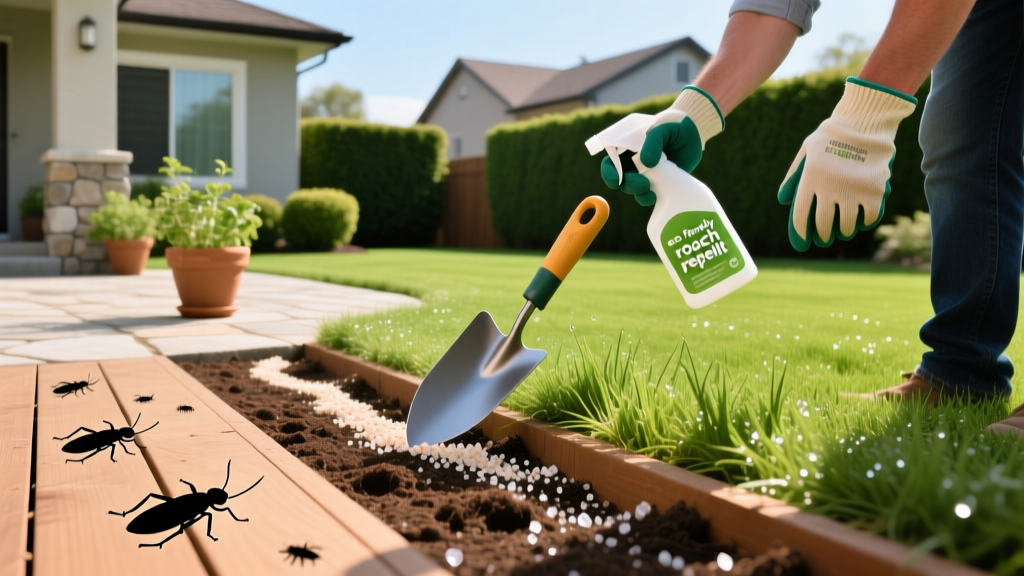
How to Repel Roaches Outdoors: Yard and Perimeter Defense
The Outdoor Roach Threat: Why Your Yard is Ground Zero
When homeowners ask how to repel roaches, they usually focus on kitchen cabinets and bathroom drains. However, species like the American cockroach (Periplaneta americana), Smokybrown cockroach, and Oriental cockroach primarily live outdoors. They breed in yard debris, mulch beds, and sewer systems, only migrating indoors when outdoor conditions become too dry, too cold, or when populations explode. According to entomologists at the University of Florida IFAS, establishing a robust outdoor perimeter defense is the most effective way to prevent these peridomestic species from ever crossing your threshold.
Repelling roaches outdoors requires a multi-layered approach: eliminating the microclimates they rely on for survival, applying strategic chemical or botanical barriers, and altering environmental triggers like exterior lighting. This guide details the exact measurements, products, and techniques required to fortify your yard in 2026.
Phase 1: Harborage and Moisture Elimination
Roaches require three things to thrive: food, shelter, and moisture. Your yard likely provides all three if not actively managed. Oriental and Smokybrown roaches are highly susceptible to desiccation (drying out), meaning they cluster in damp, shaded areas near your foundation.
Warning: The Mulch Mistake
Applying thick layers of organic hardwood mulch directly against your siding creates an ideal roach incubator. Hardwood mulch retains moisture and breaks down into organic matter that roaches consume. Limit mulch depth to a maximum of 2 inches and maintain a strict 12-inch bare soil or gravel buffer between the mulch line and your home's foundation.
Actionable Yard Cleanup Metrics
- Leaf Litter: Rake and remove all leaf accumulation within 10 feet of the foundation. Decaying leaves hold moisture and harbor roach nymphs.
- Firewood Storage: Stack firewood at least 20 feet away from the house and elevate it 6 inches off the ground on metal racks. Never stack wood directly against exterior walls.
- Gutter Maintenance: Clogged gutters overflow, saturating the soil directly against the foundation. Install stainless steel micro-mesh gutter guards (like LeafFilter or Gutterglove) to prevent organic sludge buildup.
- Irrigation Audits: Check sprinkler heads to ensure they are not misting directly onto the siding or pooling water in foundation beds. Adjust spray patterns to leave a 2-foot dry zone around the house.
Phase 2: Perimeter Barrier Treatments
Once the environment is modified, you must establish a chemical or botanical barrier. The goal is to create a treated band around the foundation that repels and kills roaches attempting to cross it. The EPA recommends using targeted, low-toxicity outdoor treatments rather than broad-spectrum yard fogging, which harms beneficial pollinators.
Top Perimeter Products for 2026
| Product / Active Ingredient | Type | Residual Life | Avg. Cost |
|---|---|---|---|
| Bifen IT (Bifenthrin 7.9%) | Synthetic Pyrethroid | 60-90 Days | $25 / 16 oz |
| Cyzmic CS (Lambda-cyhalothrin) | Microencapsulated | 90+ Days | $45 / 8 oz |
| Essentria IC3 (Rosemary/Geraniol) | Botanical / Organic | 14-30 Days | $48 / 16 oz |
| Diatomaceous Earth (Food Grade) | Mechanical Desiccant | Indefinite (if dry) | $15 / 4 lb |
Application Strategy: For synthetic options like Cyzmic CS, the microencapsulated formulation is critical for outdoor use. The microscopic polymer capsules protect the active ingredient from UV degradation and heavy rain, releasing slowly over 90 days. Mix according to label rates (typically 0.2 to 0.8 fl oz per gallon of water) and apply a continuous band 3 feet up the foundation wall and 3 feet out onto the soil using a pump sprayer.
Phase 3: Phototaxis and Structural Exclusion
Many peridomestic roaches exhibit positive phototaxis—they are attracted to light. If your exterior lighting is poorly configured, you are actively beckoning roaches from the street and neighboring yards toward your home.
Lighting Adjustments
Standard cool-white LEDs (4000K-5000K) emit high levels of blue light, which is highly visible to insect photoreceptors. Swap all exterior porch, garage, and pathway bulbs for warm-white LEDs (2700K or lower) or specialized 590nm yellow 'bug lights.' While yellow lights do not strictly 'repel' roaches, they render the light invisible to the insect's visual spectrum, drastically reducing attraction.
Sealing the Envelope
Repellents will eventually degrade, making physical exclusion the ultimate fail-safe. Inspect the exterior foundation for entry points.
- Weep Holes: Brick veneer homes have weep holes to allow moisture to escape. Never seal these with solid caulk. Instead, insert copper mesh (like Stuf-Fit) which blocks roaches and rodents while allowing airflow.
- Pipe Penetrations: Where HVAC lines, water mains, and gas lines enter the house, seal the gaps using a high-quality polyurethane expanding foam (e.g., Great Stuff Gaps & Cracks). For gaps larger than 1 inch, pack the void with copper mesh first, then apply foam over the mesh to prevent roaches from chewing through the foam alone.
- Door Sweeps: Install heavy-duty rubber or bristle door sweeps on all exterior doors. The gap between the door and threshold should be less than 1/8th of an inch.
The Repellent Paradox: Why You Must Also Use Baits
A common mistake in yard defense is relying solely on repellent sprays. While repellents keep roaches out of the house, they do not eliminate the breeding population hiding in your yard's mulch beds or sewer lines. In fact, heavy use of repellents can sometimes cause 'budding,' where a large colony fragments into smaller, harder-to-treat satellite colonies to avoid the chemical barrier.
'Effective outdoor cockroach management requires a combination of residual barrier sprays to block entry and granular baits placed in harborage areas to reduce the overall outdoor population. Relying on one without the other leaves your property vulnerable.' — Penn State Extension Entomology Department
The Baiting Solution: Supplement your liquid barrier with outdoor-specific granular baits. Products containing Indoxacarb (like Advion Insect Granular Bait) or Orthoboric Acid (like Niban FG) are highly moisture-resistant. Broadcast these granules at a rate of 2 to 4 lbs per 1,000 square feet in mulch beds, leaf litter, and around the bases of large trees. The roaches consume the bait, return to their harborage, and die, subsequently transferring the lethal dose to nymphs through coprophagy (eating feces) and emetophagy (eating vomit).
Troubleshooting Common Yard Defense Failures
Problem: Roaches return two weeks after spraying.
Diagnosis: You likely used a non-encapsulated liquid or an organic botanical spray that washed away in the rain or degraded under UV light. Alternatively, the soil was saturated before application, preventing the chemical from binding to the surface. Fix: Switch to a microencapsulated product like Cyzmic CS or Onslaught FastCap. Ensure the soil is dry before application and allow 24 hours for the product to cure before turning on irrigation systems.
Problem: Finding large roaches in the garage despite a perimeter spray.
Diagnosis: Garages often have poor weather stripping on the bottom of the roll-up door, and cardboard boxes stored inside provide harborage and food (the glue on cardboard is a roach food source). Fix: Install a heavy-duty astragal seal on the bottom of the garage door. Remove all cardboard storage and replace it with sealed plastic totes. Apply a desiccant dust like Alpine Dust or Drione Dust into the wall voids and track rails of the garage door.
Problem: Roaches emerging from outdoor drains and sewer cleanouts.
Diagnosis: American cockroaches thrive in municipal sewer systems and migrate up through dry P-traps or loose cleanout caps. Fix: Ensure all exterior cleanout caps are tightly sealed and intact. For patio drains or area drains, pour a gallon of water down them monthly to maintain the P-trap water seal, which blocks sewer gases and roaches. If the drain is unused, seal it with a rubber drain cover or apply a biological drain gel to remove the organic slime layer they feed on.

