
Pest Control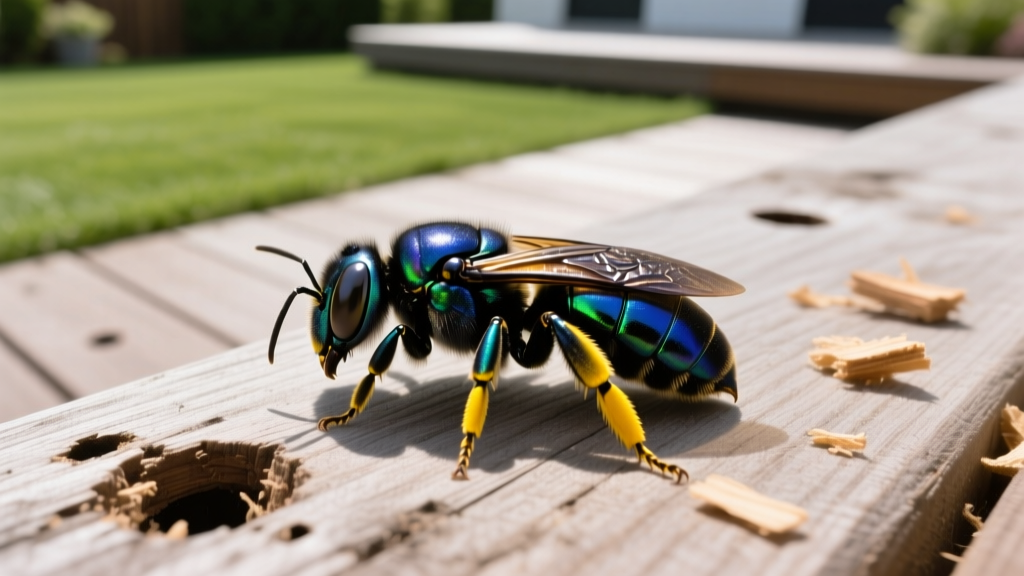
How to Rid of Wood Bees: Effective Carpenter Bee Control
Understanding the Threat: What Are Wood Bees?
When homeowners search for how to rid of wood bees, they are almost always dealing with the Eastern Carpenter Bee (Xylocopa virginica). The colloquial term 'wood bee' stems from their nesting behavior, but it is a critical misconception that these insects consume wood. Unlike termites or carpenter ants, carpenter bees do not eat cellulose. Instead, they use their robust mandibles to excavate perfectly circular tunnels into unpainted, weathered, or soft wood to create galleries for their larvae.
While a single carpenter bee causes minimal structural harm, their behavior is highly philopatric—meaning offspring return to the exact same nesting site year after year. According to Penn State Extension, a single initial gallery can branch into dozens of secondary tunnels over a span of three to five years, compromising the structural integrity of fascia boards, deck railings, and eaves. Furthermore, the tunneling attracts woodpeckers, which will tear apart the wood to reach the bee larvae, causing exponentially more damage than the bees themselves.
Identification: Wood Bees vs. Bumblebees
Before applying any treatment, accurate identification is mandatory. Carpenter bees are frequently mistaken for bumblebees due to their similar size (roughly 1 inch in length). However, their nesting habits and physical characteristics differ drastically.
| Feature | Carpenter Bee (Wood Bee) | Bumblebee |
|---|---|---|
| Abdomen | Shiny, hairless, metallic black | Fuzzy, covered in yellow and black hairs |
| Nesting Site | Excavates tunnels in dead wood / structural lumber | Underground burrows, abandoned rodent holes |
| Aggression | Males are aggressive but lack stingers; females rarely sting | Generally docile, but females will sting if nest is threatened |
| Wood Damage | Leaves 1/2-inch round holes and coarse sawdust (frass) | None |
The Damage Timeline and Lifecycle
Carpenter Bee Excavation Metrics
- Entry Hole Diameter: Exactly 1/2 inch (matches the width of their mandible spread).
- Initial Gallery Depth: 6 to 10 inches straight back into the wood grain.
- Branching Galleries: Can extend up to 4 feet laterally in older, untreated infestations.
- Frass Output: A single active female produces roughly 1/4 cup of coarse, yellowish sawdust during the 5-to-7-day excavation process.
In early spring (April to May), adult bees emerge from overwintering. Males establish territories and aggressively dive-bomb intruders, though they are physically harmless. Females begin chewing entry holes, turn 90 degrees to bore with the wood grain, and create individual brood chambers. Each chamber is provisioned with a pollen-nectar ball and a single egg, then sealed with a plug of chewed wood pulp. By late summer, the next generation matures and remains inside the wood until the following spring.
Step-by-Step Treatment: How to Rid of Wood Bees
Eradicating an active infestation requires a multi-phase approach targeting both the adult bees and the hidden larvae. Liquid sprays alone are highly ineffective because they absorb into the wood and fail to reach the deep brood chambers.
Phase 1: Dusting the Galleries (Days 1-3)
Insecticidal dust is the gold standard for carpenter bee control. Dust does not absorb into the wood; it coats the interior walls of the tunnel. When bees enter and exit, the dust clings to their bodies and is carried deep into the brood chambers.
- Select the Right Dust: Use DeltaDust (Deltamethrin 0.05%) or Sevin Dust (Carbaryl 5%). DeltaDust is moisture-resistant, making it ideal for exterior eaves and fascia.
- Timing is Critical: Apply the dust at dusk or after dark. Carpenter bees are diurnal and will be inside the galleries at night, minimizing the chance of being stung and maximizing direct contact.
- Application Tool: Use a bellows hand duster (such as the JT Eaton Bellow Duster, approx. $15). Fill the duster only 1/3 full to allow air space for the dust to aerosolize.
- Inject the Dust: Insert the duster nozzle into the 1/2-inch hole and puff 2 to 3 times. Do not plug the hole yet. Leave it open so returning bees track the poison inside.
Phase 2: Foaming Deep Void Spaces (Day 4)
For older infestations where galleries have branched extensively, dust may not reach the furthest chambers. Termidor Foam (Fipronil 0.06%) utilizes a non-repellent active ingredient with a transfer effect. Bees cannot detect the fipronil, so they walk through it and spread it to other bees in the colony.
- Attach the injection straw to the Termidor Foam canister (approx. $28-$32 per can).
- Insert the straw into the entry hole and spray for 3 to 5 seconds. The foam will expand to fill voids up to 4 inches in diameter.
- The foam dries within minutes, leaving a lethal residual coating inside the wood.
Phase 3: Surface Residual Barrier (Day 7)
To deter new bees from drilling adjacent holes, apply a microencapsulated liquid residual spray to the exterior wood surfaces. Cyzmic CS (Lambda-cyhalothrin) or Onslaught FastCap provide a 60-to-90-day residual barrier. Mix according to label rates (typically 0.8 fl oz per gallon of water) and spray the fascia, soffits, and deck railings using a pump sprayer.
CRITICAL SAFETY WARNING: Never seal a carpenter bee tunnel immediately after treatment. If you plug the hole while live bees or larvae are inside, they will simply chew a new exit hole, often breaking through interior drywall or exterior paint. Wait a minimum of 72 to 96 hours after dusting to ensure all insects have been eliminated.
Product Comparison Matrix: Carpenter Bee Insecticides
| Product Name | Active Ingredient | Formulation | Avg. Cost (2026) | Best Use Case |
|---|---|---|---|---|
| DeltaDust | Deltamethrin (0.05%) | Waterproof Dust | $25 / 1 lb | Exterior high-moisture tunnels (eaves, decks) |
| Termidor Foam | Fipronil (0.06%) | Expanding Aerosol | $30 / 20 oz | Deep, heavily branched legacy galleries |
| Sevin Dust | Carbaryl (5.0%) | Standard Dust | $12 / 1 lb | Budget-friendly interior or sheltered tunnels |
| Cyzmic CS | Lambda-cyhalothrin | Liquid Suspension | $45 / 8 oz | Preventative surface barrier spraying |
Repairing and Sealing the Tunnels
Once you have confirmed the bees are dead (no fresh frass or buzzing for at least 4 days), the holes must be sealed to prevent future generations from reusing the galleries. According to NC State Extension, proper physical exclusion is the only permanent solution to recurring wood bee damage.
- Clean the Entry: Use a straightened wire hanger or a specialized tunnel cleaning brush to pull out any remaining dead bees, pupae, and loose frass.
- Insert a Physical Plug: Do not rely solely on wood putty, as emerging bees can easily chew through it. Cut a 1/2-inch wooden dowel to a 2-inch length. Coat the dowel in exterior-grade wood glue (like Titebond III) and tap it into the hole with a rubber mallet.
- Fill and Sand: Apply a high-quality exterior wood filler (such as Minwax High Performance Wood Filler) over the dowel to make it flush with the surface. Sand smooth once cured (approx. 30 minutes).
- Paint or Seal: Carpenter bees strongly prefer unpainted, bare wood. Painting the repaired area with a high-gloss or semi-gloss exterior acrylic paint is highly effective. If you prefer the natural wood look, apply at least two coats of heavy-duty polyurethane or a thick, oil-based stain with a clear topcoat.
Natural and Non-Toxic Deterrents
For homeowners who want to avoid synthetic pyrethroids, natural deterrents exist, though their efficacy is significantly lower and requires frequent reapplication.
- Citrus Oil Sprays: Boiling citrus peels (orange, lemon, grapefruit) in water and spraying the concentrated liquid into holes can deter nesting. The d-limonene in citrus acts as a mild solvent and repellent. Reapply weekly.
- Almond Oil: Rubbing pure almond oil around the rims of entry holes masks the pheromone trails bees use to locate old nests. This is most effective as a preventative measure in early spring before drilling begins.
- Carpenter Bee Traps: Wooden traps with pre-drilled angled holes and a plastic bottle base can catch foraging males. However, traps do not eliminate the breeding females or the larvae inside the wood, making them a supplementary tool rather than a primary treatment.
Frequently Asked Questions
Do wood bees sting?
Male carpenter bees are highly territorial and will aggressively fly directly at your face, but they lack a stinger and are completely harmless. Females possess a stinger but are highly docile and will only sting if physically handled or trapped against the skin.
Why are woodpeckers destroying my fascia boards?
Woodpeckers are a secondary pest. They hear the carpenter bee larvae moving inside the wood galleries and will rip open the fascia boards to eat them. Treating the bee infestation with dust or foam will eliminate the food source, causing the woodpeckers to move on.
Can I just spray the holes with wasp freeze?
Wasp freeze (typically containing Tetramethrin) provides an instant knockdown but leaves zero residual effect. It will kill the bee currently in the hole, but will not protect the gallery from new bees attempting to use it the following week. Always use a residual dust or foam.

