
Pest Control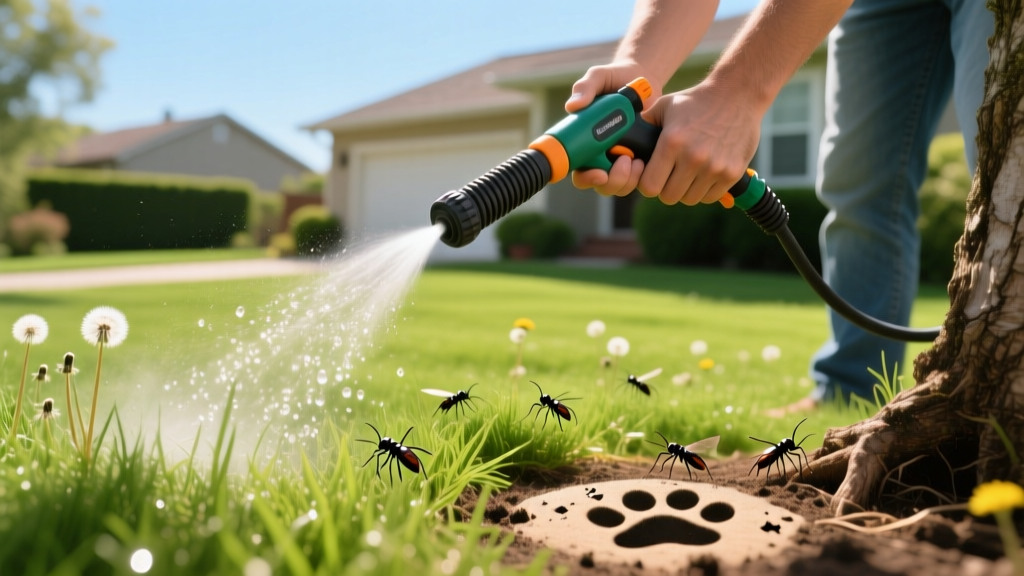
How to Spray Yard for Fleas: Step-by-Step Outdoor Defense
The 95% Rule: Why Your Yard is the Real Battleground
If you are treating your dog or cat for fleas but ignoring the lawn, you are fighting a losing battle. According to entomological data from the UC Agriculture and Natural Resources integrated pest management program, the adult fleas you see on your pets represent only 5% of the total infestation. The remaining 95%—consisting of eggs, larvae, and pupae—live in your yard's soil, thatch, and shaded debris.
Learning how to spray yard for fleas effectively requires breaking this life cycle outdoors. Fleas do not thrive in direct, scorching sunlight; UV radiation rapidly desiccates their eggs. Instead, they harbor in microclimates with high humidity and organic matter: under wooden decks, along fence lines, in dog runs, and beneath dense shrubbery. A successful outdoor defense strategy targets these specific zones with a combination of adulticides and Insect Growth Regulators (IGRs).
⚠️ Critical Pet Safety Warning: Pyrethroid-based adulticides (like permethrin and bifenthrin) are highly toxic to cats when wet. You must keep all felines indoors during application and until the treated surfaces are 100% dry, which typically takes 2 to 4 hours depending on humidity. Once dry, the chemical binds to the soil and plant matter, rendering it safe for pets to walk on.
Selecting Your Chemistry: Adulticides vs. IGRs
To achieve total yard defense, you must use a two-pronged chemical approach. An adulticide knocks down the current biting population, while an IGR acts as birth control, preventing larvae from molting into biting adults. In 2026, professional-grade concentrates remain the most cost-effective route compared to pre-mixed hardware store sprays.
| Active Ingredient | Type | Target Stage | Residual Life | Cost per 1,000 sq ft |
|---|---|---|---|---|
| Bifenthrin (e.g., Talstar P) | Adulticide | Adults | 30-45 days | ~$0.10 |
| Permethrin 10% (e.g., Martin's) | Adulticide | Adults/Larvae | 14-21 days | ~$0.08 |
| Pyriproxyfen (e.g., Archer IGC) | IGR | Eggs/Larvae | 150+ days | ~$0.15 |
| S-Methoprene (e.g., Precor) | IGR | Pupae/Larvae | 30-60 days | ~$0.12 |
The Pro Tank Mix: For severe infestations, mix 1 ounce of Bifenthrin and 1 ounce of Pyriproxyfen per gallon of water. This single gallon will cover approximately 1,000 square feet of turf, providing both an immediate kill and a 5-month reproductive barrier.
Pre-Spray Yard Preparation (Do Not Skip)
Spraying an overgrown, dry yard is a waste of chemicals. The spray must penetrate the thatch layer and reach the soil surface where larvae feed on organic debris and adult flea feces (flea dirt).
- Mow to 2.5 Inches: Cut the grass slightly shorter than your normal height. This removes adult flea harborages and allows the spray nozzle to reach the soil base without excessive chemical waste on the grass blades.
- Clear Organic Debris: Rake out leaf litter, pine needles, and dead thatch from under shrubs and along fence lines. Flea larvae feed on this debris; removing it starves them and exposes them to the insecticide.
- Pre-Water the Soil: Water your lawn deeply 24 hours before spraying. Damp soil prevents the insecticide from sinking too deeply into earthworm burrows and soil cracks, keeping the active ingredient in the top 1/4 inch of thatch where fleas actually live. Furthermore, moisture stimulates flea pupae to hatch, exposing them to the adulticide.
Step-by-Step: How to Spray Yard for Fleas
Timing is critical. According to the Environmental Protection Agency (EPA), pyrethroids degrade rapidly under intense UV light. Always apply your treatment in the late afternoon or early evening. This maximizes the chemical's residual life and protects foraging honeybees, which are inactive at dusk.
- Calibrate Your Equipment: If using a 2-gallon pump sprayer (like the Chapin Professional), set the nozzle to a fine mist or flat fan pattern. Walk at a steady pace of 3 feet per second.
- Target the Microclimates: Do not waste time spraying the middle of a sun-baked front lawn. Focus 80% of your mixture on the 'flea zones': under decks, inside dog houses, along the shaded side of your home, and beneath dense evergreen shrubs.
- Apply with a 50% Overlap: Spray in parallel passes, overlapping each pass by half the width of the spray fan to ensure zero untreated gaps in the turf.
- Treat Vertical Surfaces: Spray the base of your home's foundation, the lower 12 inches of your fence, and the trunks of shaded trees up to 2 feet high. Fleas use these vertical structures as windbreaks and transit routes.
💡 Expert Tip: The Nematode Alternative
If you maintain an organic yard or have sensitive koi ponds nearby where chemical runoff is a risk, apply Steinernema carpocapsae beneficial nematodes. These microscopic worms hunt flea larvae in the soil. Apply them via hose-end sprayer at a rate of 1 million nematodes per 2,000 square feet, ensuring the soil temperature is above 55°F.
If you maintain an organic yard or have sensitive koi ponds nearby where chemical runoff is a risk, apply Steinernema carpocapsae beneficial nematodes. These microscopic worms hunt flea larvae in the soil. Apply them via hose-end sprayer at a rate of 1 million nematodes per 2,000 square feet, ensuring the soil temperature is above 55°F.
Hose-End vs. Pump Sprayers: Which is Better?
Your application method dictates your coverage accuracy. While hardware stores sell convenient hose-end flea sprays (like Wondercide Outdoor or Vet's Best), they often lack the penetrating power and precise mixing ratios of professional gear.
Hose-End Sprayers (e.g., Ortho Dial N Spray)
- Pros: High volume, excellent for large properties (1/2 acre+), forces liquid deep into thick thatch via water pressure.
- Cons: Dilution rates are notoriously inaccurate; prone to over-watering the lawn and causing chemical runoff into storm drains.
Compression Pump Sprayers (e.g., Chapin 2-Gallon)
- Pros: Exact chemical calibration, zero water waste, allows precise targeting under decks and inside crawlspaces.
- Cons: Labor-intensive, requires manual pumping, limited to 1,000–2,000 sq ft per tank fill.
Verdict: Use a pump sprayer for targeted perimeter and shaded zone defense. Use a hose-end sprayer only for broad-acre turf applications where exact soil-level penetration is less critical than total foliage coverage.
Post-Spray Maintenance and Rebound Prevention
A single application rarely eliminates a severe outdoor infestation because flea pupae are encased in a sticky, chemical-resistant cocoon. The National Pesticide Information Center (NPIC) notes that pupae can remain dormant in the soil for months, waiting for the vibrations and carbon dioxide of a passing host before emerging.
The 21-Day Reapplication Rule
You must spray a second time exactly 14 to 21 days after the initial application. This specific window catches the newly emerged adults that hatched from the protected pupal stage before they have a chance to mate and lay a new generation of eggs. If it rains more than 1 inch within 48 hours of your first spray, you must reapply immediately, as the mechanical action of heavy rain can wash unbound chemicals out of the thatch layer.
Common Mistakes That Cause Flea Rebound
- Spraying at Noon: High heat causes the water carrier to evaporate before the active ingredient can bind to the soil, leaving crystallized residue on grass blades that degrades in hours.
- Ignoring the Dog Run: Dog runs have the highest concentration of flea eggs due to constant shedding. You must spray these dirt or gravel areas heavily, or consider replacing the top 2 inches of soil with fresh cedar chips, which naturally repel adult fleas.
- Skipping the Wildlife Factor: If opossums, feral cats, or raccoons are crossing your yard at night, they are dropping fresh flea eggs daily. Use motion-activated sprinklers or secure trash bins to break the wildlife transit route, otherwise, your chemical barrier will be constantly overwhelmed.
Mastering how to spray yard for fleas is less about the brand of chemical you buy and more about the precision of your preparation, timing, and follow-up. By combining a fast-acting adulticide with a long-lasting IGR, targeting shaded microclimates, and executing a mandatory 21-day follow-up, you can reclaim your outdoor spaces and protect your pets from the relentless cycle of outdoor flea infestations.

