
Pest Control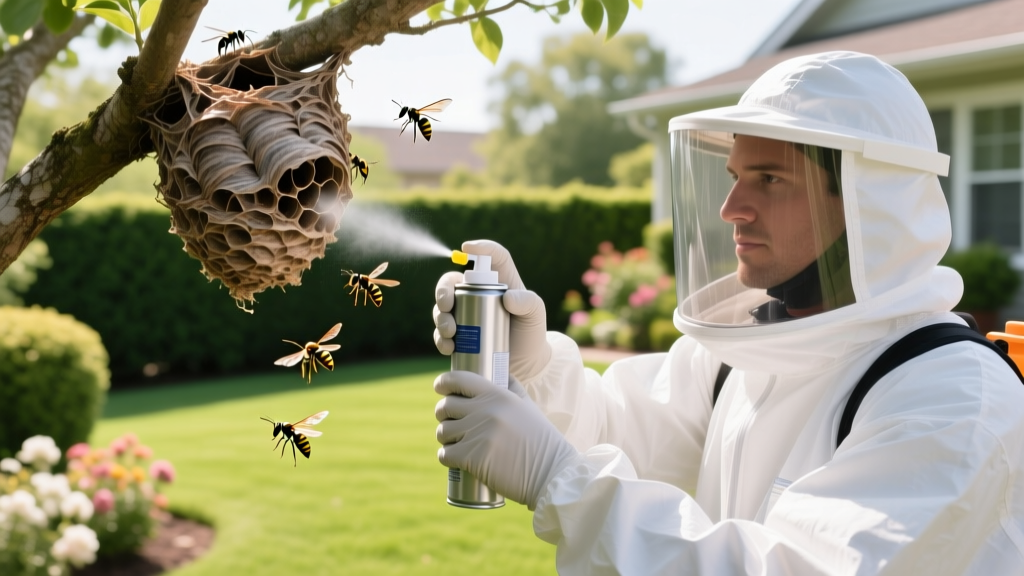
How to Take Out a Wasp Nest: Safe Yard Removal Guide
Identify the Threat: Paper Wasps vs. Yellowjackets vs. Hornets
Before attempting any removal protocol, accurate species identification dictates your chemical and tactical approach. Misidentifying a subterranean yellowjacket colony as a harmless paper wasp nest can result in hundreds of defensive stings. According to University of Minnesota Extension, understanding nest architecture and location is the first critical step in yard defense.
| Species | Nest Location & Architecture | Aggression Level | Colony Size (Late Summer) |
|---|---|---|---|
| Paper Wasps | Open, umbrella-shaped combs under eaves, pergolas, and deck railings. | Low (only if nest is directly touched) | 20 to 200 adults |
| Yellowjackets | Subterranean (abandoned rodent burrows) or enclosed papery nests in wall voids. | Extremely High (defend ground perimeter aggressively) | 1,000 to 4,000 adults |
| Bald-Faced Hornets | Large, enclosed, football-shaped paper nests in trees and shrubs. | Moderate (less defensive of foraging areas) | 100 to 700 adults |
Decision Framework: DIY Removal vs. Professional Extermination
Not every nest should be tackled by a homeowner. Use this decision matrix to determine if you can safely execute the removal or if you need to hire a licensed pest control operator.
Stop and Call a Professional If:
- The nest is located inside a wall void, attic, or underground rodent burrow (sealing the exit hole traps them inside your home's structure).
- The nest exceeds the size of a standard basketball.
- You or any household member has a documented Hymenoptera venom allergy.
- The nest is situated higher than 12 feet, requiring an unstable ladder setup.
For aerial paper wasp nests under 8 inches in diameter, or accessible bald-faced hornet nests, DIY chemical application is highly effective and costs roughly $8 to $15 in materials, compared to $150 to $350 for professional yard treatment services.
Step-by-Step: How to Take Out a Wasp Nest at Night
Wasps are diurnal. Foraging workers return to the nest at dusk, and their metabolic rate drops significantly when ambient temperatures fall below 65°F (18°C). Penn State Extension notes that nighttime applications drastically reduce the risk of being stung because the insects are sluggish and poor fliers in the dark.
Essential Gear Checklist
- Protective Clothing: Thick denim jeans tucked into socks, a heavy canvas jacket, and leather work gloves. Do not rely on standard cotton t-shirts.
- Head/Face Protection: A commercial bee veil or a wide-brimmed hat with fine mesh netting secured around the collar.
- Illumination: A headlamp fitted with a red cellophane filter. Wasps are highly attracted to white and UV light, but their compound eyes cannot process the red light spectrum effectively.
- Chemical Application: Spectracide Wasp & Hornet Killer (Water-Based). This specific model shoots a concentrated stream up to 27 feet and contains Lambda-cyhalothrin, which provides rapid knockdown and residual control. (Average retail: $7.50 per 14 oz can).
The Execution Protocol
- Plan Your Escape Route: Clear the path behind you of garden hoses, tools, or tripping hazards before approaching the nest.
- Approach at Dusk: Wait until at least 45 minutes after sunset. Keep your red-filtered light pointed at the ground, not directly at the nest entrance.
- Establish Distance: Stop 12 to 15 feet away from the nest. This keeps you out of the immediate defensive swarm radius while remaining well within the 27-foot spray range.
- Apply the Chemical: Aim directly at the nest opening or the central comb. Depress the nozzle continuously for 4 to 6 seconds, soaking the structure. The water-based formulation penetrates the papery envelope better than fast-evaporating solvent foams.
- Retreat Immediately: Turn and walk away briskly. Do not run unless actively pursued, as rapid movement and heavy breathing emit carbon dioxide and vibration triggers.
- Wait 48 Hours: Allow the residual Lambda-cyhalothrin to kill returning foragers over the next two days. Do not knock the nest down prematurely.
- Removal and Disposal: After 48 hours of zero activity, use a long stick to knock the dead nest into a heavy-duty contractor trash bag. Seal it tightly and dispose of it in your municipal waste bin.
Organic & Non-Toxic Alternatives for Garden Beds
If the nest is small (under 3 inches) and located near edible garden crops where synthetic pyrethroids are prohibited, surfactant-based treatments are a viable alternative. According to the Environmental Protection Agency (EPA), minimum-risk pesticides can be effective for localized, small-scale infestations.
Surfactants work by breaking the surface tension of water, allowing the liquid to penetrate the wasp's spiracles (breathing pores) and coat their exoskeleton, causing rapid asphyxiation without leaving toxic soil residue.
The Dish Soap Protocol
Mix 2.5 tablespoons of Dawn Ultra dish soap (the original blue formula contains the optimal surfactant concentration) into a 16-ounce pump sprayer filled with warm water. Shake gently to avoid excessive suds. Pump the sprayer to maximum pressure and drench the small nest from 4 feet away. This method requires extreme proximity and should only be used on tiny, early-season satellite nests while wearing full protective gear.
Post-Removal Yard Defense: Preventing Re-Nesting
Wasps rely on pheromone markers to identify favorable nesting sites. If you remove a nest but fail to neutralize the biological markers, a new queen may colonize the exact same pergola joint or eave the following spring.
Physical and Chemical Deterrents
- Pheromone Neutralization: Scrub the attachment point of the removed nest with a solution of 50% white vinegar and 50% water to strip residual scent markers.
- Residual Barrier Sprays: Apply a micro-encapsulated insecticide like Syngenta Demand CS (Lambda-cyhalothrin 9.7%) to the eaves and deck railings in early April. This product costs roughly $65 per pint but provides up to 90 days of residual yard defense against scout queens.
- Decoy Nests: Wasps are highly territorial and will not build a nest within 200 feet of an established colony. Hanging realistic decoy nests (such as the Essort Wasp Nest Decoy, roughly $12 for a 3-pack) under your rooflines in early spring tricks scout queens into bypassing your property.
- Habitat Modification: Ensure all outdoor trash receptacles have tight-fitting lids. Yellowjackets are heavily attracted to protein and sugar sources in late summer. Keep fallen fruit picked up from beneath orchard trees and ensure hummingbird feeders are equipped with bee guards.
Troubleshooting Common Removal Failures
If you observe continued wasp activity 72 hours after your initial chemical application, one of three failure modes has likely occurred:
- Missed the Queen: You sprayed the outer envelope but failed to penetrate the central comb where the queen resides. Re-apply the aerosol spray, focusing strictly on the entry hole to ensure the chemical reaches the brood chambers.
- Satellite Nests: Large colonies often build secondary overflow nests nearby. Inspect a 50-foot radius around the original site for secondary combs.
- Rain Wash-Off: If a heavy rainstorm occurred within 12 hours of your application, the residual chemical was likely washed away. Wait for the foliage to dry and reapply a fresh coat of spray.

