
Pest Control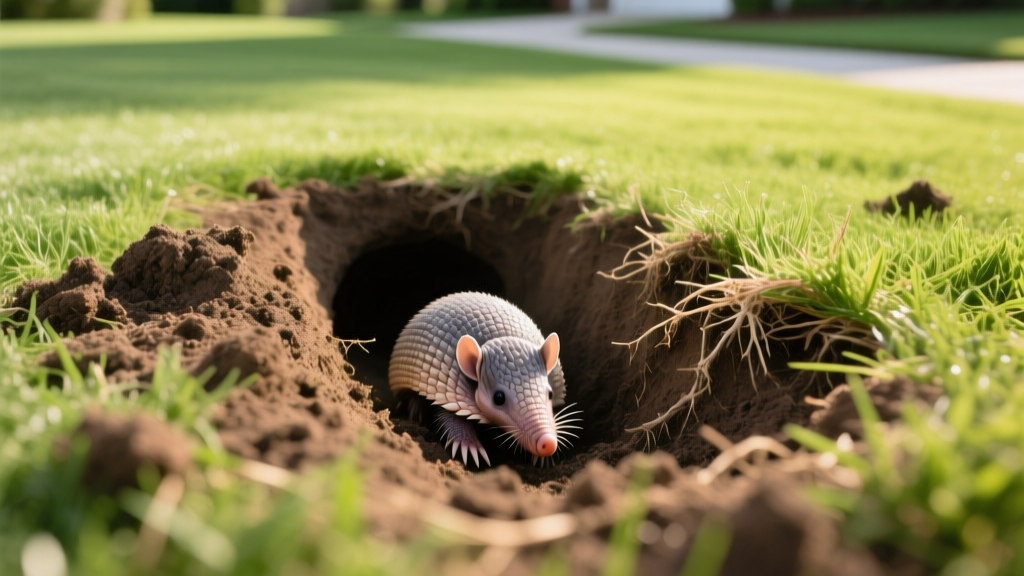
What Do Armadillo Holes Look Like? A Lawn Identification Guide
The Anatomy of an Armadillo Hole
If you are wondering what armadillo holes look like, the first step is understanding that the nine-banded armadillo (Dasypus novemcinctus) creates two distinct types of excavations in residential landscapes: shallow feeding holes and deep burrow entrances. Identifying the difference is critical for assessing the scale of the infestation and determining the correct repair strategy.
1. Shallow Feeding Holes
Armadillos are voracious insectivores, and 90% of their diet consists of grubs, beetles, ants, and earthworms. When foraging, they use their powerful front claws to tear through the turf.
- Diameter: Typically 3 to 5 inches wide.
- Depth: Shallow, usually 1 to 3 inches deep.
- Shape: Conical or V-shaped, resembling a miniature funnel.
- Pattern: Scattered randomly across the lawn, often concentrated in damp areas, flowerbeds, or near the edges of driveways where soil moisture is higher and insects are abundant.
2. Deep Burrow Entrances
These are the primary living quarters and nesting sites. An armadillo will dig a main burrow that can extend up to 15 feet long and 5 feet deep, with multiple secondary escape tunnels.
- Diameter: 7 to 8 inches wide (just large enough for their carapace to fit through).
- Depth: Plunges downward at a steep 40-degree angle.
- The 'Apron': The most defining visual characteristic is the displaced soil. Unlike groundhogs that build tall, symmetrical mounds, armadillos push dirt outward, creating a low, fan-shaped apron of loose soil extending 1 to 2 feet from the entrance.
Armadillo Holes vs. Other Lawn Pests
Misidentifying the culprit leads to ineffective treatment. Skunks, raccoons, and groundhogs also dig in yards, but their excavation signatures differ significantly. Use this comparison matrix to confirm your pest before applying deterrents.
| Pest | Hole Diameter | Depth | Soil Displacement Pattern | Primary Target |
|---|---|---|---|---|
| Armadillo | 7-8 inches (burrow) / 3-5 inches (feeding) | Up to 15 ft (burrow) / 1-3 inches (feeding) | Low, fan-shaped apron of loose dirt | Grubs, ants, earthworms |
| Skunk | 3-4 inches | 1-3 inches | Small, conical piles of dirt; neat edges | White grubs, bee nests |
| Raccoon | 3-5 inches (sod chunks) | Surface level | Sod is peeled or rolled back like a carpet | Grubs, Japanese beetles |
| Groundhog | 10-12 inches | Up to 5 feet deep | Massive, symmetrical mound (up to 2 feet wide) | Vegetation, roots, clover |
| Vole | 1-2 inches | Surface to 6 inches | No mound; creates raised surface runways | Plant roots, bulbs, bark |
Why Armadillos Target Specific Lawn Areas
Armadillos do not dig randomly. They rely heavily on their olfactory senses to locate prey beneath the soil surface. According to wildlife management experts at the Internet Center for Wildlife Damage Management, armadillos prefer loose, porous, and moist soils. If your lawn has poor drainage, frequent overwatering, or a heavy layer of thatch trapping moisture, it creates an ideal environment for soil-dwelling insects—and consequently, an ideal foraging ground for armadillos.
⚠️ Structural Warning: While shallow feeding holes are a cosmetic nuisance, deep burrows located near foundations, retaining walls, or concrete patios can cause severe structural damage. A single armadillo burrow system can displace over 100 pounds of soil, leading to foundation settling or patio collapse over time.
Action Plan: How to Fill and Repair Armadillo Burrows
Simply shoveling dirt back into an armadillo hole will not work; the armadillo will easily re-excavate it the following night. Follow this specific protocol to permanently seal the burrow and restore the turf.
Step 1: Verify the Burrow is Vacant
Before sealing, ensure the armadillo is not inside. Insert a long, flexible stick into the hole. If the tunnel takes a sharp turn or you feel resistance, leave the hole open for 24 hours. Place a few smooth stones or a layer of flour at the entrance. If the stones are pushed aside or the flour is disturbed the next morning, the burrow is active. Wait until the armadillo abandons it (usually within a few days) or use a live trap first.
Step 2: Collapse the Tunnel Network
Use a tamping bar or a long piece of rebar to probe the soil around the entrance. Punch down repeatedly to collapse the shallow secondary tunnels. This removes the structural integrity of the burrow, making it unappealing for the armadillo or other pests (like snakes or skunks) to reclaim.
Step 3: Fill with a High-Density Soil Mix
Do not use pure topsoil, which is too loose. Mix 60% native clay-heavy soil, 30% coarse builder's sand, and 10% compost. The sand and clay create a dense, compact matrix that is difficult for armadillo claws to penetrate. Shovel the mix into the hole, tamping it down every 4 inches with a hand tamper or the flat end of a digging bar.
Step 4: Overseed and Hydrate
Top the filled hole with 1 inch of premium topsoil. Broadcast grass seed matching your existing lawn (e.g., Bermudagrass for southern zones, Tall Fescue for transition zones). Water heavily for the first 48 hours to help the soil mix settle and eliminate air pockets.
Proven Deterrents to Keep Armadillos Out
Repairing holes is only half the battle. To prevent future damage, you must alter the environment and install physical or chemical barriers. Research from the University of Georgia Extension highlights that habitat modification combined with exclusion yields the highest long-term success rates.
1. Eliminate the Food Source (Grub Control)
If there are no grubs, the armadillo will move on. Apply a curative grub treatment containing Trichlorfon (e.g., Dylox) if you see active damage in late summer, or a preventative treatment containing Imidacloprid (e.g., Merit) in early spring. Alternatively, apply beneficial nematodes (Heterorhabditis bacteriophora) at a rate of 1 billion nematodes per acre for a purely organic approach. Expect to pay between $40 and $65 for professional-grade chemical treatments covering 5,000 square feet.
2. Physical Exclusion Fencing
Armadillos are poor climbers but excellent diggers. Standard chicken wire is useless. You must use 19-gauge, 1/2-inch galvanized hardware cloth. Dig a trench 18 inches deep along your property line or garden perimeter. Bury the hardware cloth so it extends 18 inches below ground and 12 inches above ground. Crucially, bend the bottom 6 inches of the wire outward (away from the yard) at a 90-degree angle. When the armadillo digs down and hits the wire, it will not know to dig deeper to bypass it.
3. Castor Oil Repellents
Armadillos have highly sensitive noses. Castor oil-based repellents, such as Nature's Mace Armadillo Repellent (typically $25 to $35 for a 32oz concentrate), coat the soil and mask the scent of grubs while irritating the armadillo's nasal passages. Apply using a hose-end sprayer every 3 to 4 weeks, or immediately after heavy rainfall. This is most effective for protecting specific focal points like flowerbeds rather than entire multi-acre properties.
Frequently Asked Questions
Do armadillos carry diseases dangerous to humans?
Yes. The nine-banded armadillo is one of the only mammals, besides humans, known to carry Mycobacterium leprae, the bacterium that causes Hansen's disease (leprosy). While transmission is rare, the CDC advises never handling an armadillo with bare hands. Always wear thick leather gloves when filling burrows or handling traps, and wash your hands thoroughly afterward.
How many holes can an armadillo dig in one night?
A single foraging armadillo can dig 15 to 20 shallow feeding holes in a single night, especially if the soil is soft and damp from recent irrigation or rainfall. This rapid pace is why early intervention is critical.
Will mothballs or ammonia keep armadillos away?
No. Using mothballs (naphthalene) or ammonia outdoors is illegal in many jurisdictions, highly toxic to local wildlife and pets, and entirely ineffective against armadillos. The chemicals dissipate rapidly in open soil and do not penetrate deep enough into the burrow to deter the animal. Stick to EPA-registered castor oil repellents or physical exclusion.

