
Pest Control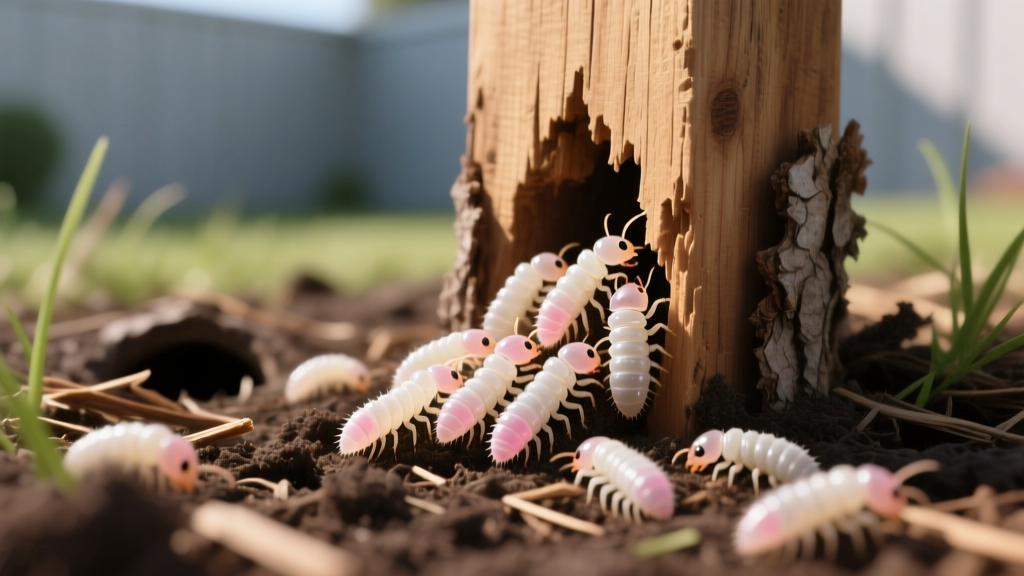
How to Identify and Eliminate Termite Larvae in Your Yard
The 'Termite Larvae' Misconception: Nymphs vs. True Larvae
When homeowners dig into their garden beds or turn over mulch, they frequently encounter pale, segmented, soft-bodied insects and immediately search for solutions to get rid of 'termites larvae.' However, from an entomological standpoint, termites do not have a true larval stage. Unlike ants or beetles (which undergo complete metamorphosis and produce true larvae), termites are hemimetabolous insects. They undergo incomplete metamorphosis, meaning they hatch from eggs as nymphs that closely resemble smaller, paler versions of the adults.
Understanding this biological distinction is critical for yard defense. If you are finding true, legless, C-shaped white grubs in your soil, you are likely looking at the larvae of scarab beetles (like June bugs or Japanese beetles), not termites. Conversely, if you find pale, six-legged, soft-bodied nymphs clustered near wood-to-soil contact points, you have an active subterranean termite colony breeding in your yard. Misidentifying these pests leads to wasted money on the wrong pesticides. According to entomologists at the University of Florida IFAS, accurate identification of immature termites is the first step in preventing structural damage to your home.
Visual Identification: Spotting Immature Termites in the Soil
To properly execute a yard defense strategy, you must accurately differentiate termite nymphs from other common soil-dwelling immatures. Use the comparison matrix below when inspecting your perimeter.
| Feature | Termite Nymphs ('Larvae') | Ant Larvae | White Grubs (Beetle Larvae) |
|---|---|---|---|
| Legs | Six distinct, jointed legs | Completely legless | Six short legs near the head |
| Body Shape | Elongated, segmented, straight | Cylindrical, slightly curved, maggot-like | C-shaped, thick, curled into a 'C' |
| Head Capsule | Distinct, pale yellow or brown head | No distinct head capsule | Hard, distinct brown/orange head |
| Location | Inside mud tubes, damp soil, decaying wood | Deep inside ant nests, protected chambers | Feeding on grass roots in the thatch layer |
Yard Defense: Why Immature Termites Threaten Your Perimeter
Finding termite nymphs in your yard indicates that a mature, reproductive colony is established nearby. Subterranean termites require constant contact with soil moisture to survive. Your yard provides the perfect foraging ground if it contains excessive mulch, wood debris, or poor drainage. The EPA's Termite Control Guidelines emphasize that eliminating yard-level moisture and food sources is just as vital as chemical barriers.
⚠️ Mulch & Moisture Warning: Never pile mulch higher than 2 inches, and always maintain a strict 6-inch gap between any mulch bed and your home's concrete foundation. Mulch retains the exact moisture levels termite nymphs need to survive outside the main colony.
Targeted Soil Treatment Protocols
If you have confirmed the presence of termite nymphs near your foundation, you must establish a continuous chemical trench. The industry standard for non-repellent liquid termiticides is Fipronil (9.1% concentration), commonly sold under the brand name Taurus SC or Termidor SC.
Step-by-Step Trenching Application
- Calculate the Perimeter: Measure the linear footage of your foundation. A standard 20 oz bottle of Taurus SC costs approximately $45 to $55 and treats 60 linear feet.
- Dig the Trench: Using a trenching shovel, dig a trench exactly 6 inches wide and 6 inches deep directly against the foundation wall.
- Mix the Solution: Dilute 0.8 fluid ounces of Fipronil 9.1% per gallon of water. You will need 4 gallons of finished solution for every 10 linear feet of trench.
- Apply and Backfill: Pour the solution evenly into the trench. Allow it to soak into the soil for 2 hours, then backfill the trench with the excavated dirt, treating the backfill dirt at a rate of 1 gallon per 5 cubic feet as you shovel it back in.
Bait Stations vs. Liquid Trenching: Choosing Your Defense
While liquid trenching provides an immediate, continuous barrier, baiting systems offer a different approach to colony elimination. Here is a practical decision framework for selecting your yard defense method:
- Choose Liquid Trenching (Fipronil) If: You need immediate protection, your soil is well-draining, and you want a cost-effective solution (approx. $0.75 - $1.00 per linear foot for DIY materials). The non-repellent nature of Fipronil means foraging workers and nymphs unknowingly carry the toxin back to the colony, causing a secondary kill.
- Choose Bait Stations (e.g., Advance Termite Bait System) If: Your property has a high water table, you have a well on the property, or your foundation features complex landscaping and hardscaping that makes continuous trenching impossible. Bait stations cost roughly $12 to $15 per station, placed every 10 feet, plus $30 per inspection cartridge.
Biological and Organic Yard Controls
For homeowners seeking organic yard defense, beneficial nematodes (Steinernema carpocapsae) provide a biological control method. These microscopic roundworms actively seek out and infect soil-dwelling insects, including termite nymphs and workers.
'Nematodes are highly effective in moist, sandy loam soils where termite foraging tunnels are close to the surface. However, they do not provide the structural guarantee of a chemical barrier and must be reapplied annually.' — NC State Extension Entomology
Application Specifics: Purchase nematodes in a refrigerated state. Apply at a rate of 1 million nematodes per 1,000 square feet of yard space. Mix with water and apply using a hose-end sprayer in the late evening to prevent UV degradation. The soil temperature must be between 55°F and 85°F for the nematodes to remain active. Expect to spend about $35 to $45 per 1-million-nematode pack.
Perimeter Maintenance Checklist
Chemical and biological treatments will fail if your yard continues to invite termite colonies. Implement this seasonal maintenance checklist to starve immature termites of their required resources:
- Remove Wood-to-Soil Contact: Elevate wooden fence posts using metal post anchors. Replace rotting landscape timbers with composite or stone alternatives.
- Manage Downspouts: Extend all gutter downspouts at least 4 feet away from the foundation to prevent soil saturation near the house.
- Aerate Heavy Clay: Termites thrive in compacted, moisture-retaining clay. Core aerate your lawn annually to improve drainage and reduce the localized humidity that nymphs require.
- Store Firewood Properly: Keep firewood stacks at least 20 feet from the home and elevate them 6 inches off the ground on a metal rack.

