
Pest Control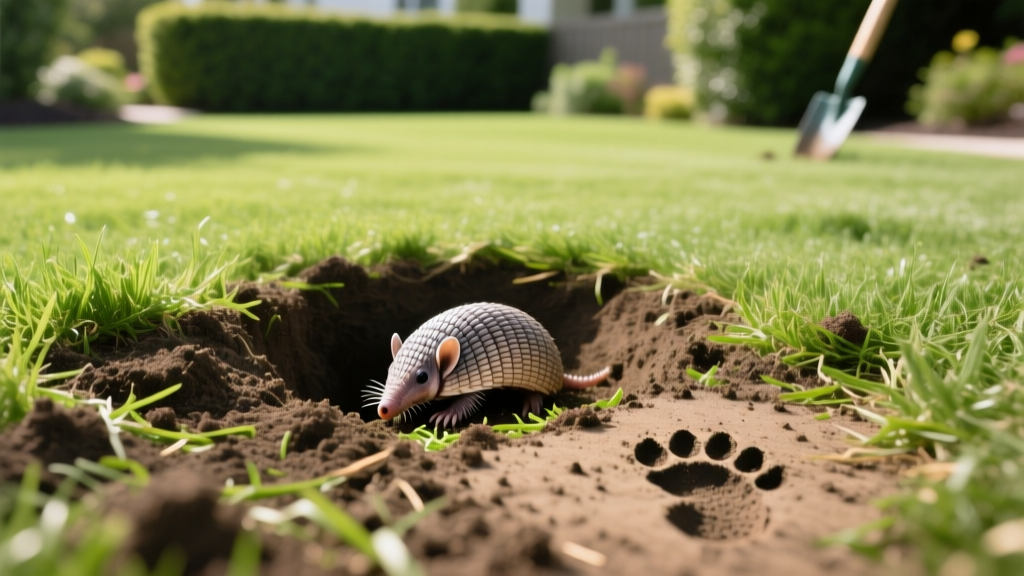
How to Identify, Fill, and Prevent an Armadillo Hole in Your Lawn
Waking up to a lawn pockmarked with deep, conical craters is a frustrating reality for homeowners in the South and Southeast. While several pests dig in yards, the nine-banded armadillo is uniquely destructive due to its foraging habits and the sheer volume of earth it displaces. A single armadillo can dig dozens of foraging burrows in a single night, undermining root systems, creating tripping hazards, and compromising the structural integrity of patios and shallow foundations.
Successfully managing this mammal requires more than just kicking dirt back into the void. You must accurately confirm the culprit, eradicate the underlying food source, repair the turf with a compaction-resistant soil matrix, and deploy physical or chemical barriers. This guide provides a comprehensive, professional-grade protocol for reclaiming your yard from armadillo damage.
Anatomy of an Armadillo Hole: How to Confirm the Culprit
Before investing time and money into deterrence, you must verify that armadillos are actually the problem. Misidentifying the pest leads to ineffective treatments. Armadillos possess poor eyesight but an exceptional sense of smell, which they use to locate subterranean insects. When they detect a grub or earthworm, they dig rapidly, creating a very specific type of excavation.
According to the Internet Center for Wildlife Damage Management, armadillo foraging holes are typically 3 to 5 inches wide and 7 to 12 inches deep. They are distinctly conical or funnel-shaped, unlike the shallow divots left by skunks. Furthermore, armadillos often excavate primary burrows for sleeping, which are much larger—up to 8 inches wide and 15 feet long—usually located under brush piles, rock outcroppings, or concrete porches.
Wildlife Excavation Identification Matrix
| Pest | Hole Width | Depth | Dirt Mound Characteristics | Primary Location |
|---|---|---|---|---|
| Armadillo | 3 - 5 inches | 7 - 12 inches | Scattered, no distinct mound | Moist soil, near foundations, under shrubs |
| Skunk | 2 - 3 inches | 1 - 3 inches | Loose soil around a shallow divot | Open lawn areas, golf courses |
| Vole | 1 - 2 inches | Surface level | No mound, surface runways visible | Under snow, along fence lines, garden beds |
| Groundhog | 10 - 12 inches | Up to 5 feet | Large, crescent-shaped dirt mound | Open fields, near woodlines, under sheds |
The Root Cause: Eradicating the Subterranean Food Source
Armadillos do not dig holes for recreation; they dig to eat. Their diet consists almost entirely of insects, grubs, and earthworms. If your lawn has an armadillo hole problem, you almost certainly have a white grub infestation. Treating the grubs is the most critical step in long-term deterrence. If the food is gone, the armadillos will move on to a more productive foraging ground.
Step-by-Step Grub Eradication Protocol
- Confirm Grub Presence: Cut a 1-foot by 1-foot square of sod and peel it back. Count the white, C-shaped grubs. If you find more than 5 to 10 grubs per square foot, treatment is mandatory.
- Apply Beneficial Nematodes: Use Heterorhabditis bacteriophora (Hb) nematodes. These microscopic worms actively hunt and kill grubs without harming earthworms or plants. Purchase a commercial formulation containing at least 10 million nematodes per 1,000 square feet (expect to pay around $35 to $45 per treatment block).
- Timing and Hydration: Apply nematodes in the late afternoon or early evening when UV radiation is low. Soil temperatures must be above 60°F. Immediately irrigate the lawn with at least 1/4 inch of water to wash the nematodes off the grass blades and into the soil profile where the grubs live.
- Deploy Milky Spore (Long-Term): For a multi-year solution, apply Paenibacillus popilliae (Milky Spore). Products like St. Gabriel Organics MilkySpore ($40 for a 20 oz box covering 7,000 sq ft) establish a bacterial presence in the soil that specifically targets Japanese beetle grubs. It takes 1 to 3 years to reach peak efficacy but can remain active in the soil for up to 15 years.
How to Properly Fill and Repair Armadillo Holes
A common mistake homeowners make is simply kicking loose topsoil back into an armadillo hole and tamping it down with a boot. Because armadillos prefer loose, easily penetrable soil, a standard topsoil fill will often be re-dug within 48 hours. You must alter the soil composition to make it physically resistant to digging.
The Anti-Dig Soil Matrix Recipe
Mix 70% heavy clay topsoil with 30% coarse masonry sand. The sand particles lock together with the clay when wet, creating a dense, compacted matrix that is highly resistant to the armadillo's front claws. Fill the hole in 3-inch increments, spraying each layer lightly with water and tamping it aggressively with a hand tamper or the end of a 4x4 post until the fill is flush with the surrounding grade.
Once the hole is filled and compacted, aerate the immediate surrounding area with a manual core aerator to relieve compaction for the grass roots, then overseed with a matching turfgrass variety or lay a piece of fresh sod cut 2 inches wider than the repair zone.
Long-Term Deterrence: Fencing and Repellents That Actually Work
According to Penn State Extension, physical exclusion is the only 100% effective method for keeping armadillos out of specific high-value areas like vegetable gardens or prized flower beds. Chemical repellents can serve as a secondary line of defense for broader lawn perimeters.
Physical Exclusion: The Angled Trench Method
Standard vertical fencing fails against armadillos because they are proficient diggers. To stop them, you must use 1/2-inch galvanized hardware cloth (approximately $35 for a 25-foot roll). Dig a trench 18 inches deep along the perimeter of the area you wish to protect. Bury the hardware cloth in the trench, but angle the bottom 6 inches outward, away from the garden, at a 45-degree angle. When the armadillo encounters the wire and attempts to dig under it, it will hit the outward-angled metal and lack the cognitive ability to back up and dig deeper.
Chemical Repellents: Castor Oil Formulations
Armadillos rely heavily on their sense of smell to forage. Repellents that overwhelm their olfactory senses or irritate their nasal passages are the most effective. Look for liquid repellents where castor oil is the primary active ingredient (e.g., Nature's MACE Armadillo Repellent, roughly $35 for a 32 oz ready-to-spray bottle). Castor oil coats the soil and the grubs within it, making the food source taste and smell repulsive to the mammal. Apply heavily after aeration or core aeration to ensure the oil penetrates the root zone, and reapply every 30 days or after heavy rainfall exceeding 1 inch.
Frequently Asked Questions
Do ultrasonic armadillo repellents work?
No. Independent tests and wildlife management agencies consistently show that solar-powered ultrasonic stakes are entirely ineffective against armadillos. Armadillos have poor hearing and their foraging behavior is driven almost exclusively by olfactory cues (smell), not auditory ones. Save your money and invest in castor oil treatments or physical trench fencing instead.
Is it legal to trap and relocate an armadillo?
Wildlife trapping laws vary strictly by state and municipality. In many states, such as Florida and Texas, it is legal to trap armadillos on your own property, but relocating them to public lands or distant areas is often illegal due to the risk of spreading disease and disrupting local ecosystems. In many jurisdictions, trapped armadillos must be humanely euthanized or released on the exact same property. Always consult your local Department of Natural Resources or county extension office before setting a live trap.
Why are armadillos digging under my concrete driveway?
Armadillos seek out the microclimates created by concrete structures. The soil beneath driveways, sidewalks, and patios retains moisture longer and stays cooler in the summer and warmer in the winter, making it an ideal habitat for the earthworms and grubs they eat. Furthermore, the concrete provides structural support for their primary sleeping burrows, preventing cave-ins. To stop this, inject a castor-oil-based repellent into the expansion joints and cracks of the concrete using a pump sprayer with a nozzle attachment.

