
Pest Control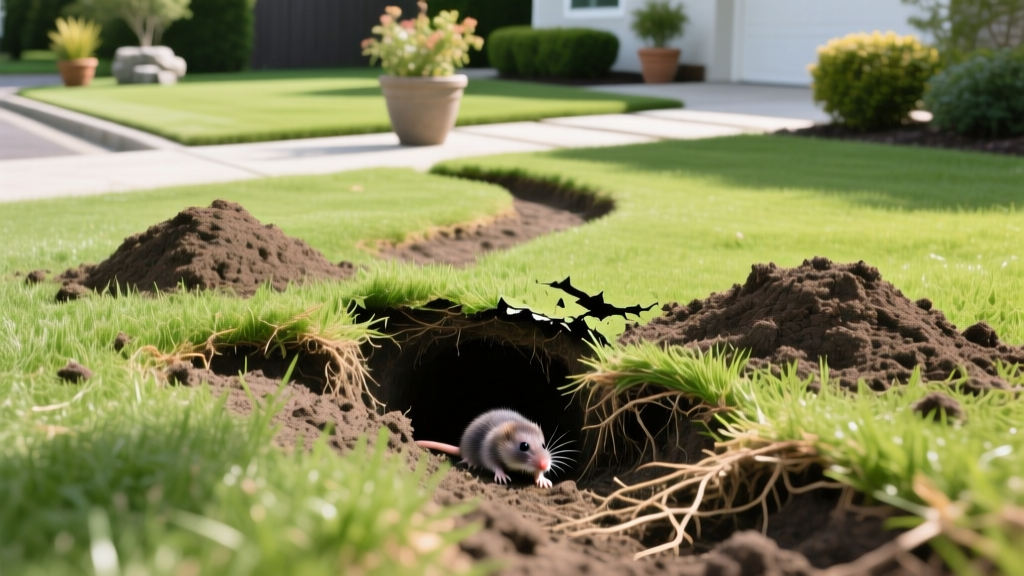
How to Tell If You Have Moles in Your Yard: Signs vs. Voles & Gophers
Discovering raised ridges or mounds of dirt in your lawn is the first sign of a subterranean invasion, but misidentifying the culprit is the most common mistake homeowners make. Treating for voles when you have moles—or vice versa—wastes time and money. Moles (primarily the Eastern mole, Scalopus aquaticus) are insectivores that can consume 70% to 100% of their body weight in grubs and earthworms daily. Before deploying traps or repellents, you must confirm the species. Here is the exact diagnostic framework to determine if moles are tunneling under your turf.
The 4 Definitive Signs of Mole Activity
Moles leave highly specific architectural signatures in the soil. Unlike rodents that chew through roots, moles push soil upward as they excavate. Look for these four precise indicators:
- Volcano-Shaped Molehills: Moles dig vertical shafts to the surface to eject excavated soil. This creates symmetrical, conical mounds that resemble miniature volcanoes. These mounds typically range from 2 to 8 inches in height and 6 to 24 inches in diameter. The soil is often finely clumped, as moles sift through it for insects.
- Raised Surface Ridges: As moles hunt just beneath the surface (usually 1 to 4 inches deep), they push the turf upward, creating raised, meandering ridges. These ridges are typically 2 to 3 inches wide and feel spongy or hollow when you step on them.
- Absence of Visible Entry Holes: Moles plug their vertical exit holes with dirt clods to keep predators out and maintain tunnel humidity. If you see a clean, open hole at the top of a dirt mound, you likely have a gopher or ground squirrel, not a mole.
- Dead Grass Strips: While moles do not eat grass roots, their shallow tunneling severs root contact with the soil, causing the turf directly above the ridge to dry out and turn brown in distinct, winding lines.
Mole vs. Vole vs. Gopher: The Lawn Pest Identification Matrix
Accurate identification dictates your entire deterrence strategy. Voles require vegetation management, gophers require deep burrow trapping, and moles require targeted tunnel trapping or grub reduction. Use this matrix to cross-reference your yard's damage.
| Diagnostic Feature | Moles | Voles | Pocket Gophers |
|---|---|---|---|
| Mound Shape | Symmetrical, conical (volcano) | No mounds; small soil piles near holes | Asymmetrical, crescent or fan-shaped |
| Surface Tunnels | Raised, spongy ridges (2-3" wide) | Cleared runways (1-2" wide) under grass/snow | Rarely visible on surface |
| Hole Appearance | Plugged with dirt clods; no open holes | Clean, open holes (1-1.5" diameter) | Plugged holes adjacent to fan-shaped mounds |
| Tunnel Depth | Shallow (1-4") and deep (6-12") | Very shallow, just under thatch layer | Deep (6-18" or more) |
| Primary Diet | Earthworms, white grubs, insects | Grass blades, roots, bark, bulbs | Fleshy roots, tubers, bulbs |
For a deeper taxonomic breakdown of subterranean lawn pests, the Internet Center for Wildlife Damage Management provides extensive behavioral data on mammalian turf damage.
The "Active Tunnel" Test: A Step-by-Step Diagnostic
Moles create extensive tunnel networks, but they only actively patrol a fraction of them daily. If you plan to use scissor-jaw traps or castor oil deterrents, you must locate the active runways. Perform this 48-hour diagnostic test:
- Locate the Main Runways: Look for long, straight ridges that connect multiple molehills. Avoid the short, meandering surface tunnels, which are often abandoned after a single hunting session.
- Flatten a Test Section: Use the heel of your boot to step firmly on a 12-inch section of the suspected main ridge. This collapses the tunnel ceiling without filling it with dirt.
- Mark the Spot: Insert a brightly colored landscaping flag or a wooden stake next to the flattened section so you can easily relocate it.
- Wait 24 to 48 Hours: Moles are highly territorial and will quickly repair breaches in their primary transit routes to maintain temperature control and block predator access.
- Evaluate the Results: If the soil has been pushed back up and the ridge is rebuilt, the tunnel is active. If it remains flat, the mole has abandoned that specific corridor.
Warning: Avoid the "Grub-Only" Fallacy
A common misconception is that eliminating grubs will automatically force moles to leave. According to University of Minnesota Extension research, earthworms make up the vast majority of a mole's diet. Applying heavy insecticides to kill grubs may remove a secondary food source, but it will not evict moles if your soil is rich in earthworms. Grub control is a supplemental strategy, not a standalone cure.
When to Treat for Grubs: The Threshold Metric
While earthworms are their primary food, a severe white grub infestation will attract moles from neighboring properties. Before applying chemicals like chlorantraniliprole (Acelepryn) or imidacloprid, you must verify the grub population density.
- Sampling Method: Cut three sides of a 1-square-foot section of turf with a spade and peel it back like a carpet.
- The Threshold: Count the C-shaped, grayish-white grubs in the top 2 inches of soil. If you find more than 5 to 8 grubs per square foot, treatment is justified.
- Timing: Preventative applications of chlorantraniliprole should occur in late spring to early summer (May-June). Curative treatments with trichlorfon (Dylox) are effective in late summer when grubs are actively feeding near the surface.
Initial Deterrence: Repellents and Habitat Modification
If trapping is not an option, you can attempt to make the environment inhospitable. Moles rely heavily on their highly developed olfactory and tactile senses. Disrupting these senses is the core mechanism of commercial repellents.
Castor Oil-Based Repellents
Casters oil coats the earthworms and soil particles, causing severe digestive upset for moles without killing them. Products like Bonide Mole Repellent (typically $15–$22 for a 32oz hose-end sprayer) use a ricinoleic acid base. For maximum efficacy, apply 1 quart per 5,000 square feet, and water it in with exactly 0.5 inches of irrigation to push the oil into the root zone where the tunnels sit. Reapply every 3 to 4 weeks, or immediately after heavy rainfall exceeding 1 inch.
Sonic and Vibrational Spikes
Moles are highly sensitive to ground vibrations. Solar-powered sonic spikes, such as the Thanos Sonic Mole Repeller ($35–$45 for a 4-pack), emit intermittent low-frequency pulses (typically 400 to 1,000 Hz). Deployment Strategy: Place spikes every 15 to 20 feet in a grid pattern. They are most effective in dense, moist clay soils that conduct sound waves efficiently. In loose, sandy soils, the vibrational energy dissipates rapidly, rendering sonic spikes largely ineffective.
Frequently Asked Questions
Do mothballs or chewing gum kill moles?
No. These are persistent internet myths. Moles will simply push mothballs out of their tunnels, and they do not possess the digestive biology to be harmed by chewing gum. Furthermore, mothballs contain naphthalene or paradichlorobenzene, which illegally and toxically contaminate your soil and groundwater when placed outdoors.
Can I just flatten the tunnels and roll the lawn?
Using a heavy lawn roller to crush tunnels provides a temporary cosmetic fix but compacts your soil, restricting oxygen to grass roots. The mole will simply dig a new tunnel adjacent to the crushed one within 48 hours. Always address the active tunnel via trapping or targeted castor oil application instead.

