
Pest Control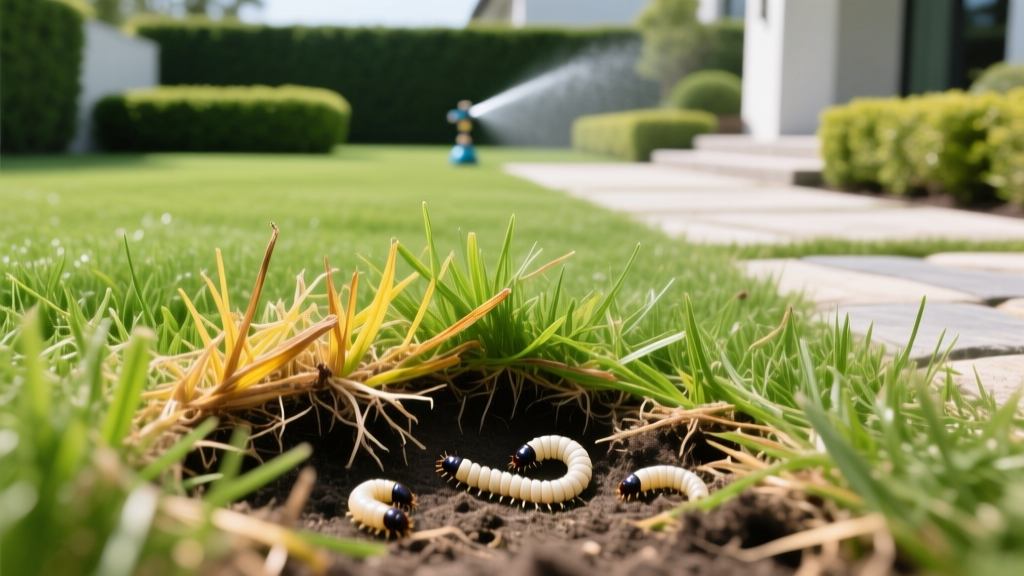
Billbug Lawn Damage: Identification and Treatment Guide
The Silent Turf Killer: Understanding Billbug Weevils
Homeowners frequently misdiagnose billbug damage as drought stress, disease, or white grub infestations. Billbugs (Sphenophorus spp.) are actually snout beetles, or weevils, that wreak havoc on turfgrass crowns and roots. The bluegrass billbug (Sphenophorus parvulus) devastates Kentucky bluegrass in northern climates, while the hunting billbug (Sphenophorus venatus) targets warm-season grasses like Zoysia and Bermuda in the transition zone and southern states.
Unlike grubs that consume roots from below, adult billbugs chew into the turf stem to lay eggs, and the resulting larvae hollow out the crown. By the time brown patches appear in mid-summer, the internal structure of the grass plant is completely severed. Accurate identification and precise chemical timing are the only ways to prevent total lawn renovation. According to University of Kentucky Entomology, billbug larvae produce a distinct sawdust-like excrement (frass) that accumulates at the base of the plant, serving as the ultimate diagnostic clue.
The Tug Test: Billbugs vs. White Grubs vs. Drought
Before purchasing any pest control products, you must confirm the pest. Applying a grub-specific preventative too early or too late will result in total chemical failure against billbugs. Perform the "Tug Test" on the margins of the damaged brown patches where the grass is just beginning to wilt.
| Diagnostic Factor | Billbug Damage | White Grub Damage | Drought / Heat Stress |
|---|---|---|---|
| The Tug Test | Stems snap off easily at the soil line; roots remain anchored. | Entire patch of turf rolls back like a carpet; roots are severed. | Grass pulls up with resistance or breaks mid-blade; roots intact. |
| Visual Evidence | Fine, sawdust-like frass at the crown and soil surface. | C-shaped white larvae (grubs) visible in the top 2 inches of soil. | No frass or insects; soil is bone dry and hydrophobic. |
| Stem Inspection | Hollowed-out stems with packed frass inside the crown. | Roots chewed off; crown is generally intact until secondary rot sets in. | Stems are dry and brittle; no internal hollowing. |
| Peak Damage Window | July through August (larval feeding stage). | August through October (late instar grub feeding). | Any period of prolonged rainfall deficit. |
Decoding the Lifecycle for Precision Timing
Chemical failure usually stems from treating the wrong life stage. Billbugs undergo complete metamorphosis, but their above-ground and below-ground phases dictate your treatment window.
- Overwintering Adults (March - April): Adults emerge from leaf litter and thatch when soil temperatures consistently reach 65°F. They migrate across sidewalks and driveways to reach turf.
- Adult Feeding & Mating (May): Adults chew small cavities into the turf stem to feed and lay eggs. You may see notched grass blades.
- Larval Hatch & Crown Boring (June - July): Legless, cream-colored larvae hatch and immediately bore into the stem, eventually dropping to the soil to feed on roots. This is the most destructive phase.
- Pupation (August - September): Larvae pupate in the soil, and new generation adults emerge to feed briefly before seeking overwintering sites.
2026 Treatment Protocols: Preventative and Curative Options
Effective billbug management requires selecting the correct active ingredient based on the current month and the severity of the infestation. Penn State Extension emphasizes that preventative controls are vastly superior to curative rescue treatments for billbugs, as the larvae are protected inside the stem during their early instars.
Preventative Chemistry (The Gold Standard)
Preventative treatments target the newly hatched larvae before they can hollow out the crown. These must be applied between mid-May and early June, allowing the active ingredient to translocate into the turf tissue and root zone.
Top Preventative Active Ingredients:
- Chlorantraniliprole (e.g., Acelepryn, Scotts GrubEx): The safest and most effective option. It has a long soil residual (up to 4 months) and is highly targeted, sparing beneficial earthworms and pollinators. Apply at a rate of 1.15% granular (approx. 2.87 lbs per 1,000 sq ft). Cost: ~$45-$60 per 5,000 sq ft bag.
- Imidacloprid (e.g., Bayer Advanced Grub Killer): A neonicotinoid that provides solid control but has a shorter residual window. Must be applied closer to the egg-hatch period (early June). Cost: ~$35 per 5,000 sq ft.
Curative Rescue (When Damage is Active)
If you missed the preventative window and notice frass and snapping stems in July, you must use a fast-acting curative insecticide. Curative options have short residuals and require immediate irrigation to push the chemical past the thatch layer to the crown.
- Trichlorfon (e.g., Dylox, Bayer 24-Hour Grub Killer): The industry standard for rapid knockdown. It kills active larvae within 24 to 48 hours but degrades quickly in alkaline soils (pH above 7.2). Apply at 1.8 lbs per 1,000 sq ft. Cost: ~$30-$40 per 5,000 sq ft.
- Clothianidin (e.g., Arena): Offers both curative knockdown and extended residual control, making it a premium choice for late-summer outbreaks. Requires a commercial applicator license in many jurisdictions.
⚠️ Critical Warning: Heat and Trichlorfon
Never apply Trichlorfon (Dylox) when daytime air temperatures exceed 90°F or when the turf is experiencing drought stress. The combination of high heat and this specific organophosphate can cause severe phytotoxicity, chemically burning the turf and compounding the damage caused by the billbugs.
Biological Warfare: Entomopathogenic Nematodes
For organic lawn care programs, beneficial nematodes offer a highly effective, non-chemical alternative. Specifically, Heterorhabditis bacteriophora (Hb) and Steinernema carpocapsae (Sc) actively hunt billbug larvae in the soil profile.
Application Specifics: Purchase fresh nematodes (e.g., NemaSeek or BioLogic) and store them in the refrigerator until use. Apply at a rate of 1 to 2 billion nematodes per acre (approx. 25,000 to 50,000 per square foot). They must be sprayed in the late afternoon or on an overcast day to avoid UV degradation, and the soil must be kept continuously moist for 10 days post-application to allow the nematodes to penetrate the larvae. Cost: ~$45 to $65 per 10 million nematode pack (treats ~400 sq ft).
Cultural Practices to Billbug-Proof Your Turf
Chemical controls are only one pillar of defense. Modifying your turf environment makes it inherently hostile to billbug establishment.
Endophyte-Enhanced Grasses
Billbugs strongly prefer endophyte-free grasses. Endophytes are naturally occurring, beneficial fungi that live inside the tissues of tall fescue, perennial ryegrass, and fine fescues. These fungi produce alkaloids that are highly toxic to stem-boring insects like billbugs and chinch bugs. When overseeding damaged areas, specifically source seed blends labeled as "endophyte-enhanced" or "turf-type tall fescue with endophytes." Note that Kentucky bluegrass and Bermudagrass do not host these beneficial fungi.
Thatch and Irrigation Management
Billbug larvae thrive in thick thatch layers, which provide a buffer against soil-applied insecticides and nematodes. Maintain thatch at less than 0.5 inches through annual core aeration. Furthermore, while billbugs exploit drought-stressed turf, overwatering promotes shallow root systems that cannot tolerate any larval feeding. Implement deep, infrequent watering protocols (0.5 to 1 inch per week) to force roots deeper into the soil profile, out of reach of early-instar larvae.
Frequently Asked Questions
Do billbugs fly into my yard from neighboring properties?
No. While adult billbugs have wings, they are weak fliers and primarily migrate by walking. If you have a severe infestation, it is likely because the adults overwintered in your own leaf litter, thatch, or adjacent mulch beds, not because they flew in from a neighbor's lawn.
Will treating for grubs automatically kill billbugs?
Not necessarily. While products containing Chlorantraniliprole (like Acelepryn) control both white grubs and billbugs, the application timing differs. Grub preventatives are often applied in late June or July to target Japanese beetle and masked chafer eggs. Billbug preventatives must be applied 4 to 6 weeks earlier (mid-May) to intercept the weevil larvae before they bore deep into the crown.
Can I just let the billbugs run their course and overseed in the fall?
You can, but you risk total turf loss. Billbug larvae sever the crown, meaning the plant cannot regenerate even if autumn rains return. Furthermore, the adult weevils that emerge in late summer will overwinter in your yard, guaranteeing a compounded, exponentially worse infestation the following spring. Eradication is vastly more cost-effective than a full lawn renovation, which averages $0.15 to $0.25 per square foot for professional hydroseeding.

