
Pest Control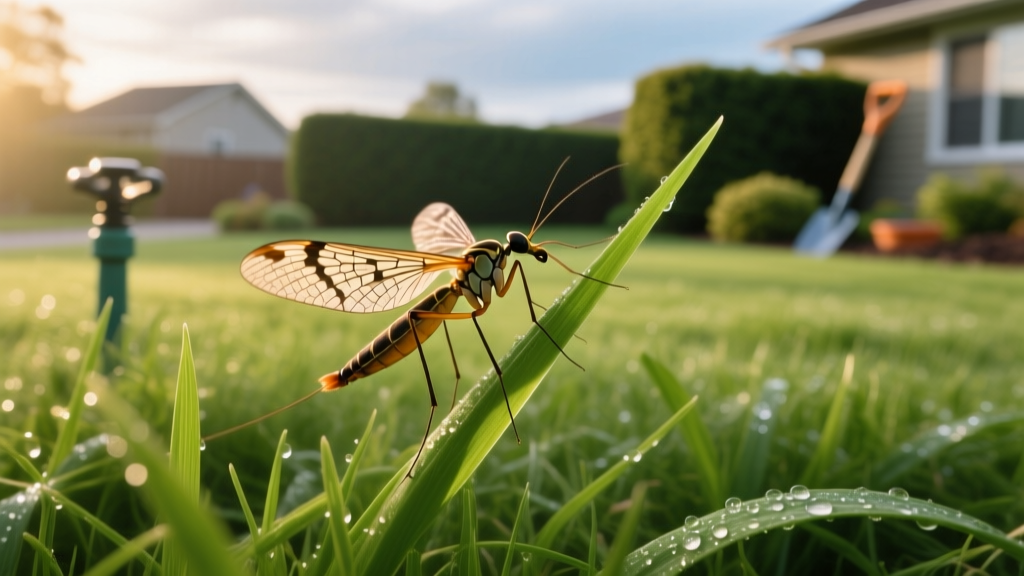
How to Identify and Treat the Long Winged Insect Destroying Your Lawn
The 'Long Winged Insect' Misconception: Friend vs. Foe
Homeowners frequently spot a large, long winged insect hovering clumsily around their porch lights or resting on their turf in late summer. Often mistaken for giant mosquitoes or 'daddy longlegs,' these insects are typically adult crane flies (family Tipulidae). While the adult crane fly itself is entirely harmless—it does not bite, sting, or feed on your grass—its presence is a critical biological indicator. The adults you see in August and September are actively laying eggs in your turf, which will hatch into the real threat: leatherjackets.
Before initiating any pest control protocol, it is vital to correctly identify the long winged insect in your yard. Confusing a beneficial predator with a turf pest leads to unnecessary chemical applications and ecological disruption.
Crane Flies (The Pest Indicator) vs. Dragonflies (The Ally)
Dragonflies and damselflies also feature long wings and frequent lawns, but they are apex insect predators that consume mosquitoes and gnats. Crane flies, conversely, are the reproductive stage of a major lawn-destroying grub. Use the comparison matrix below to confirm your identification.
| Feature | Crane Fly (Pest Indicator) | Dragonfly / Damselfly (Beneficial) |
|---|---|---|
| Flight Pattern | Clumsy, erratic, weak flier; often crashes into walls | Agile, rapid, highly controlled hovering and darting |
| Wing Posture | Wings fold flat over the back or stick out awkwardly at rest | Wings remain spread wide or held together above the back at rest |
| Legs | Extremely long, fragile legs that easily break off | Shorter, robust legs adapted for perching and catching prey |
| Habitat Focus | Found directly on turfgrass, porch lights, and damp soil | Found near water sources, patios, and open sunny airspace |
The Real Threat: Leatherjacket Larvae
According to Penn State Extension, the European crane fly (Tipula paludosa) and the common crane fly (Tipula oleracea) are the primary species damaging North American lawns. The adult long winged insect lives for only 10 to 15 days, solely to mate and lay up to 300 eggs in the thatch layer of your lawn.
These eggs hatch into larvae known as leatherjackets. Leatherjackets are grayish-brown, legless, cylindrical grubs with a tough, leathery skin. They feed aggressively on the crowns, roots, and shoots of cool-season grasses like Kentucky bluegrass, perennial ryegrass, and tall fescue. The most severe damage occurs in two distinct windows: late fall (October to November) when they are young and hungry, and early spring (March to April) when they emerge from winter dormancy as large, third-instar larvae capable of devouring massive amounts of root mass.
Step-by-Step Lawn Damage Assessment
Do not apply treatments based solely on the presence of adult crane flies. You must verify larval population density. Follow this standardized scouting protocol to determine if your lawn has crossed the economic injury threshold.
- Select Sample Zones: Choose three distinct areas of your lawn, prioritizing shaded, moist areas where crane flies prefer to lay eggs.
- Cut the Sod: Using a sharp spade, cut a 12-inch by 12-inch square into the turf, going exactly 2 inches deep into the soil profile.
- Peel and Inspect: Roll back the turf square like a carpet. Inspect the exposed soil and the underside of the thatch layer.
- Count the Larvae: Count the number of leatherjackets present in that single square foot.
- Evaluate the Threshold: A healthy lawn can tolerate 10 to 15 larvae per square foot. If you count 25 to 30 or more per square foot, immediate intervention is required to prevent catastrophic turf loss.
⚠️ Secondary Damage Indicator: If you notice flocks of starlings, crows, or raccoons aggressively tearing up your lawn in early spring, they are likely foraging for mature leatherjackets. The physical tearing by wildlife often causes more cosmetic damage to the turf than the insects themselves.
How to Treat Leatherjackets (The Larval Stage)
Treating the adult long winged insect is impossible and ecologically counterproductive. Control efforts must target the larval stage in the soil. You have two primary pathways: biological (organic) control and conventional chemical control.
Organic Control: Beneficial Nematodes
Beneficial nematodes are microscopic, unsegmented roundworms that actively hunt and parasitize soil-dwelling pests. For leatherjackets, the most effective species is Steinernema carpocapsae, though Heterorhabditis bacteriophora is also utilized for deeper soil penetration. As noted by University of Minnesota Extension, nematodes enter the host through natural openings, release symbiotic bacteria that kill the larva within 48 hours, and reproduce inside the carcass.
- Product Recommendation: Arbico Organics NemaSeek (Steinernema carpocapsae) or BioLogic Ecomask.
- Application Rate: Apply at a rate of 50,000 to 100,000 infective juveniles per square foot. For a standard 5,000 sq. ft. lawn, you need a minimum of 250 million to 500 million nematodes.
- Cost: Expect to pay $40 to $75 for a pack of 250 million nematodes.
- Soil Temperature Requirement: Soil temps must be consistently between 50°F and 85°F (10°C - 29°C). Nematodes become dormant and ineffective in cold soil.
- Application Method: Mix with water and apply via a hose-end sprayer or watering can. Water the lawn heavily immediately after application to wash the nematodes off the grass blades and into the soil profile where the leatherjackets live.
Conventional Control: Pyrethroids and Neonicotinoids
If biological controls fail or the infestation is severe (>40 larvae per sq. ft.), synthetic insecticides provide rapid knockdown. Timing is critical; you must apply chemicals when larvae are small and actively feeding near the surface (early October or late April).
- Active Ingredient: Bifenthrin (e.g., Talstar P Professional Insecticide) or Imidacloprid (e.g., Merit 0.5 G).
- Bifenthrin Rate: Mix 1 fluid ounce of Talstar P per 1,000 square feet. Apply using a pump sprayer and water in with 0.25 inches of irrigation to move the chemical into the thatch.
- Cost: A 32 oz bottle of Talstar P costs approximately $45 to $55 and will treat up to 32,000 sq. ft.
- Precaution: Bifenthrin is highly toxic to aquatic life and pollinators. Never apply near storm drains, ponds, or while bees are actively foraging on blooming lawn weeds like clover or dandelions.
💡 Expert Timing Tip: Applying insecticides in July or August when you see the adult long winged insect flying is a waste of money. The eggs have not yet hatched, and the chemical residue will degrade before the leatherjackets emerge in September. Target the early fall larval stage for maximum ROI.
Preventative Lawn Care Strategies
Crane flies seek out specific environmental conditions to lay their eggs. By altering your lawn's microclimate, you can make your turf highly unattractive to the long winged insect.
Thatch Management and Aeration
Leatherjackets thrive in thick, moist thatch layers. If your thatch exceeds 0.5 inches, perform core aeration and dethatching in late summer. This physically disrupts the soil surface, destroying newly laid eggs and exposing young larvae to desiccation and predatory birds.
Irrigation Control in Late Summer
Adult crane flies require moist soil to successfully deposit their eggs, and the eggs require high humidity to survive the incubation period. If your region experiences adequate rainfall in August and September, turn off your automated irrigation system. Allowing the top inch of soil to dry out between waterings can cause up to 80% mortality in newly hatched crane fly eggs.
Frequently Asked Questions
Do bug zappers work on adult crane flies?
No. Bug zappers rely on UV light to attract insects. While crane flies may clumsily blunder into porch lights, they are not strongly phototactic (attracted to light) like moths. Furthermore, killing the adults is ineffective because a single female can lay 300 eggs before she dies; zappers cannot eliminate the population fast enough to prevent larval damage.
Will rolling the lawn crush leatherjackets?
Using a heavy water-filled lawn roller was a historical method to crush larvae near the surface. However, modern turf science advises against this. Rolling severely compacts the soil, reducing oxygen flow to grass roots and actually creating the damp, poorly drained conditions that crane flies prefer for future egg-laying.
Are crane flies harmful to pets or humans?
Despite urban legends calling them 'mosquito hawks' or suggesting they carry venom, crane flies possess no mouthparts capable of biting humans or pets. They are entirely benign in their adult stage and pose zero toxicity risk to dogs or cats roaming the yard.

