
Pest Control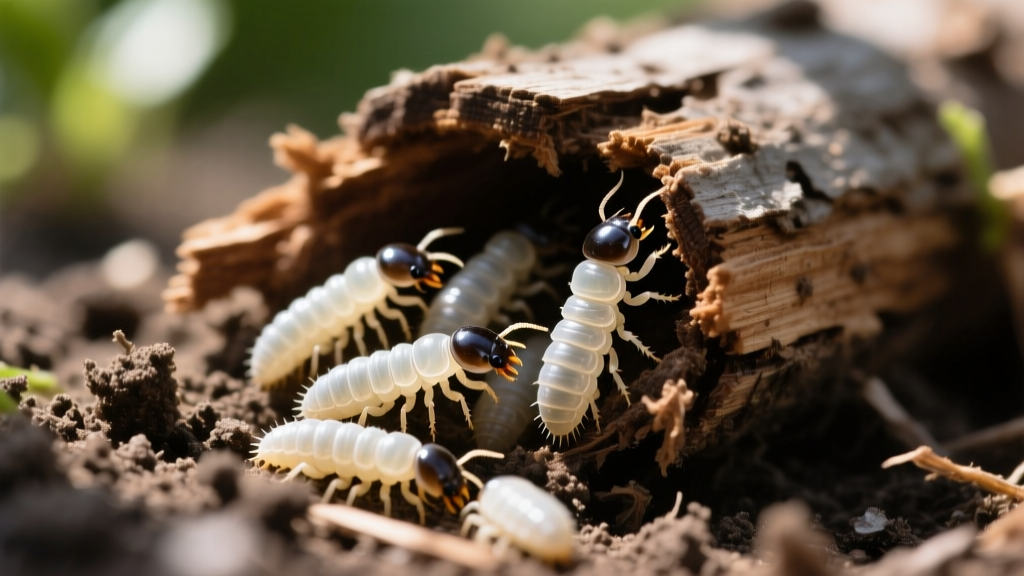
Termite Larvae Identification: Stopping the Hidden Yard Threat
The Hidden Nursery: Why Termite Larvae Matter in Yard Defense
When homeowners spot termite damage, they typically react to the visible foragers or the seasonal swarmers (alates). However, the true engine of a subterranean termite colony lies hidden in the soil: the immature population. In entomological terms, termites are hemimetabolous insects, meaning they do not have a true "larval" stage like ants or beetles. Instead, they hatch as nymphs that resemble miniature, pale workers. In the pest control industry and among homeowners, these early-instar nymphs are universally referred to as termite larvae.
These immature termites are entirely dependent on worker termites for survival. Workers forage for cellulose, digest it, and share the nutrient-rich liquid with the larvae through a process called trophallaxis. If your yard harbors a high density of termite larvae, it indicates a mature, deeply established colony nearby. Eradicating the foragers without disrupting the nursery guarantees a rapid population rebound. Effective yard defense requires targeting the soil environment where these nymphs develop, molting into the soldiers and workers that will eventually compromise your home's structural integrity.
Termite Nymphs vs. Ant Larvae: Field Identification Matrix
Homeowners digging in mulch or turning over decaying logs often confuse termite nymphs with ant larvae. Misidentification leads to incorrect treatment protocols, as ant baits and sprays are largely ineffective against subterranean termite colonies. Use the following matrix to accurately identify what is crawling in your yard soil.
| Characteristic | Termite Nymphs ("Larvae") | Ant Larvae |
|---|---|---|
| Body Shape | Elongated, segmented, uniform width | C-shaped, grub-like, tapered at the head |
| Legs | Six distinct, jointed legs present | Completely legless |
| Antennae | Short, bead-like (moniliform) antennae | No antennae visible |
| Mobility | Can crawl slowly when disturbed | Immobile; rely on workers for transport |
| Color | Translucent white to pale cream | Opaque white, sometimes with dark gut tract |
According to the University of California Integrated Pest Management (UC IPM) program, finding these six-legged, pale nymphs in soil adjacent to your foundation is a primary indicator of a localized subterranean termite satellite colony.
Mapping the Nursery: Signs of Immature Termites in the Yard
Termite larvae are highly susceptible to desiccation and UV light. You will never find them on the surface of your lawn. To locate the nursery, you must map the micro-climates in your yard that sustain them.
Moisture and Cellulose Intersections
Subterranean termites require wood with a moisture content exceeding 20% to initiate feeding, and the soil surrounding their nursery must remain consistently damp. Inspect your yard for these high-risk intersections:
- Stump-Soil Interfaces: Decaying tree stumps left in the ground act as both a food source and a moisture trap. Probe the soil directly beneath the taproot.
- Grade-to-Siding Contact: Soil piled against wooden siding or brick weep holes retains moisture and hides mud tubes.
- AC Condensate Drip Lines: The constant drip from HVAC units creates localized saturated soil zones, perfect for termite nursery expansion.
Tracking Mud Tubes to the Source
Break open the exterior mud tubes (shelter tubes) running up your foundation. If you see thousands of pale, fast-moving nymphs alongside the workers, you have tapped into a primary foraging artery leading directly back to the central nursery.
Chemical Eradication: Disrupting the Molting Cycle
To eliminate termite larvae, you must exploit their biological need to molt and their reliance on worker termites for food. Modern termiticides utilize two distinct mechanisms to collapse the nursery from the inside out.
Expert Warning: Never use repellent chemicals (like bifenthrin or permethrin) near a suspected termite nursery. Repellents cause worker termites to avoid the treated soil, effectively trapping the larvae inside an untreated zone where they will continue to breed and eventually find an untreated gap to bypass your defense.
The 6x6 Trenching Protocol for Liquid Non-Repellents
Fipronil (the active ingredient in Termidor SC) remains the industry standard for soil treatment. As a non-repellent, workers unknowingly crawl through the treated soil, pick up the active ingredient, and carry it back to the nursery. Through trophallaxis, they feed the lethal dose to the termite larvae.
- Dig the Trench: Excavate a trench 6 inches wide and 6 inches deep directly against the foundation perimeter.
- Mix the Solution: Dilute Fipronil 9.1% concentrate to a 0.06% finished solution. This requires 0.8 fluid ounces of product per gallon of water.
- Apply the Drench: Apply 4 gallons of the finished solution per 10 linear feet of trench. For a standard 150-linear-foot home perimeter, you will need 60 gallons of solution and approximately 48 ounces of concentrate.
- Backfill: Push the treated soil back into the trench to create a continuous chemical barrier.
Cost Analysis: As of 2026, a 20 oz bottle of professional-grade Fipronil concentrate costs between $85 and $95, which is sufficient to trench and treat roughly 60 linear feet of standard soil.
Chitin Synthesis Inhibitors (Bait Matrices)
If trenching is impossible due to hardscaping or environmental concerns, use bait stations containing Hexaflumuron (e.g., Sentricon). Hexaflumuron is an Insect Growth Regulator (IGR). Because termite larvae must constantly shed their exoskeleton to grow, Hexaflumuron inhibits chitin synthesis. When the nymphs attempt to molt, they die. The University of Kentucky Entomology Department notes that IGR baits are exceptionally effective at collapsing colonies because they specifically target the reproductive and developmental future of the colony.
Biological Controls: Nematodes for Yard Perimeter Defense
For homeowners seeking organic yard defense to suppress termite populations before they reach the foundation, entomopathogenic nematodes offer a biological solution. Specifically, Steinernema carpocapsae actively hunts subterranean termites in the top 6 inches of soil.
- Application Rate: Apply 1 million nematodes per 100 square feet of soil around tree stumps, mulch beds, and perimeter zones.
- Timing: Apply at dusk or on overcast days. UV light kills nematodes instantly.
- Soil Temperature: Ensure soil temperatures are between 60°F and 85°F. Water the soil deeply before and immediately after application to help the nematodes penetrate the thatch and soil crust.
While nematodes will not eradicate a massive, established colony deep underground, they act as a highly effective biological perimeter fence, killing foraging workers and shallow nymphs before they can expand the colony's footprint toward your home.
Expert FAQ on Termite Colony Disruption
Can I kill termite larvae by flooding their nest with water?
No. Subterranean termite colonies are highly adapted to moisture and can survive temporary waterlogging by sealing off gallery chambers with soil and feces. Furthermore, flooding your yard can cause soil erosion, compromising your foundation and actually creating the damp, settled soil conditions that termites prefer.
Do termite larvae eat wood directly?
Early-instar termite nymphs lack the robust mandibles and the fully developed gut protozoa required to digest raw cellulose. They rely entirely on workers to feed them pre-digested, nutrient-rich liquids. This biological dependency is exactly why non-repellent transfer chemicals and IGR baits are so devastating to the colony.
How deep do termite nurseries go in the yard?
While foraging tunnels can extend 300 feet from the nest and reach depths of 20 feet or more to bypass frost lines, the central nursery containing the queen and the highest density of larvae is typically located 4 to 18 inches below the surface, usually directly beneath a massive, moisture-retaining food source like a buried stump or a thick layer of wood mulch.

