
Pest Control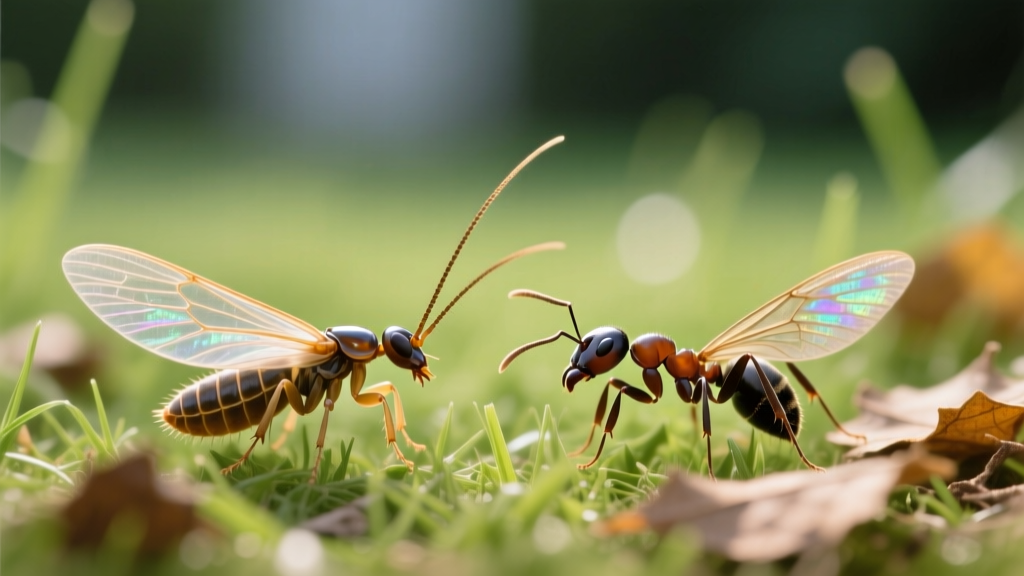
Insect With Wings Looks Like an Ant? Termite vs Ant Swarmer ID Guide
Spotting an insect with wings that looks like an ant swarming near your foundation, mulch beds, or patio is a common trigger for homeowner panic. While these winged insects share a superficial resemblance, they belong to entirely different biological orders and require drastically different pest management strategies. The two primary culprits are termite alates (swarmers) and carpenter ant alates. Misidentifying them leads to wasted money on ineffective chemical treatments and allows structural or lawn damage to progress unchecked.
This guide provides a definitive anatomical breakdown, behavioral clues, and actionable 2026 treatment protocols to help you accurately identify the insect and protect your property.
The Core Suspects: Physical Identification Matrix
To the untrained eye, a swarm of winged insects looks like a chaotic cloud of dark bugs. However, capturing a single specimen and examining three specific anatomical features—waist, wings, and antennae—will immediately reveal its identity. According to the University of Kentucky Entomology Department, these morphological differences are the gold standard for field identification.
| Anatomical Feature | Termite Swarmer (Subterranean) | Carpenter Ant Swarmer |
|---|---|---|
| Waist | Broad, uniform thickness (no pinch) | Narrow, sharply pinched (hourglass) |
| Wings | Two pairs, equal length, milky/translucent | Two pairs, front wings longer than hind wings, tinted |
| Antennae | Straight, beaded (moniliform) | Elbowed (geniculate) |
| Body Color | Dark brown to black (pale body in drywood) | Black, red, or multi-colored |
| Wing Shedding | Shed wings found in massive piles | Rarely shed wings in piles; found attached |
Deep Dive: Anatomical and Behavioral Clues
1. Wing Structure and the Shedding Indicator
Termite wings are structurally fragile and designed for a single, short flight. The front and hind wings are identical in length and shape, often extending twice the length of the termite's body. After mating, alates snap their wings off at a natural fracture line near the base. If you find piles of translucent, identical wings on your windowsills, driveway, or lawn edge, you are almost certainly dealing with termites.
Carpenter ant wings are robust, with the front pair noticeably longer and darker than the hind pair. They do not typically shed their wings immediately after swarming, so finding detached wings in large piles is rare.
2. The Waist and Antennae Test
Termites belong to the order Blattodea (related to cockroaches) and possess a broad, thick waist that makes their thorax and abdomen look like a single continuous tube. Their antennae are straight and resemble a string of tiny beads.
Carpenter ants (Camponotus pennsylvanicus) belong to the order Hymenoptera. They feature a distinct, sharply pinched petiole (waist) separating the thorax and abdomen. Their antennae have a distinct 90-degree bend or 'elbow' in the middle.
The Lawn Curveball: Velvet Ants
If the insect you spotted in your lawn is fuzzy, brightly colored (usually red and black), and moves rapidly across dry soil, you may be looking at a male velvet ant. Despite the name, velvet ants are actually flightless or winged wasps (family Mutillidae).
Warning: Velvet Ant Sting
Male velvet ants (Dasymutilla occidentalis) have wings and are harmless, but the wingless females possess a highly potent sting rated near the top of the Schmidt sting pain index. They frequent dry, sandy lawn patches and overgrown weedy areas. Do not attempt to handle them bare-handed.
Male velvet ants (Dasymutilla occidentalis) have wings and are harmless, but the wingless females possess a highly potent sting rated near the top of the Schmidt sting pain index. They frequent dry, sandy lawn patches and overgrown weedy areas. Do not attempt to handle them bare-handed.
Swarming Behavior: Where and When
Understanding the environmental triggers for swarming provides critical context for identification.
- Eastern Subterranean Termites (Reticulitermes flavipes): Swarm during daylight hours, typically between March and May. The trigger is a combination of soil temperatures reaching 65°F to 70°F at a 2-inch depth, combined with a recent heavy rain event. You will see them emerging from mud tubes near foundation walls or landscape timbers.
- Carpenter Ants: Swarm later in the season, usually from May through July, often in the late afternoon or early evening. They emerge from established satellite nests, which are frequently located in moist, decaying wood within mulch beds, tree stumps, or landscape railroad ties.
2026 Action Plan and Treatment Costs
If you have confirmed the insect is a termite swarmer, immediate professional intervention is required. The Environmental Protection Agency (EPA) strongly advises against DIY termite treatments due to the specialized equipment and soil-trenching calculations required for a continuous chemical barrier.
Crucial First Step: Do Not Spray
Never use over-the-counter aerosol sprays (like Raid) on a swarm. Spraying kills the visible alates but forces the surviving colony to seal off their mud tubes and relocate their foraging tunnels deeper into your foundation, making professional detection significantly harder.
Never use over-the-counter aerosol sprays (like Raid) on a swarm. Spraying kills the visible alates but forces the surviving colony to seal off their mud tubes and relocate their foraging tunnels deeper into your foundation, making professional detection significantly harder.
Termite Treatment Protocols and Pricing
Current market rates for professional termite eradication vary based on linear footage and foundation type (slab vs. crawlspace).
- Liquid Soil Barrier (Termidor SC / Fipronil 9.1%): Technicians dig a 6-inch deep by 6-inch wide trench around the foundation and inject 4 gallons of diluted termiticide per 10 linear feet. Average Cost: $1,500 to $3,200.
- Bait Station Systems (Sentricon Always Active / Noviflumuron): Stations are installed every 10 feet around the perimeter. The active ingredient disrupts the termite molting process, collapsing the colony over 60 to 90 days. Average Cost: $1,200 to $2,500 initial installation, plus $300-$500 annual monitoring.
Carpenter Ant Treatment Protocols
Carpenter ants do not eat wood; they excavate it to build galleries. Treatment focuses on locating the parent nest and utilizing transfer baits.
- Gel Baits (Advion Ant Gel / Indoxacarb): Applied directly near foraging trails. Worker ants carry the bait back to the queen. DIY Cost: $35 for a 4-tube pack; Professional application: $250 to $450.
- Perimeter Sprays (Bifen IT / Bifenthrin): Used as a preventative exterior barrier to stop foraging ants from entering the structure. Professional application: $150 to $300 per quarter.
Frequently Asked Questions
Can flying ants cause structural damage to my home?
Carpenter ants can cause structural damage over many years by hollowing out moisture-damaged wood, but they do not consume the wood like termites. The immediate threat level is significantly lower than that of a subterranean termite colony, which can cause thousands of dollars in damage in a single year.
Why are there so many winged insects suddenly in my yard?
Swarming is a synchronized reproductive event. A mature colony (typically 3 to 5 years old) releases hundreds or thousands of alates simultaneously to mate and establish new colonies. The presence of a swarm indicates a mature, established colony is located within 100 to 300 yards of where you are seeing them.
How do I collect a sample for identification?
Use a clear glass or plastic vial. Gently trap the insect against a flat surface and slide a piece of stiff paper under the opening. Do not crush the specimen, as crushing destroys the delicate wing and antennae structures required for accurate identification by a pest control professional.

