
Pest Control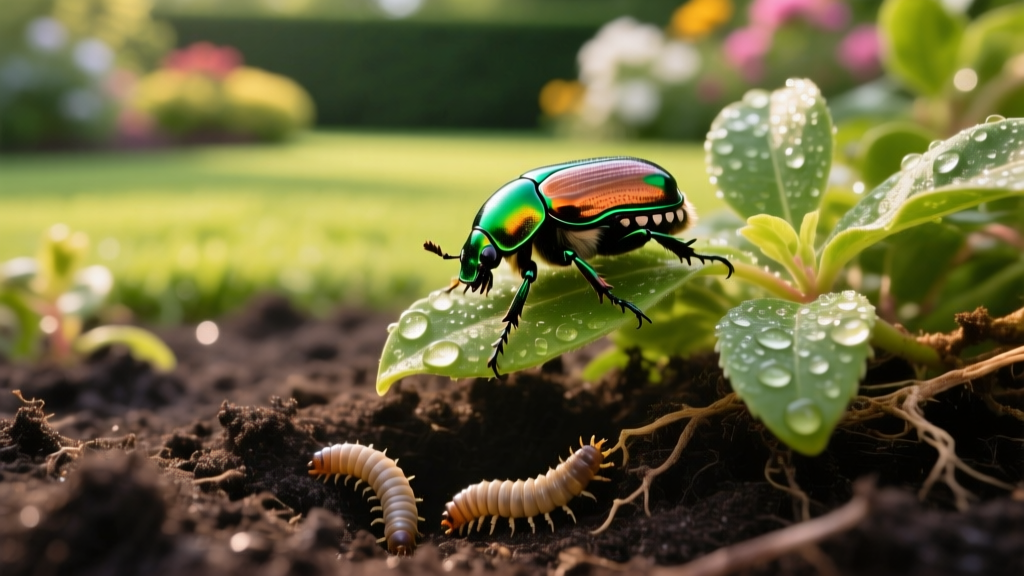
Best Insecticide for Japanese Beetles: Grub and Adult Defense Guide
Japanese beetles (Popillia japonica) inflict compounding damage on residential landscapes. The larvae (grubs) sever grass roots, causing massive turf die-off, while the adults skeletonize the foliage of over 300 ornamental plant species. Selecting the correct insecticide for Japanese beetles requires a bifurcated approach: targeting the subterranean grub stage with systemic or curative granular treatments, and managing the aerial adult stage with targeted contact or biological sprays.
The Dual-Threat Lifecycle and Application Timing
Mistiming your insecticide application is the primary cause of treatment failure. Japanese beetles operate on a strict one-year lifecycle. Adults emerge from the soil in early summer (June to July), mate, and lay eggs in the top two inches of irrigated turf. These eggs hatch in late July and August, producing young grubs that feed aggressively on grassroots before burrowing deep into the soil for winter dormancy.
- Preventative Grub Window (April - May): Apply slow-acting systemic insecticides like Chlorantraniliprole before eggs hatch.
- Curative Grub Window (August - September): Apply fast-acting contact insecticides like Trichlorfon when young grubs are actively feeding near the surface.
- Adult Knockdown Window (June - August): Apply foliar contact sprays at dusk when beetles are clustering and pollinator activity is minimal.
Contact vs. Systemic Insecticide for Japanese Beetles
Understanding the translocation properties of active ingredients dictates where and how you apply them. Systemic chemicals are absorbed by plant roots or turf and move through the vascular system, while contact chemicals remain on the surface to kill on impact.
| Feature | Contact Insecticides (e.g., Bifenthrin, Trichlorfon) | Systemic Insecticides (e.g., Imidacloprid, Chlorantraniliprole) |
|---|---|---|
| Speed of Kill | Immediate to 24 hours | 7 to 60 days (depending on chemical and plant uptake) |
| Residual Activity | Short (7 to 14 days for foliar, 30 days for soil) | Long (Up to 120 days in soil and plant tissue) |
| Best Target Stage | Adults (foliar spray) and large grubs (curative soil drench) | Young grubs (preventative soil application) and early instars |
| Pollinator Risk | High if sprayed on blooming plants; low if applied to turf | High if applied to soil beneath blooming ornamentals or linden trees |
Adult Beetle Knockdown: Active Ingredients and Tactics
When adult populations peak in July, defoliation can strip a rose bush or grapevine in 48 hours. Contact sprays provide the immediate knockdown required to save ornamental foliage.
Bifenthrin and Cyfluthrin (Pyrethroids)
Products containing Bifenthrin (such as Talstar P, priced around $55 for a 3/4-gallon concentrate) or Cyfluthrin (Bayer Advanced Complete Insect Killer) offer rapid paralysis and kill. Mix Bifenthrin at a rate of 0.5 to 1.0 fluid ounces per gallon of water. Spray foliage thoroughly, including the undersides of leaves where beetles hide during peak daytime heat. Pyrethroids leave a short residual film (10-14 days) that deters re-infestation, but they are highly toxic to aquatic life and bees. Never spray pyrethroids on blooming plants or near water features.
Carbaryl (Sevin)
Carbaryl remains a staple for adult beetle control. Available as a liquid concentrate or ready-to-use dust, it provides excellent knockdown. However, Sevin dust is easily washed away by irrigation and rain, and it indiscriminately kills beneficial insects. Liquid applications (e.g., Sevin SL) are preferred for even coverage. Expect to reapply every 7 to 10 days during heavy emergence flights.
⚠️ Pollinator Protection Protocol: Japanese beetles heavily target linden, basswood, and rose species. If your target plants are currently blooming, you must avoid synthetic pyrethroids and carbamates. Opt for Bacillus thuringiensis galleriae (sold as beetleGONE!), a biological spray that specifically targets beetle digestive systems without harming bees or butterflies.
Grub Control: The Underground Defense Strategy
Killing adults only addresses the symptom; eliminating grubs protects your turf and reduces next year's emerging population. According to turfgrass entomologists at the University of Minnesota Extension, a healthy lawn can tolerate up to 10 grubs per square foot, but populations exceeding this threshold will cause the turf to detach from the soil, rolling back like a carpet.
Step-by-Step Preventative Grub Application
- Select the Right Active Ingredient: For preventative spring applications, use Chlorantraniliprole (e.g., Scotts GrubEx1, approx. $28 for a 10lb bag covering 5,000 sq ft). It is highly effective and has a lower toxicity profile for earthworms and birds compared to older neonicotinoids.
- Calibrate Your Spreader: Set your rotary spreader to the exact setting listed on the product label (typically setting 3.5 or 4 for Scotts broadcast spreaders). Overlapping passes ensures uniform distribution without chemical burn.
- Time with Soil Temperature: Apply when soil temperatures at a 2-inch depth consistently reach 65°F, usually mid-to-late May. This ensures the chemical is in the root zone when eggs hatch in late July.
- Water In Immediately: Chlorantraniliprole requires 0.5 inches of irrigation or rainfall to wash the granules off the grass blades and into the thatch layer where it binds to organic matter and roots. Without this activation step, UV degradation will render the product useless within 48 hours.
Curative Treatment for Active Grub Infestations
If you discover active grubs in late August or September (indicated by brown turf patches and increased foraging by crows, skunks, or raccoons), preventative chemicals are useless. You need a fast-acting curative insecticide like Trichlorfon (e.g., Bayer Advanced 24 Hour Grub Killer, approx. $15 for 3,000 sq ft). Trichlorfon degrades rapidly in high-pH soils and under UV light. Apply it in the early morning and water it in with at least 0.5 inches of water within 30 minutes of spreading.
The Pheromone Trap Fallacy
'Commercial Japanese beetle traps utilizing floral lures and sex pheromones consistently attract significantly more beetles into a landscape than they actually capture. Research indicates that traps placed near susceptible plants increase localized defoliation by up to 40%.' - University of Kentucky Entomology Department
Do not rely on bag traps for yard defense. If you must use them to monitor emergence timing, place them at least 100 feet away from your prized ornamentals and vegetable gardens, and empty the bags daily to prevent the trapped beetles from emitting distress odors that attract more scouts.
Biological and Organic Interventions
For homeowners managing organic landscapes or protecting edible gardens where synthetic insecticides are prohibited, biological controls offer viable, albeit slower, population suppression.
- Milky Spore (Paenibacillus popilliae): A bacterial disease specific to Japanese beetle grubs. Applied via grid inoculation ($40 for 10 oz treating 2,500 sq ft), it takes 2 to 4 years to establish in the soil profile. Once established, it provides 10 to 15 years of suppression. It is ineffective against adult beetles and requires soil temperatures above 65°F to infect grubs.
- Beneficial Nematodes (Heterorhabditis bacteriophora): Microscopic worms that seek out and parasitize grubs. Apply via hose-end sprayer in the late evening when soil moisture is high. Nematodes are highly sensitive to UV light and desiccation; they must be watered into the soil immediately. Cost averages $35 for 50 million nematodes (covering 5,000 sq ft). Note that Steinernema carpocapsae is less effective against deep-dwelling Japanese beetle grubs than H. bacteriophora.
- Azadirachtin (Neem Oil Extract): Unlike standard cold-pressed neem oil which acts primarily as a fungicide and weak repellent, clarified hydrophobic extract of neem oil (Azadirachtin) acts as an insect growth regulator (IGR). It disrupts the molting process of young grubs and deters adult feeding. Apply a 4.5% Azadirachtin concentrate as a soil drench for grubs or a foliar spray for adults, repeating every 7 days.
Common Application Mistakes and Failure Modes
Even premium insecticides fail when application parameters are ignored. Avoid these critical errors:
- Applying Imidacloprid to Linden Trees: Systemic soil drenches of Imidacloprid applied to the base of blooming linden or basswood trees will translocate into the nectar, causing mass bee die-offs. Use trunk injections performed by licensed arborists for large canopy trees instead.
- Ignoring Thatch Buildup: If your lawn has a thatch layer thicker than 0.5 inches, granular grub insecticides will bind to the dead organic matter and never reach the soil where the grubs feed. Dethatch or core aerate before applying soil-applied insecticides.
- Spraying Adults During Peak Heat: Spraying foliar contact insecticides at noon when temperatures exceed 85°F causes rapid evaporation, reducing efficacy and increasing the risk of phytotoxicity (leaf burn) on sensitive ornamentals. Always spray at dusk.

