
Pest Control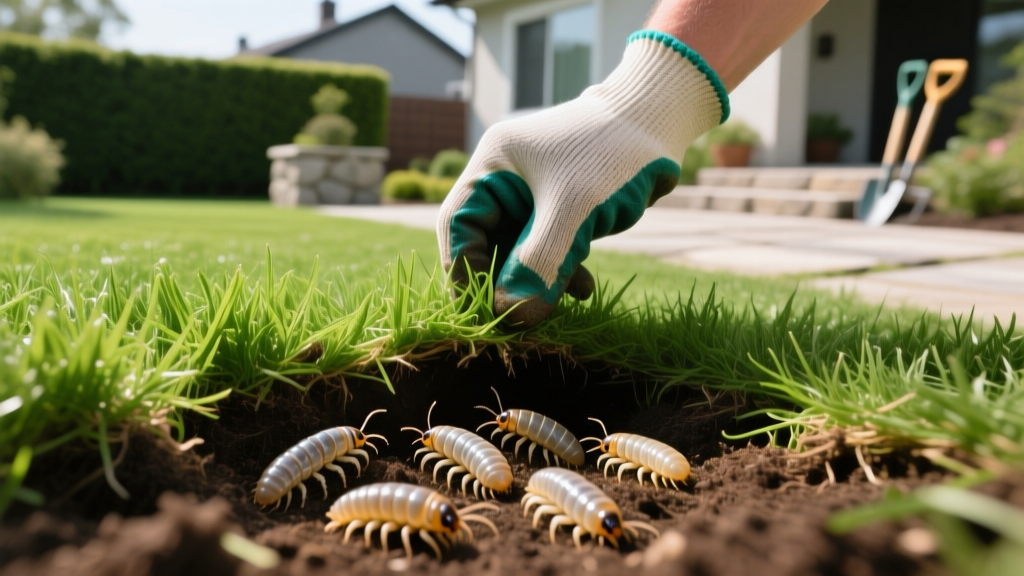
Is It Too Late to Treat for Grubs? Late-Season Rescue Guide
The Short Answer: It Depends on Soil Temperature
Homeowners frequently ask, "is it too late to treat for grubs?" when they notice brown patches, spongy turf, or skunk damage in late September or October. The definitive answer relies entirely on soil temperature and the biological life cycle of the white grub. If your local soil temperatures have consistently dropped below 50°F at a 2-inch depth, the grubs have migrated 4 to 8 inches deep into the soil profile for winter diapause. At this stage, surface-applied chemical treatments will not reach them, and it is officially too late for curative insecticides.
However, if you are in the early-to-mid fall window and soil temperatures remain above 55°F, grubs are still actively feeding in the shallow root zone. In this scenario, fast-acting curative treatments like Trichlorfon (Dylox) can still rescue your lawn from severe root destruction. Understanding the exact timing, product chemistry, and application thresholds is critical to saving your turf and avoiding wasted money on ineffective chemicals.
Pro Tip: The 50°F Threshold
Use a digital soil thermometer to check the temperature at a 2-inch depth in the early morning. If it reads below 50°F, cancel your insecticide application. The grubs are no longer feeding, and the chemicals will degrade in the soil without providing any benefit.
Use a digital soil thermometer to check the temperature at a 2-inch depth in the early morning. If it reads below 50°F, cancel your insecticide application. The grubs are no longer feeding, and the chemicals will degrade in the soil without providing any benefit.
The Biological Clock: Why Timing Dictates Your Treatment
White grubs (the larval stage of Japanese beetles, June bugs, and Asiatic garden beetles) follow a predictable annual cycle. Eggs are laid in mid-to-late summer and hatch in August. From late August through October, the young larvae feed aggressively on grassroots to build fat reserves for the winter. This is the window where curative treatments are highly effective.
By November, as soil cools, they burrow deep below the frost line. They remain dormant until April, when they migrate back to the surface to feed briefly before pupating into adult beetles. According to Michigan State University Extension, treating in late spring (April/May) is largely ineffective because the mature grubs are nearing the end of their life cycle, feeding very little, and are highly resistant to insecticides due to their thickened exoskeletons.
Is It Too Late? A Month-by-Month Decision Matrix
Use this matrix to determine your next steps based on the current month and the type of products available to you.
| Timeframe | Grub Stage & Behavior | Is It Too Late? | Recommended Action |
|---|---|---|---|
| July - Early August | Eggs hatching; tiny larvae near surface. | No | Apply preventatives (Chlorantraniliprole/Imidacloprid). |
| Late August - September | Peak feeding; high root damage risk. | No | Apply fast-acting curatives (Trichlorfon/Dylox). Best rescue window. |
| October | Slowing feeding; preparing to burrow. | Borderline | Curatives work ONLY if soil is above 55°F. Water heavily. |
| November - March | Deep winter diapause; dormant. | Yes | Stop treating. Plan for spring lawn repair and overseeding. |
| April - May | Pre-pupation; minimal feeding. | Yes | Do not apply insecticides. Apply beneficial nematodes or repair turf. |
Late-Season Curative Treatments: What Actually Works
If you have determined that it is not too late and the grubs are still active in the topsoil, you must abandon slow-acting preventatives like Scotts GrubEx (Chlorantraniliprole) and switch to contact-knockdown curatives. Here are the specific products and application protocols for late-season rescue.
Trichlorfon (Dylox): The 24-Hour Knockdown
Trichlorfon, commonly sold to consumers as Bayer Advanced 24-Hour Grub Killer Plus, is the gold standard for late-season rescue. It is a fast-acting organophosphate that kills grubs within 24 hours of contact or ingestion.
- Application Rate: 3 lbs of product per 1,000 square feet (for the standard 2.5% granular consumer formulation).
- Cost: Approximately $45 to $55 per 30 lb bag, which covers 10,000 sq. ft.
- Critical Edge Case (Soil pH): Trichlorfon is highly sensitive to alkaline conditions. If your soil pH is above 7.0, the active ingredient will undergo alkaline hydrolysis and degrade before it reaches the grubs. You must apply the product and water it in with at least 0.5 inches of irrigation immediately after spreading.
Chlorantraniliprole (Acelepryn): The Early-Fall Curative
While primarily a preventative, professional-grade Syngenta Acelepryn (Chlorantraniliprole) can act as a curative if applied in early September. It takes 14 to 21 days to kill the grubs, making it useless for late October rescues, but excellent for early fall transitions where you also want residual spring control.
- Application Rate: 1.1 to 2.3 oz per 1,000 square feet (liquid formulation) or follow granular label rates.
- Cost: High upfront cost (~$120 for a 50 lb bag of Acelepryn G), but highly cost-effective for large properties over multiple seasons.
Warning: Avoid "Weed and Feed" Combos
Never apply a combination herbicide/fertilizer/insecticide product for late-season grub rescue. The herbicide components can severely stress cool-season grasses that are already suffering from root loss due to grub feeding, leading to total lawn collapse.
Never apply a combination herbicide/fertilizer/insecticide product for late-season grub rescue. The herbicide components can severely stress cool-season grasses that are already suffering from root loss due to grub feeding, leading to total lawn collapse.
Identifying Severe Late-Stage Grub Damage
Before spending money on chemicals, confirm that grubs are actually the culprit. According to UMass Amherst Extension, the economic threshold for treatment is 5 to 10 grubs per square foot. Look for these specific indicators:
- The Tug Test: Grab a handful of the brown, dying grass and pull. If it rolls back effortlessly like a newly laid carpet with no soil attached to the roots, grubs have severed the root system.
- Visual Confirmation: Peel back the dead turf and dig 2 inches into the soil. You are looking for C-shaped, white larvae with brown head capsules and six legs near the thorax.
- Predator Activity: If your lawn looks like it has been tilled by a rototiller, you likely have skunks, raccoons, or crows digging for the grubs. Ironically, the wildlife often does more cosmetic damage to the turf than the insects themselves.
The "Too Late" Protocol: When to Stop Treating and Start Repairing
If it is November, the ground is freezing, or you missed the window, do not apply chemicals. Instead, execute this recovery framework to save your lawn for the following spring:
- Mitigate Animal Damage: Use motion-activated sprinklers or castor oil-based repellents to deter skunks and raccoons from further tearing up your lawn.
- Tamp Down Turf: Walk over the peeled-back sections of grass with flat-soled shoes to press the remaining roots back into contact with the soil. This prevents the turf from completely desiccating over the winter.
- Spring Nematode Application: In late April, when soil temperatures reach 60°F, apply Heterorhabditis bacteriophora beneficial nematodes. These microscopic worms actively hunt and infect the overwintered grubs before they can pupate.
- Overseed and Topdress: In early spring, aerate the damaged zones, lay down a 1/4 inch layer of compost, and overseed with a turf-type tall fescue blend, which exhibits moderate natural tolerance to grub feeding.
Frequently Asked Questions
Can I treat for grubs in the winter?
No. Winter treatments are entirely ineffective. Grubs are dormant deep in the soil, and liquid or granular insecticides cannot penetrate frozen ground or reach the target depth. Wait until late summer or early fall of the following year.
Does milky spore work for late-season rescue?
No. Milky spore (Paenibacillus popilliae) is a biological control that only targets Japanese beetle grubs, and it takes 2 to 5 years to build up sufficient spore counts in the soil to be effective. It is strictly a long-term preventative strategy, not a curative rescue treatment.
Should I fertilize my lawn if it has grub damage in the fall?
Apply a slow-release, low-nitrogen winterizer fertilizer (e.g., 10-0-14) in late October to encourage root growth without pushing vulnerable top growth. Avoid high-nitrogen synthetic fertilizers, which can burn stressed, rootless turf.

