
Pest Control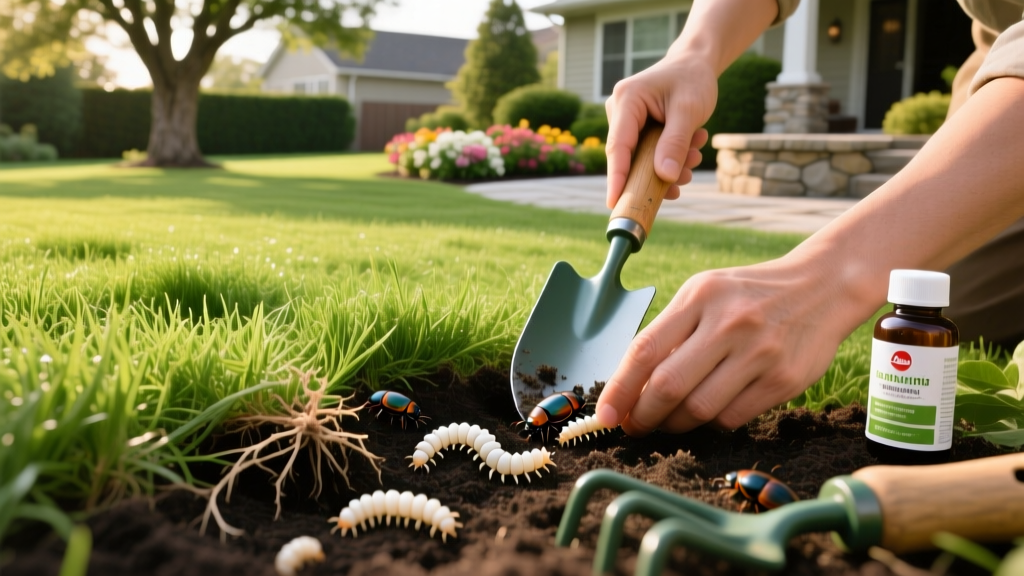
Eradicating Japanese Beetle Grubs: A Complete Lawn Defense Guide
The Hidden Threat Beneath Your Turf
Japanese beetle grubs (Popillia japonica) are the larval stage of one of the most destructive turf pests in North America. These C-shaped, white larvae with distinct brown head capsules feed aggressively on the root systems of cool-season and warm-season grasses. Unlike surface-feeding insects, grubs sever the roots entirely, causing the turf to detach from the soil and roll back like a loose carpet. According to Ohio State University Extension, severe infestations can destroy up to 80% of a residential lawn's root mass in a single autumn season if left unchecked.
Effective yard defense requires moving beyond generic "grub killer" applications. You must align your treatment strategy with the insect's biological timeline, utilize precise soil sampling, and select active ingredients based on whether you need preventative or curative action.
The Life Cycle: Timing Your Defense Strategy
Mistiming your application is the number one reason homeowners fail to control Japanese beetle grubs. The larvae go through three distinct instars (growth stages), and their susceptibility to chemicals and biologicals shifts dramatically throughout the year.
📅 The Grub Timeline:
- July – August: Adult beetles lay eggs in the soil. Eggs hatch in 12–18 days.
- September – October: First and second instar grubs feed heavily near the surface. This is the peak window for curative treatments.
- November – March: Grubs migrate 6–12 inches deep into the soil profile to overwinter. Treatments are completely ineffective during this phase.
- April – May: Third instar grubs return to the surface to feed briefly before pupating. Curative controls work, but damage is already done.
- June: Pupation occurs; adults emerge.
Diagnosing an Infestation: The 6x6 Soil Sampling Test
Do not apply insecticides based on the mere presence of adult beetles in your landscape. You must verify grub populations in the soil. The economic threshold for Japanese beetle grubs is generally 7 to 10 grubs per square foot. Below this threshold, healthy turf can outgrow the root pruning.
Step-by-Step Soil Sampling Protocol
- Select Sampling Zones: Choose 5 to 10 areas of the lawn, prioritizing sunny, south-facing slopes and areas near ornamental trees (where adult beetles prefer to lay eggs).
- Cut the Sod: Using a sharp spade or a specialized turf cup cutter, cut a 6x6 inch square of sod (exactly 0.25 square feet).
- Lift and Inspect: Peel the grass back. Inspect the top 3 inches of the soil profile and the thatch layer.
- Calculate the Density: Count the grubs and multiply by 4 to get the population per square foot. If your 6x6 square yields 2 grubs, your density is 8 grubs per square foot—treatment is required.
Chemical Controls: Preventative vs. Curative Matrix
Selecting the correct active ingredient is critical. Preventative chemicals target newly hatched, vulnerable first-instar grubs, while curative chemicals are designed to kill larger, third-instar grubs that are actively destroying roots.
| Active Ingredient | Brand Example | Strategy | Application Window | Rate (per 1,000 sq ft) |
|---|---|---|---|---|
| Chlorantraniliprole | Acelepryn | Preventative | April – June | 0.08 – 0.11 oz (liquid) |
| Imidacloprid | Merit | Preventative | June – July | 1.4 – 1.8 lbs (0.5% granular) |
| Trichlorfon | Dylox | Curative | Aug – Oct / April | 1.5 – 2.0 lbs (granular) |
| Clothianidin + Bifenthrin | Aloft | Curative/Preventative | July – Sept | 1.8 – 2.7 lbs (granular) |
⚠️ 2026 Resistance Warning: Recent field trials noted by University of Kentucky Entomology indicate growing localized resistance to older neonicotinoids like Imidacloprid in areas with heavy historical usage. If Merit has failed your lawn in consecutive years, rotate to Chlorantraniliprole (Acelepryn), which operates via ryanodine receptor modulation and boasts an excellent environmental safety profile for pollinators when applied to non-flowering turf.
The Watering Mandate
All granular grub controls require immediate irrigation to move the active ingredient through the thatch layer and into the top 2 inches of soil. You must apply exactly 0.25 to 0.5 inches of water immediately after spreading. Without this, the chemical remains trapped in the thatch, degrading under UV light and failing to reach the root zone where the grubs feed.
Biological Controls: Nematodes and Milky Spore
For homeowners managing organic yards or properties near sensitive waterways, biological controls offer a highly effective alternative to synthetics, provided you respect their environmental requirements.
Heterorhabditis bacteriophora (Hb Nematodes)
Not all nematodes are created equal. While Steinernema species are cheaper, Heterorhabditis bacteriophora (Hb) is the proven specialist for deep-soil Japanese beetle grubs. Hb nematodes carry symbiotic bacteria (Photorhabdus luminescens) that kill the grub within 48 hours of infection.
- Application Rate: 1 billion nematodes per acre (approx. 23,000 per square foot).
- Cost: Expect to pay $40–$60 for a 10-million count pouch, sufficient for roughly 4,000 square feet.
- Critical Constraint: Soil temperature must be between 55°F and 85°F. The soil must be kept consistently moist for 10 days post-application. Apply at dusk to prevent UV desiccation.
Milky Spore (Paenibacillus popilliae)
Milky Spore is a bacterial disease specific to Japanese beetle grubs. While heavily marketed, Rutgers University researchers caution that it is a long-term inoculation strategy, not a quick fix. It takes 3 to 5 years for the spores to build up to suppressive levels in the soil. Furthermore, its efficacy drops significantly in soils with high pH (above 7.5) or in northern climates where soil temperatures rarely stay above 70°F for extended periods.
Managing Secondary Predator Damage
Often, the most severe damage to a lawn is not caused by the grubs themselves, but by the mammals that hunt them. Raccoons, skunks, and crows will tear up large swaths of turf to access the protein-rich larvae. If you notice 6-inch deep divots and rolled-back sod overnight, you have a secondary predator issue.
"Trapping predators is a temporary band-aid. The only permanent solution to predator digging is eliminating the food source. Apply a fast-acting curative like Trichlorfon (Dylox) immediately, and use bird netting or motion-activated sprinklers to deter mammals while the chemical takes effect."
Turf Recovery and Overseeding Protocols
Once the grub population is eradicated, the severed roots will not reattach. Dead patches must be renovated.
- Remove Dead Sod: Use a sod cutter or heavy rake to remove the dead, detached turf.
- Aerate and Topdress: Core aerate the compacted soil and apply a 1/4 inch layer of compost.
- Select Resistant Cultivars: When overseeding, choose turfgrass species with natural resistance or endophyte enhancements. Tall fescues (like 'Titan Ultra' or 'Rhambler') contain naturally occurring endophytic fungi that deter surface-feeding insects and improve drought tolerance, though they do not repel root-feeding grubs directly. However, their deeper, more robust root systems tolerate low-level grub feeding far better than shallow-rooted Kentucky Bluegrass.
- Fertilize: Apply a starter fertilizer high in phosphorus (e.g., 10-18-10) to stimulate rapid root regeneration before winter dormancy.

