
Pest Control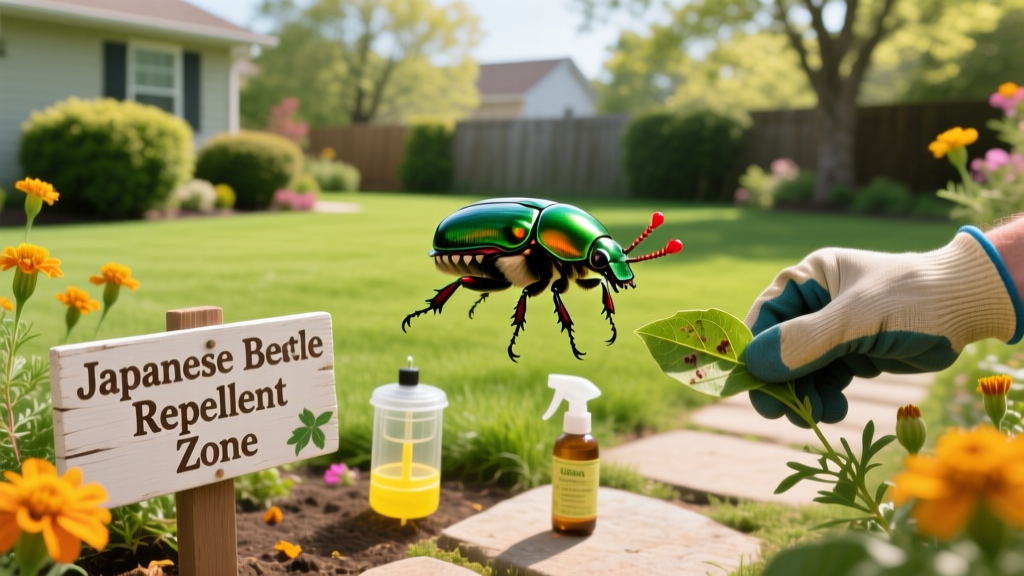
Effective Japanese Beetle Repellent Strategies for Yard Defense
The metallic green and copper-brown carapace of Popillia japonica (the Japanese beetle) is a notorious sight for homeowners. These voracious pests skeletonize over 300 plant species, with a severe preference for roses, linden trees, and grapevines. While the adult beetles decimate foliage in the summer, their subterranean larval stage (grubs) silently destroys turfgrass root systems. Effective yard defense requires a dual-layered approach: deploying a reliable Japanese beetle repellent for adult foliage protection while simultaneously targeting the grub population before emergence.
⚠️ Critical Timing Alert: Adult Japanese beetles emerge when soil temperatures reach exactly 65°F at a 2-inch depth for several consecutive days, typically between late June and early July. Applying foliar repellents before this thermal threshold is a waste of product; applying them after the beetles have already established feeding sites reduces efficacy by up to 40%.
The Biology of the Invasion: Why Repellents Fail
Many homeowners mistakenly believe that spraying a contact insecticide in May will prevent a July infestation. This fundamentally misunderstands the beetle's lifecycle. Japanese beetles spend roughly 10 months underground as grubs. They overwinter deep in the soil (below the frost line) and migrate upward in spring to feed on grass roots before pupating. True Japanese beetle repellent strategies must address the adult feeding phase (foliar defense) and the larval phase (turf defense) as distinct, separate operations.
Furthermore, adult beetles are highly mobile, capable of flying up to 5 miles to locate preferred host plants. They feed in aggregates, attracted by a congregation pheromone and the volatile organic compounds (VOCs) released by damaged plant tissue. Once a few scouts find your prized hydrangeas, the localized pheromone signal triggers a mass feeding event. Therefore, the primary goal of a foliar repellent is not necessarily to kill the beetle on contact, but to mask the plant's VOCs and disrupt the aggregation pheromone, making your yard an unappealing landing zone.
Botanical vs. Chemical Repellents: A Decision Matrix
Choosing the right Japanese beetle repellent depends on your landscape's ecological sensitivity, local pollinator activity, and your tolerance for reapplication frequency. Below is a comparative matrix of the most effective active ingredients available for residential yard defense.
| Active Ingredient | Mode of Action | Rainfastness | Best Application Window |
|---|---|---|---|
| Geraniol (Botanical) | Olfactory masking / Contact deterrent | Low (Washes off in 0.5" rain) | Dusk or early morning (avoid peak UV) |
| Azadirachtin (Neem) | Antifeedant / Growth regulator | Moderate (Resists light drizzle) | Late evening to prevent leaf burn |
| Imidacloprid (Systemic) | Neurotoxin (absorbed via roots) | High (Rainfast in 24 hours) | Early spring soil drench (pre-emergence) |
| Pyrethrins (Botanical) | Contact neurotoxin (knockdown) | Very Low (Degrades rapidly in UV) | Directly on visible aggregations at dusk |
Deep Dive: Geraniol and Neem Oil Formulations
For homeowners managing organic gardens or protecting blooming pollinator attractants, botanical repellents are the safest choice. Products utilizing Geraniol (such as EcoSmart Insect Killer, typically priced around $18 for a 32 oz ready-to-spray bottle) work by overwhelming the beetle's highly sensitive olfactory receptors. To maximize efficacy, mix pure geraniol oil at a rate of 2.5 oz per gallon of water, adding 1 oz of non-ionic surfactant to ensure the oil coats the waxy cuticle of the leaves.
Cold-pressed Neem Oil (containing minimum 4.5% Azadirachtin) acts primarily as an antifeedant. When a Japanese beetle ingests neem-treated foliage, it ceases feeding within hours and eventually fails to molt or reproduce. Unlike synthetic pyrethroids, neem does not cause immediate knockdown, which frustrates some gardeners. However, its residual antifeedant properties last 7 to 10 days, provided it is not washed away by heavy irrigation. Always apply neem at a dilution of 1 to 2 oz per gallon during twilight hours; applying neem under direct midday sun will cause severe phytotoxicity (leaf burn) on sensitive plants like Japanese maples and roses.
Grub-Targeted Yard Defense: Stopping Them Before They Emerge
Foliar repellents only treat the symptom; biological grub control treats the disease. If your lawn suffered from Japanese beetle grub damage the previous fall (evidenced by irregular brown patches that pull up like loose carpet), you must deploy biological controls in late summer.
The gold standard for organic grub eradication is the entomopathogenic nematode Heterorhabditis bacteriophora (Hb strain). Unlike the more common Steinernema feltiae (which targets fungus gnats and early-stage grubs), the Hb strain actively seeks out and infects large, late-instar Japanese beetle grubs in the top 3 inches of soil. In 2026, a commercial-grade package containing 10 million Hb nematodes costs approximately $45 to $60 and treats up to 2,500 square feet of turf.
Step-by-Step: Applying Hb Nematodes for Maximum Mortality
- Verify Soil Moisture: Nematodes require a damp environment to swim through soil pores. Irrigate the target lawn area with 0.25 inches of water 24 hours before application.
- Mix in Shade: UV radiation kills nematodes in minutes. Mix the powdered or sponge-based nematodes into a 5-gallon sprayer tank filled with cool (not cold) water, strictly in the shade or at dusk.
- Agitate Continuously: Nematodes sink rapidly. Keep the sprayer tank gently agitated during the entire application process to ensure even distribution.
- Water-In Immediately: After spraying, apply another 0.25 inches of irrigation to wash the nematodes off the grass blades and down into the thatch layer and soil profile.
- Maintain Moisture: Water the lawn lightly every 2 days for the next 10 days. If the top inch of soil dries out, the nematode population will crash, resulting in a failed treatment.
The Trap Crop Strategy: The Decoy Method
Advanced yard defense involves manipulating beetle behavior rather than just fighting it. Japanese beetles show a strong foraging preference for specific plants, notably borage, evening primrose, and wild raspberry. By planting a perimeter of these highly attractive "trap crops" 50 to 100 feet away from your primary garden beds, you can intercept the beetles before they reach your prized ornamentals.
Once the beetles aggregate on the trap crops in the late afternoon, you can easily vacuum them off using a handheld shop-vac filled with an inch of soapy water, or apply a targeted knockdown spray exclusively to the decoy plants, drastically reducing the chemical load on your main landscape.
Expert Warning on Pheromone Traps: According to Rutgers University Extension, commercial pheromone traps (the green and yellow bags hung on stakes) attract significantly more beetles into your yard than they actually catch. Research indicates that traps intercept only about 60% of the beetles they lure, leaving the remaining 40% to feed on nearby foliage. Never place a pheromone trap within 100 feet of your garden; if you must use one, place it at the farthest edge of your property line to draw beetles away from your home.
Expert Troubleshooting: When Repellents Wash Off
The most common failure point in Japanese beetle repellent programs is rainfastness. A sudden July thunderstorm can strip botanical repellents from leaf surfaces, leaving your garden entirely unprotected during the peak feeding hours of the following morning.
The Surfactant Solution: To increase the rainfastness of neem oil and geraniol sprays, incorporate a silicone-based organosilicone surfactant (such as CapSil) at a rate of 1/4 teaspoon per gallon. This reduces the surface tension of the spray droplets, allowing the active ingredients to spread into a micro-thin, uniform film that adheres tightly to the leaf cuticle, surviving up to 1 inch of rainfall.
Systemic Fallback for High-Value Trees: For large, established trees like Lindens or Birches where foliar spraying is physically impossible for a homeowner, rely on systemic treatments. Applying a soil drench of Imidacloprid (e.g., Bayer Advanced 12-Month Tree and Shrub Protect & Feed) in early May allows the chemical to be drawn up through the xylem. By the time the beetles emerge in July, the leaves contain a lethal dose. However, as noted by Penn State Extension, avoid using systemic neonicotinoids on trees that are currently blooming or about to bloom, as the active ingredient can translocate into the nectar and pollen, posing a severe risk to native bee populations.
Summary: Building Your 2026 Defense Calendar
Successful Japanese beetle management is a calendar-driven operation. Apply Hb nematodes in late August to crash the grub population. Drench high-value, non-blooming trees with systemic treatments in May. Finally, when soil temperatures hit 65°F in late June, begin dusk applications of geraniol or neem-based repellents on your most vulnerable ornamentals. By layering biological, systemic, and olfactory defenses, you can maintain a pristine landscape without resorting to broad-spectrum aerial spraying.

