
Pest Control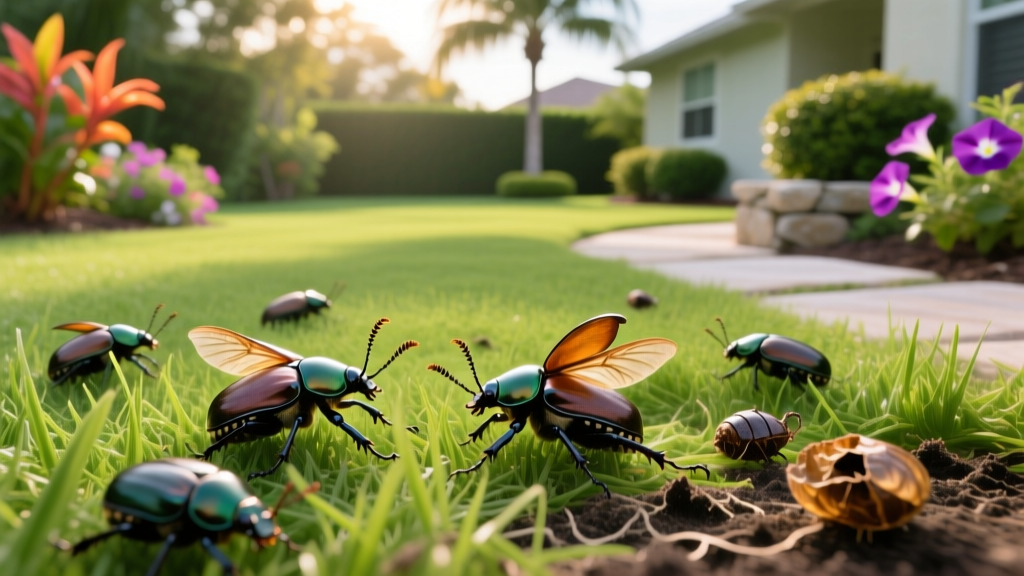
June Bugs in Florida: Seasonal Emergence and Treatment Calendar
The Florida "June Bug" Identity Crisis
When managing turfgrass in the Southeast, the colloquial term "June bug" masks a complex biological reality. In northern states, this term almost exclusively refers to Phyllophaga species (May/June beetles). However, when dealing with june bugs florida turf managers and homeowners are actually battling a dual threat: the traditional Phyllophaga species and the highly destructive Green June Beetle (Cotinis nitida). According to the University of Florida IFAS Entomology Department, the Green June Beetle is uniquely adapted to Florida's subtropical climate and causes damage through both root feeding and physical soil disruption.
Understanding which species is present in your lawn dictates your entire treatment strategy. Phyllophaga grubs feed strictly on grassroots, causing the turf to detach from the soil and roll back like a carpet. In contrast, Green June Beetle grubs are larger, possess a distinct velvety texture, and crawl on their backs. They push up mounds of soil as they tunnel, creating a spongy, uneven lawn surface that disrupts mowing and invites secondary fungal pathogens.
Regional Emergence Calendar: North, Central, and South Florida
Florida's diverse USDA hardiness zones (ranging from 8b in the Panhandle to 11a in the Keys) mean that June bug emergence is not a statewide synchronized event. Timing your preventative grub applications to coincide with local egg hatch windows is the single most critical factor in achieving control. Applying granular insecticides too early results in environmental degradation of the active ingredient before the grubs are present; applying too late allows the larvae to grow past the vulnerable early-instar stages.
| Florida Region | Peak Adult Flight | Egg Hatch & Early Grub Feeding | Optimal Preventative Application Window |
|---|---|---|---|
| North FL (Zones 8b-9a) | Late May – June | July – August | Early to Mid-June |
| Central FL (Zones 9b-10a) | Mid-May – July | June – August | Mid-May to Early June |
| South FL (Zones 10b-11) | April – August (Staggered) | May – September | Early May (Follow-up in July) |
Diagnosing the Damage: Root Feeders vs. Soil Turners
Before purchasing any chemical controls, verify the pest. Misidentifying drought stress or fungal diseases (like Large Patch or Take-All Root Rot) as grub damage leads to wasted chemicals and continued turf decline. Perform a "tug test" on the grass; if it pulls up effortlessly with no roots attached, you likely have Phyllophaga or white grubs. If the turf is firmly rooted but the ground feels spongy underfoot and you see small, pencil-sized soil mounds, you are dealing with Green June Beetles.
🔍 The Soap Flush Test:
Mix 2 tablespoons of liquid dish soap with 1 gallon of water. Pour this solution over a 1-square-yard area of the lawn's margin (where healthy grass meets damaged grass). Wait 10 minutes. If grubs or adult beetles are present in the thatch or upper soil profile, the soap will irritate them and force them to the surface, confirming the infestation and allowing for species identification.
Mix 2 tablespoons of liquid dish soap with 1 gallon of water. Pour this solution over a 1-square-yard area of the lawn's margin (where healthy grass meets damaged grass). Wait 10 minutes. If grubs or adult beetles are present in the thatch or upper soil profile, the soap will irritate them and force them to the surface, confirming the infestation and allowing for species identification.
Strategic Treatment Protocol: Preventative vs. Curative
The UF/IFAS Lawn Insects Management Guide emphasizes that preventative applications yield vastly superior results compared to curative rescue treatments. Once grubs reach their third-instar (late fall), their exoskeletons thicken, and their feeding slows, making them highly resistant to standard chemical controls.
1. Preventative Chemistry (Spring/Early Summer)
For long-residual prevention, Chlorantraniliprole is the industry gold standard. It is highly effective against early-instar grubs, possesses an excellent environmental safety profile, and does not harm earthworms or pollinators when applied as a granular soil treatment.
- Top Product: Scotts GrubEx1 (0.08% Chlorantraniliprole)
- Application Rate: 3.3 lbs per 1,000 square feet.
- Activation: Requires 0.5 inches of irrigation immediately after application to move the active ingredient into the root zone.
- Cost: Approximately $25 for a 14 lb bag (covers ~4,300 sq ft), equating to $0.0058 per square foot.
2. Curative Chemistry (Late Summer/Fall)
If you missed the preventative window and are seeing active turf detachment in August or September, you must switch to a fast-acting, short-residual curative insecticide like Trichlorfon.
- Top Product: BioAdvanced 24 Hour Grub Killer Plus (Dylox / Trichlorfon)
- Application Rate: 1.15 to 1.3 lbs per 1,000 square feet.
- Activation: Must be watered in immediately. Trichlorfon degrades rapidly in high-pH soils and sunlight, so application in the late afternoon followed by immediate irrigation is mandatory.
⚠️ Critical Warning: Never apply Trichlorfon (Dylox) as a spring preventative. Its soil half-life is less than 14 days. If applied in May for a July egg hatch, the chemical will be completely gone before the grubs even exist. Reserve Trichlorfon strictly for active, late-summer infestations.
Biological Controls: Entomopathogenic Nematodes
For homeowners managing organic lawns or those looking to reduce synthetic pesticide loads, beneficial nematodes offer a highly effective biological alternative. The species Heterorhabditis bacteriophora (Hb nematodes) actively seeks out and infects white grubs and Green June Beetle larvae in the soil profile.
Application Specifics: Nematodes are living organisms and require strict handling protocols. They must be stored in a refrigerator (not frozen) and applied during the early morning or late evening to avoid UV degradation. The required application density is roughly 23,000 nematodes per square foot (1 billion per acre). Because a standard 10-million nematode package costs around $40 and only covers 400 square feet, this method is cost-prohibitive for entire lawns but highly recommended for targeted spot-treatments in high-value landscape beds or localized grub hotspots.
Cultural Controls: Manipulating the Microclimate
Chemical and biological controls will fail if the underlying lawn environment continues to invite egg-laying adults. Female Green June Beetles are highly attracted to moist, organically rich soil with a heavy thatch layer to lay their eggs.
- Thatch Management: St. Augustinegrass and Zoysia are prone to rapid thatch accumulation. If your thatch layer exceeds 0.5 inches, perform core aeration and dethatching in early spring (March/April) before the adult flight season begins.
- Irrigation Manipulation: During peak adult flight in June, allow the top 1 inch of soil to dry out between watering cycles. Deep, infrequent watering (providing 0.75 inches of water twice a week) promotes deep root growth while denying the surface moisture that female beetles require for oviposition.
- Organic Fertilizer Timing: Avoid applying heavy, fast-release nitrogen fertilizers or fresh manure in late May and June. The volatile organic compounds released by decomposing organics act as a powerful pheromone attractant for adult June bugs.
Cost Analysis: Professional vs. DIY Grub Management
Deciding whether to tackle a June bug infestation yourself or hire a licensed turf professional depends on lawn size and the severity of the damage. Below is a comparative cost breakdown for a standard 5,000-square-foot Florida lawn.
| Treatment Method | Materials / Service Cost | Time Investment | Efficacy Guarantee |
|---|---|---|---|
| DIY Preventative (Chlorantraniliprole) | $30 - $40 | 1.5 hours (spread & water) | High (if timed correctly) |
| DIY Curative (Trichlorfon) | $25 - $35 | 1.5 hours (spread & water) | Moderate (depends on grub size) |
| Professional Lawn Care Application | $65 - $95 (per application) | Zero (handled by technician) | Very High (commercial-grade chemistries) |
For lawns under 8,000 square feet, DIY preventative applications using consumer-grade Chlorantraniliprole provide excellent ROI. However, for large properties or severe Green June Beetle infestations requiring specialized curative tank mixes and soil surfactants, professional intervention prevents costly turf replacement expenses that can exceed $1.50 per square foot for new St. Augustine sod installation.

