
Pest Control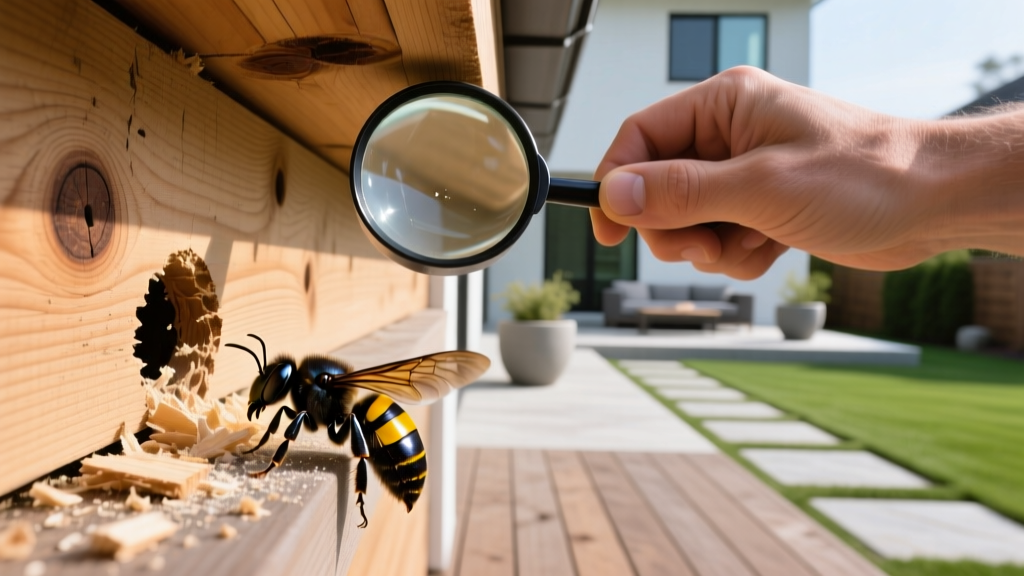
How to Keep Carpenter Bees Away From Decks and Eaves
The Real Cost of Carpenter Bee Excavation
Carpenter bees (Xylocopa species) are large, solitary insects that excavate perfectly round, half-inch diameter tunnels into structural wood to create nesting galleries. Unlike termites or carpenter ants, they do not consume the wood; they simply hollow it out to lay their eggs. While a single tunnel might seem harmless, these bees reuse and expand the same galleries year after year. Over successive generations, tunnels can extend several feet into a deck joist, fascia board, or fence post, trapping moisture and accelerating wood rot.
Figuring out how to keep carpenter bees away requires understanding their preferences. They overwhelmingly target unpainted, weathered softwoods. According to Penn State Extension, the most vulnerable materials on a residential property include cedar, redwood, cypress, and unpainted pine. If you leave these materials exposed, you are essentially providing them with a pre-approved building site.
⚠️ The Secondary Damage Threat: The bees themselves rarely cause catastrophic structural failure on their own. The real danger comes from woodpeckers. Woodpeckers can hear the larvae moving inside the wood and will aggressively peck through fascia boards and deck railings to reach them, causing massive, expensive cosmetic and structural damage in a matter of days.
Wood Vulnerability and Treatment Matrix
Before applying any repellent or insecticide, you must assess the current state of your wood surfaces. The effectiveness of your defense strategy depends entirely on the wood's finish and density.
| Wood Type & Condition | Vulnerability Level | Recommended Primary Defense |
|---|---|---|
| Unpainted Cedar / Redwood | Extreme | Polyurethane sealant + Pyrethroid barrier |
| Weathered Pine (Fences) | High | Exterior paint or heavy stain + Almond oil |
| Painted Hardwoods | Low | Routine paint maintenance (fill chips immediately) |
| Pressure-Treated Lumber | Very Low | Monitor end-cuts (treat cut ends with copper naphthenate) |
Chemical Barrier Strategies: Microencapsulated Pyrethroids
For active infestations or high-risk areas where painting isn't an option, residual insecticides are the most reliable way to keep carpenter bees away. Standard liquid sprays often fail because the wood absorbs the moisture, leaving the active ingredient trapped below the surface where foraging bees never contact it.
Top Professional-Grade Products for 2026
- Syngenta Demon WP (Cypermethrin): This wettable powder leaves a visible micro-crystalline residue on the wood surface. When a bee lands on the treated fascia board, the crystals cling to its legs, delivering a lethal dose. It provides up to 90 days of residual control. Cost: ~$35 for a box of 10 water-soluble packets.
- Control Solutions Cyzmic CS (Lambda-cyhalothrin): If you are treating stained cedar or redwood where a visible white residue is unacceptable, use a microencapsulated suspension. The tiny polymer capsules sit on the wood surface and dry completely clear, resisting UV degradation and rain wash-off. Cost: ~$48 per pint.
Application Protocol: Mix the chosen product according to label rates (typically 1 packet or 0.8 oz per gallon of water). Use a pump sprayer like the Chapin 1949 (approx. $30) pressurized to 40 PSI. Apply heavily to the undersides of deck joists, eaves, and window trim in early spring (March to April) just before the adult bees emerge to mate and excavate. Always follow EPA Safe Pest Control guidelines regarding protective equipment and environmental runoff.
Non-Toxic and Organic Deterrents
For homeowners managing organic gardens or those with chemical sensitivities, natural repellents can disrupt the bees' nesting cycle, though they require much more frequent reapplication than synthetic pyrethroids.
Almond Oil (Benzaldehyde)
Carpenter bees possess a strong olfactory aversion to benzaldehyde, the primary compound in bitter almond oil. You can purchase food-grade bitter almond oil or specialized horticultural almond oil sprays (approx. $15 to $22 per bottle). Apply it directly inside existing holes and wipe it across vulnerable, unpainted wood surfaces using a rag. Limitation: The scent dissipates rapidly in direct sunlight and high heat, requiring reapplication every 10 to 14 days during the peak spring mating season.
Citrus Boil Spray
Boil the peels of lemons, limes, and oranges in water for 15 minutes. Let the mixture cool, strain it, and pour it into a spray bottle. The high concentration of d-limonene acts as a natural contact irritant and repellent. While less effective as a long-term barrier, it is an excellent, zero-cost method for actively chasing foraging bees away from a specific board while you prepare to seal it.
Remediation: How to Plug Existing Tunnels Safely
A common mistake is plugging a hole while the bee is inside or while larvae are developing. If you seal an active tunnel, the bee will simply chew a new exit hole, often damaging the exterior paint or wood finish in the process. According to North Carolina State University Extension, proper remediation requires a specific sequence.
Pro-Tip: Avoid Steel Wool
Many DIY guides recommend stuffing holes with steel wool. Do not use steel wool on exterior wood, especially cedar or redwood. As the steel rusts from rain and humidity, it will leach severe black iron stains deep into the wood grain, permanently ruining the appearance of your deck or eaves. Always use copper mesh or aluminum screening instead.
Many DIY guides recommend stuffing holes with steel wool. Do not use steel wool on exterior wood, especially cedar or redwood. As the steel rusts from rain and humidity, it will leach severe black iron stains deep into the wood grain, permanently ruining the appearance of your deck or eaves. Always use copper mesh or aluminum screening instead.
The 4-Step Plugging Process
- Treat the Gallery: Wait until late evening when bees are inactive. Puff an insecticidal dust, such as DeltaDust (Deltamethrin), directly into the hole using a hand duster. This ensures any bees inside are eliminated before sealing.
- Wait 48 Hours: Allow the dust to work and ensure no further buzzing or movement is detected from the tunnel.
- Insert a Physical Barrier: Roll up a small piece of 1/2-inch copper mesh or aluminum window screen and stuff it tightly into the hole, leaving about 1/4 inch of depth from the surface.
- Seal the Surface: Fill the remaining 1/4 inch with a high-quality, exterior-grade wood filler (e.g., Minwax High Performance Wood Filler, approx. $12). Once dry, sand it flush and apply a coat of exterior paint or polyurethane to match the surrounding wood.
Long-Term Structural Maintenance
Ultimately, the most permanent way to keep carpenter bees away is to remove the visual and tactile cues that attract them. Carpenter bees prefer the grip and texture of raw, weathered wood. Applying a heavy coat of exterior acrylic-latex paint completely masks the wood grain and creates a surface too smooth and thick for their mandibles to penetrate. If you prefer the natural wood look, a thick, multi-coat application of spar urethane or a solid-body exterior stain will provide a physical barrier that rivals paint, provided you inspect and re-coat the surfaces every three to four years to prevent micro-cracking.

