
Pest Control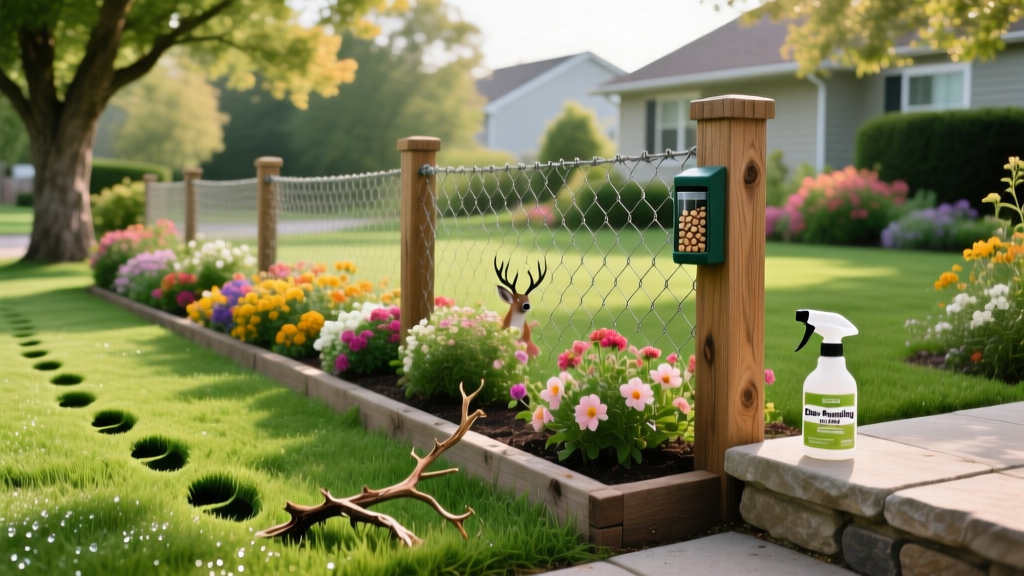
How Do I Keep Deer Away From My Garden? Expert Fencing & Repellents
The Reality of Deer Pressure in Residential Landscapes
White-tailed deer cause over $2 billion in agricultural and residential plant damage annually across North America. When homeowners ask, 'how do I keep deer away from my garden,' they are often met with generic advice that fails under heavy local browsing pressure. Deer are highly adaptable, neophobic (fearful of new objects) but quick to habituate to static threats. According to the Internet Center for Wildlife Damage Management, effective deterrence requires a multi-tiered strategy combining physical exclusion, chemical repellents, and tactical landscaping.
This guide provides exact specifications, product models, and application metrics to secure your garden against persistent mammalian herbivores.
Physical Exclusion: The 8-Foot Rule and Fence Engineering
A standard 6-foot privacy fence will not stop a determined deer. White-tailed deer can clear an 8-foot vertical jump from a standstill. However, they lack the depth perception to judge the landing zone on the other side of a tall, opaque barrier, which is why an 8-foot fence is the industry gold standard for total exclusion.
Fencing Material Comparison Matrix
| Fence Type | Specifications | Cost (Per Linear Ft) | Longevity | Best Use Case |
|---|---|---|---|---|
| Woven Wire (Field Fence) | 12.5-gauge galvanized steel, 8 ft height | $4.50 - $7.00 | 20+ years | Perimeter security, high-wind areas |
| Polypropylene Mesh | 7.5 to 8 ft height, UV-stabilized black | $1.20 - $2.50 | 10 - 15 years | Large garden enclosures, budget-conscious |
| Slant Fence (Angled) | 6 ft height, angled outward at 45 degrees | $3.00 - $5.00 | 15+ years | Small yards where 8 ft vertical violates HOA codes |
Pro Tip: The Slant Fence Hack
If your local zoning or HOA prohibits 8-foot vertical structures, build a 6-foot fence slanted outward at a 45-degree angle. Deer are excellent vertical jumpers but poor horizontal leap estimators. The outward slant disrupts their spatial calculation, effectively mimicking an 8-foot barrier.
If your local zoning or HOA prohibits 8-foot vertical structures, build a 6-foot fence slanted outward at a 45-degree angle. Deer are excellent vertical jumpers but poor horizontal leap estimators. The outward slant disrupts their spatial calculation, effectively mimicking an 8-foot barrier.
Chemical Repellents: Active Ingredients and Rainfastness
When physical fencing is impossible, chemical repellents are your primary defense. Repellents fall into two categories: contact (taste-based) and area (odor-based). For maximum efficacy in 2026, rely on putrescent whole egg solids or capsaicin-based formulas.
Top-Performing Repellent Formulations
- Liquid Fence (EPA Reg. No. 83994-1): Contains 2.0% putrescent whole egg solids. The sulfur compounds mimic predator urine and decaying matter. Cost: ~$35 per gallon. Application: Spray until foliage is wet but not dripping. Requires 6 hours of dry weather to become rainfast. Reapply every 3 to 4 weeks during the growing season.
- Deer Out (Capsaicin/Peppermint): Relies on capsaicin (hot pepper extract) and essential oils. Cost: ~$40 per gallon. Highly effective for young, tender shoots in spring. Warning: Can cause phytotoxicity (leaf burn) on sensitive plants like Japanese Maples if applied in direct sunlight above 80°F.
- Milorganite (Milwaukee Organite): A nitrogen-rich biosolid fertilizer with a strong odor. While heavily marketed as a deer deterrent, university trials show it fails under heavy winter browsing pressure when natural forage is scarce. Use it as a fertilizer first, deterrent second.
Crucial Metric: 1 gallon of ready-to-use liquid repellent covers approximately 1,000 square feet of dense foliage. For a standard 50x50 foot garden perimeter, budget for 2.5 gallons per application cycle.
Tactical Landscaping: The Rutgers Resistance Ratings
No plant is 100% deer-proof; a starving deer will eat almost anything. However, selecting plants with high toxicity, strong aromatic oils, or fuzzy foliage drastically reduces browsing. The Rutgers New Jersey Agricultural Experiment Station maintains the most authoritative database on deer resistance, rating plants from A (Rarely Severely Damaged) to D (Frequently Severely Damaged).
Level 'A' Deer-Resistant Garden Staples
- Daffodils (Narcissus): Contain lycorine, an alkaloid that is highly toxic to mammals. Excellent for spring border buffers.
- Bleeding Heart (Lamprocapnos spectabilis): Features fern-like foliage and contains isoquinoline alkaloids that cause gastrointestinal distress in deer.
- Foxglove (Digitalis purpurea): Contains cardiac glycosides. Highly toxic and naturally avoided by all mammalian herbivores.
- Boxwood (Buxus sempervirens): Dense, evergreen shrub with alkaloid-rich leaves. Ideal for creating a low, aromatic hedge around vulnerable vegetable beds.
Motion-Activated Deterrents: Startling the Herd
Ultrasonic sound devices are largely ineffective against deer, as their hearing range and habituation rates render high-frequency noise useless after 48 hours. Instead, rely on sudden physical stimuli.
The Orbit 62100 Yard Enforcer is the current market leader for motion-activated sprinklers. It utilizes a passive infrared (PIR) sensor to detect heat signatures up to 40 feet away, triggering a 35-foot burst of water. The sudden noise and physical impact of the water exploit the deer's neophobia. Powered by 3 AA batteries, it delivers up to 3,000 activation cycles. To prevent habituation, move the unit every 5 to 7 days and adjust the sensitivity dial to avoid false triggers from wind-blown branches.
Troubleshooting: Why Your Deterrents Stopped Working
If deer are suddenly ignoring your repellents or bypassing your scare tactics, you are likely experiencing habituation or seasonal dietary shifts.
- The 3-Week Rotation Rule: Deer possess an acute sense of smell and quickly learn that a static odor (like peppermint) does not equate to a physical threat. You must rotate between an odor-based repellent (putrescent egg) and a taste-based repellent (capsaicin) every 3 weeks.
- Winter Desperation: In late January through March, natural forage drops to near zero. Deer will risk toxic plants and tolerate foul-tasting repellents to avoid starvation. During this window, physical fencing (poly mesh) is the only 100% reliable method.
- Sprout Stage Vulnerability: Repellents often fail in early spring because rapid plant growth (2-3 inches per week) produces new, untreated foliage. You must reapply contact repellents immediately after new growth flushes, not just on a calendar schedule.
Frequently Asked Questions
Will coffee grounds keep deer away from my garden?
No. While coffee grounds mask human scent temporarily, they do not contain compounds that trigger a deer's biological avoidance mechanisms. Once the grounds dry and lose their volatile oils (usually within 24 hours), they offer zero deterrent value and merely act as a mild nitrogen mulch.
How high should a fence be to keep deer out of a raised bed?
If the raised bed is 2 feet tall, you need a minimum of 6 feet of fencing above the bed's rim (8 feet total from the ground). Deer measure jump clearance from their takeoff point, not the absolute ground level. However, if the raised bed is surrounded by a 4-foot wide obstacle (like a boulder border or a secondary low fence), a 5-foot fence above the bed is usually sufficient, as deer cannot get the necessary running approach.
Are there any dog breeds that are effective for deer deterrence?
Yes, but with caveats. Livestock guardian breeds like the Great Pyrenees or Anatolian Shepherd are highly effective at patrolling perimeters and using scent-marking to establish territorial boundaries. However, roaming dogs violate many municipal leash laws and can be injured if they chase deer onto roadways. A dog confined to a large, invisible-fence perimeter is a strong biological deterrent, as the deer will detect the canine urine and feces markers.

