
Pest Control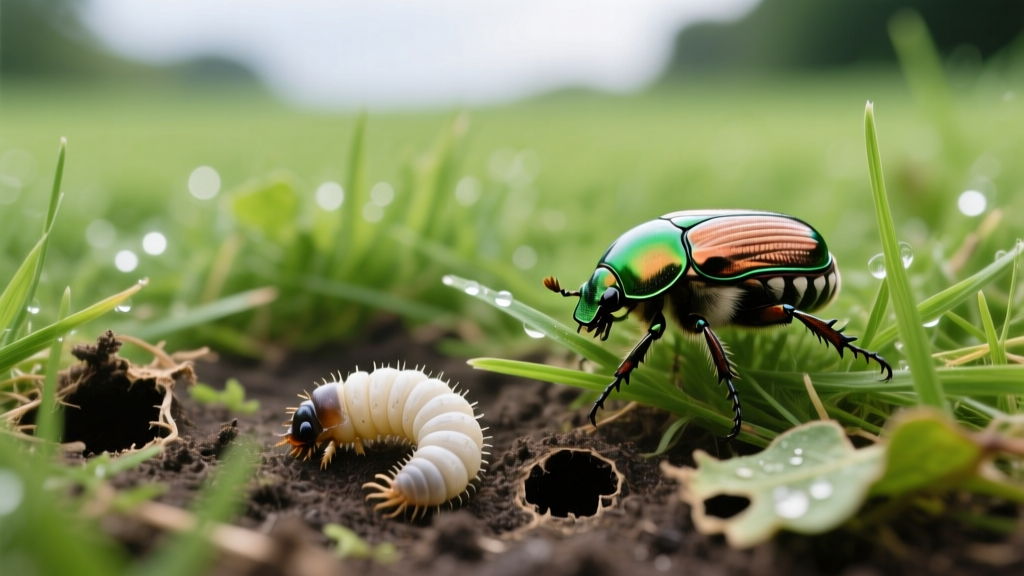
Killing Japanese Beetle Grubs and Adults: The Ultimate Yard Guide
The Lifecycle Timeline: When to Strike
Successfully killing Japanese beetle (Popillia japonica) populations requires precise timing. Because this pest spends ten months of the year underground as a grub and only two months above ground as an adult, your yard defense strategy must be bifurcated. Applying a curative grub killer in May or spraying foliar insecticides in October guarantees failure and wastes money. According to University of Kentucky Entomology, the beetle's lifecycle dictates strict application windows based on soil temperature and regional phenology.
- April - May: Overwintering grubs move upward to feed on roots before pupating. (Preventative chemical window).
- June - July: Adults emerge, mate, and skeletonize foliage. (Adult foliar defense window).
- August - September: Eggs hatch into young grubs near the soil surface. (Curative chemical and biological window).
- October - March: Grubs burrow 4-8 inches deep to overwinter. (Dormant period; treatment is ineffective).
Killing Japanese Beetle Grubs (Lawn Defense)
Grubs sever grass roots just below the soil line, causing turf to roll back like loose carpet. To stop this, you must choose between biological controls, chemical preventatives, and chemical curatives. Note: Imidacloprid (often sold as Merit), once the gold standard for grub control, now shows widespread resistance in Japanese beetle populations and should be avoided for this specific pest.
Biological Controls: Nematodes and Bt
For organic yard defense, Heterorhabditis bacteriophora (Hb nematodes) are highly effective. You must purchase them from reputable suppliers who ship with cold packs, as heat kills them during transit. Apply at a rate of 1 billion nematodes per acre (roughly 250,000 per 1,000 sq ft) when soil temperatures at a 2-inch depth reach at least 65°F. Cost is approximately $40 for a 10-million nematode pack covering 2,000 sq ft. Water the lawn with 0.25 inches of irrigation immediately after application to wash them into the soil profile.
A newer biological option is Bacillus thuringiensis galleriae (Bt galleriae), sold under trade names like grubGONE!. Unlike older Bt strains that only target caterpillars, Bt galleriae specifically paralyzes the digestive tract of scarab beetle grubs. Apply it in late summer when grubs are actively feeding near the surface.
Chemical Preventatives vs. Curatives
Preventatives contain long-residual active ingredients that kill grubs as they hatch. Chlorantraniliprole (trade name Acelepryn, or consumer brand Scotts GrubEx) is the safest option for pollinators and earthworms. Apply it between April 1 and May 15. It costs roughly $15 to treat 5,000 sq ft and requires watering in within 48 hours.
If you missed the preventative window and find active grub damage in late August, you need a curative. Trichlorfon (Dylox 6.2) acts on contact and kills grubs within 24 to 48 hours. However, it degrades rapidly in high-pH soils (above 7.2) and requires immediate incorporation with 0.5 inches of water to reach the thatch-soil interface.
| Active Ingredient | Trade Name Example | Type | Cost per 5k sq ft | Application Window | Rainfastness |
|---|---|---|---|---|---|
| Chlorantraniliprole | Acelepryn / GrubEx | Preventative | $15 - $22 | April - May | 24 hours |
| Trichlorfon | Dylox 6.2 | Curative | $30 - $38 | Late Aug - Sept | Immediate water-in |
| H. bacteriophora | NemaSeek Hb | Biological | $35 - $45 | Aug - Sept (Soil >65°F) | Immediate water-in |
| Bt galleriae | grubGONE! | Biological | $25 - $30 | August | 4 hours |
Killing Japanese Beetle Adults (Garden Defense)
Adults emerge in early summer, releasing aggregation pheromones that attract hundreds of other beetles to your prized roses, grapes, and linden trees. University of Minnesota Extension notes that adult beetles prefer plants in direct sunlight and will completely skeletonize leaves, leaving only the vein network intact.
The Pheromone Trap Trap
Warning: Trap Placement Errors
Commercial pheromone traps catch only about 70% of the beetles they attract. If you place a trap near your garden, you will draw in beetles from neighboring properties, and the 'spillover' will decimate your plants. If you must use traps to monitor population density, place them at least 30 to 50 feet away from your host plants, ideally downwind and near a non-host perimeter like a pine tree line.
Commercial pheromone traps catch only about 70% of the beetles they attract. If you place a trap near your garden, you will draw in beetles from neighboring properties, and the 'spillover' will decimate your plants. If you must use traps to monitor population density, place them at least 30 to 50 feet away from your host plants, ideally downwind and near a non-host perimeter like a pine tree line.
Foliar Sprays and Systemics
For immediate knockdown of adults, Spinosad (e.g., Captain Jack's Deadbug Brew) is highly effective. It is a bacterial derivative that disrupts the insect's nervous system. While toxic to bees when wet, it becomes safe for pollinators once the spray has completely dried (usually 2 to 3 hours). Apply in the late evening when bees are not actively foraging. Expect to pay around $18 for a 16 oz concentrate that yields up to 24 gallons of spray.
Neem oil (clarified hydrophobic extract) acts as an antifeedant. It won't kill adults instantly, but it coats the leaves in a bitter residue that discourages feeding. Reapplication is required every 3 to 4 days, or immediately after rainfall, as neem breaks down rapidly under UV light.
For long-term defense of non-flowering ornamental trees (like lindens or birches), a soil drench of Dinotefuran (Safari) applied in early spring translocates up the trunk. Because Dinotefuran is highly water-soluble, it moves through the xylem faster than older systemic neonicotinoids, providing protection right as adults emerge. Never apply systemic insecticides to plants that are about to bloom, as this will poison pollinators.
Long-Term Yard Defense Strategy
Killing Japanese beetles requires an integrated, multi-year approach. A single year of treatment will not eradicate them, as adults can fly up to 5 miles from surrounding untreated areas to reinfest your yard.
- Year 1 (Knockdown): Apply Chlorantraniliprole in May to stop the current year's hatch. Hand-pick adults into a jar of soapy water (1 tablespoon of dish soap per quart of water) during the early morning when they are sluggish. Use Spinosad sprays on high-value crops like raspberries.
- Year 2 (Biological Establishment): Introduce H. bacteriophora nematodes in late August to target the new grub generation. Maintain soil moisture to ensure nematode survival. Reduce broad-spectrum insecticide use to protect natural ground beetles that prey on grubs.
- Year 3 (Maintenance): Monitor adult populations using trap lures placed far from the garden. Apply targeted foliar sprays only if defoliation exceeds 20% of the plant's canopy. Spot-treat localized grub patches with Dylox rather than treating the entire lawn.
Frequently Asked Questions
Does milky spore disease work for Japanese beetle grubs?
Milky spore (Paenibacillus popilliae) is a naturally occurring bacterium, but its efficacy is highly debated in modern turf science. While it can suppress populations over 3 to 5 years, it requires very specific soil temperatures (67°F to 82°F) and moisture levels to establish. In many northern climates, soil temperatures do not remain in this optimal range long enough for the spores to build up to infectious levels. For reliable, fast-acting control, nematodes or chemical curatives are vastly superior.
Why are there so many beetles on my linden tree but none on my maple?
Japanese beetles are highly selective feeders. According to Penn State Extension, they strongly prefer plants in the Rosaceae family (roses, raspberries, cherries) and specific trees like lindens, birches, and elms. Maples, oaks, and pines are generally avoided. If you are planting new ornamentals in an area with heavy beetle pressure, choose resistant species like dogwood, magnolia, or red maple to naturally reduce your yard's vulnerability.
Can I use Sevin (Carbaryl) to kill Japanese beetle adults?
Carbaryl (Sevin) will kill adult Japanese beetles on contact, but it is a broad-spectrum insecticide that is highly toxic to bees, ladybugs, and parasitic wasps. Using Sevin often triggers secondary pest outbreaks, particularly spider mites, because it wipes out the natural predators that keep mite populations in check. Spinosad or Neem oil are much safer, more targeted alternatives for garden environments.

